The words writers, students, and teachers use most — explained in plain language, free, for anyone. Each entry tells you what the term means and why it matters at Global Sovereign University. Whether you are writing your first true sentence or climbing your eighth Helix volume, this is your map of the craft.
The Sentence
The basic unit of writing — a subject (who or what) joined to a predicate (what they do or are), making one complete thought.
The GSU Perspective: GSU's Writing Helix begins right here, in Volume 1, Say One True Thing. Master the sentence and you own the brick every paragraph, essay, and book is built from.
Sentence Fragment
A piece of a sentence punctuated as if it were whole — missing a subject, a verb, or a finished idea.
The GSU Perspective: The Writing Climb drills the difference until your ear catches a fragment on its own. A fragment can be a choice, but it should never be an accident.
Run-On Sentence
Two complete sentences jammed together with no punctuation or joining word between them.
The GSU Perspective: Fixed with a period, a comma-and-conjunction, or a semicolon. Clean breaks between thoughts are a courtesy to the reader.
The Writing Process
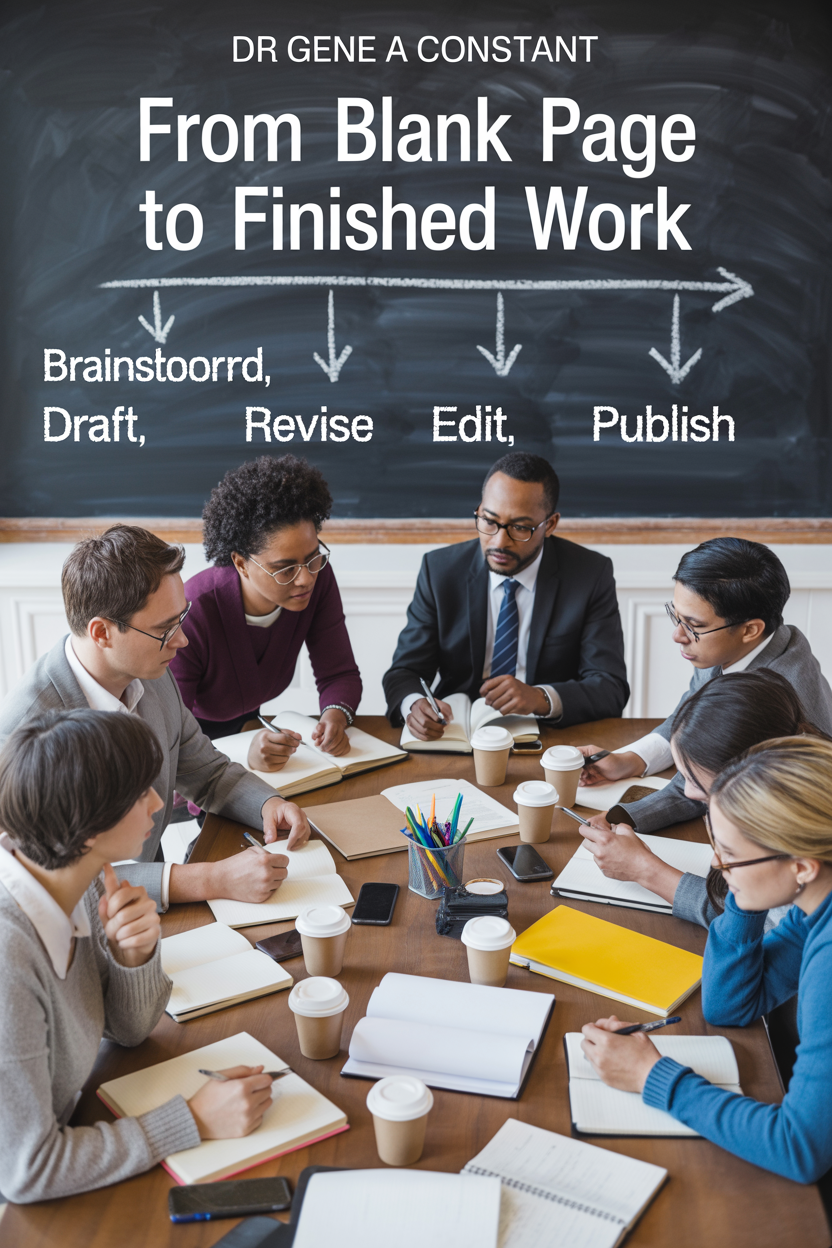
The stages writing actually moves through — brainstorm, outline, draft, revise, edit, and publish — not one perfect pass.
The GSU Perspective: Volume 2, From Blank Page to Finished Work, dismantles the lie that writers are born, not made. Process beats talent, and the first draft is allowed to be bad.
Revision vs. Editing
Revision changes the big things — ideas, order, clarity. Editing fixes the small things — grammar, spelling, punctuation, word choice.
The GSU Perspective: GSU teaches them as two separate jobs. Reshape the house before you polish the doorknobs.
Narrative
Writing that tells what happened, usually in the order it happened, with a beginning, a middle, and an end.
The GSU Perspective: Volume 3, Tell Me What Happened. Story is how humans remember — the oldest and most durable form of writing there is.
Show, Don't Tell
Letting the reader see an action or feeling through detail instead of being handed a label — 'she slammed the door' over 'she was angry.'
The GSU Perspective: A craft move the Writing Climb rewards every round. Showing trusts the reader; telling does their thinking for them.
Topic Sentence
The sentence — usually first — that states a paragraph's one main idea.
The GSU Perspective: Volume 4, The Sentence Up, builds the paragraph outward from the sentence. One idea per paragraph, announced up front, keeps writing clear.
Transition
A word or phrase — however, next, because, therefore — that links one idea to the next so the writing flows.
The GSU Perspective: Transitions are the handrails of an argument. They tell the reader which way the thinking turns.
Parallel Structure
Keeping items in a list or pair in the same grammatical form — 'reading, hiking, and swimming,' not 'reading, to hike, and swam.'
The GSU Perspective: Parallelism is rhythm the ear can feel. GSU treats it as a mark of a writer in control of the line.
Thesis (Claim)
The one-sentence statement of the point you intend to prove — the spine of any argument or essay.
The GSU Perspective: Volume 5, The Honest Argument. State your claim plainly; a reader can't follow an argument that hides its own point.
Evidence
The facts, examples, data, or testimony that support a claim — not 'everybody knows,' but something a reader can actually check.
The GSU Perspective: GSU draws a hard line between evidence and assertion. A named source with a number persuades; a vague 'some say' does not.
Counterargument
The strongest objection from the other side, raised and answered honestly inside your own writing.
The GSU Perspective: Honest argument faces the counterargument instead of hiding it. Answering the best opposing point is what makes a case trustworthy.
Analysis
Taking something apart to see how it works, weighing it on fair terms, and drawing the conclusion the evidence actually supports.
The GSU Perspective: Volume 6, Weigh It in the Balance. The thinking skill behind every serious essay, review, and report — including the willingness to change your mind when the evidence does.
Audience & Purpose
Who will read your writing, and why you are writing it — the two questions that decide every other choice.
The GSU Perspective: Volume 7, Writing That Opens Doors. Practical writing — the email, the application, the request — gets results by serving a real reader with a clear ask.
Voice
The way your writing sounds — your own honest personality on the page, not an imitation of someone else.
The GSU Perspective: Volume 8, Find Your Voice. It is found through practice and wide reading, not waiting. GENO can show you examples, but the voice is yours.
Tone
The attitude a piece of writing carries — serious, playful, urgent, warm — chosen to fit the reader and the moment.
The GSU Perspective: Tone is voice aimed at a purpose. GSU teaches writers to set it deliberately, not by accident.
Diction (Word Choice)
The specific words a writer chooses. Concrete, precise words ('a warm cinnamon roll') beat vague ones ('some food').
The GSU Perspective: Strong verbs and concrete nouns carry meaning like nothing else can. 'Use,' not 'utilize' — unless the bigger word truly earns its keep.
Concision
Saying what you mean in as few words as it takes — cutting any word that can go without changing the meaning.
The GSU Perspective: Lean writing is strong writing. The Writing Climb trims 'due to the fact that' down to 'because,' and keeps going.
The Writing Helix
GSU's signature framework for writing — eight free volumes that climb in deliberate order, from the single sentence to your own voice.
The GSU Perspective: Like the Reading and Math Helixes, it is a scope and sequence you can see: each volume a rung, each rung harder than the last, every one a free PDF to keep.
The Writing Climb
GSU's teach-then-play game for the Writing Helix — each round teaches one idea of the craft, then asks you to use it.
The GSU Perspective: No-fail, free, and built to climb from Bronze to Platinum. A miss simply shows the explanation and a tip from GENO, with no penalty.
GENO
GSU's AI tutor — a patient guide available 24 hours a day, in 32 languages, who has read every GSU book in full.
The GSU Perspective: Stuck on a sentence or an argument? GENO is one tap away on every page, ready to talk it through with you in plain language.