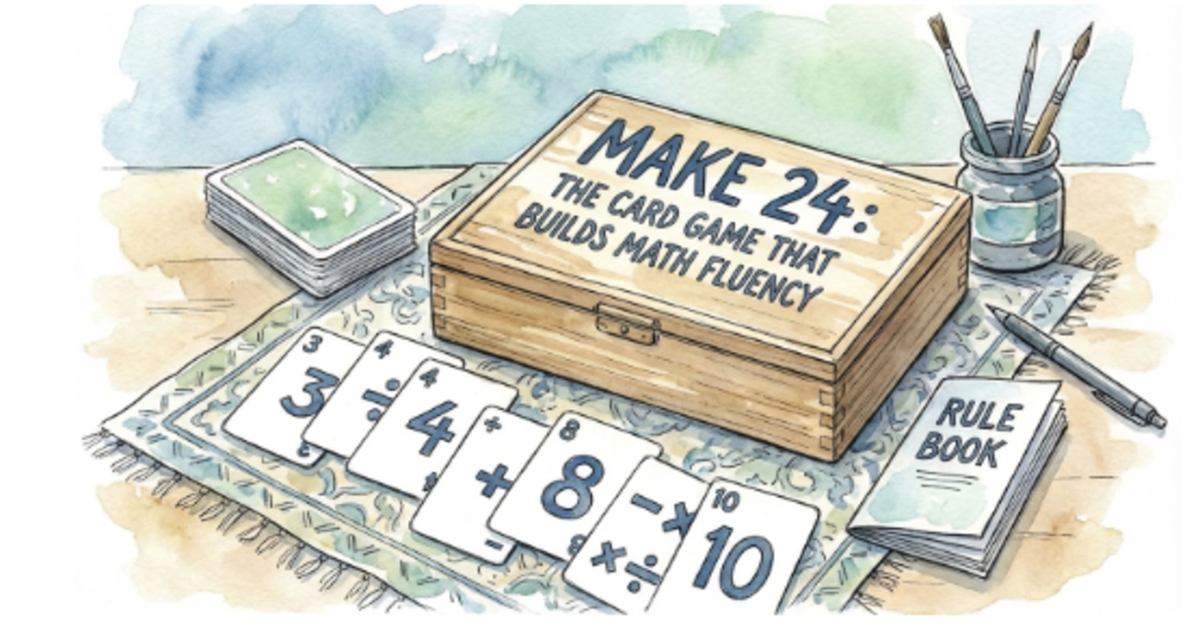
There is a specific kind of mathematical competency that standardized tests cannot measure and that most math curricula do not deliberately build. It is the ability to look at a set of numbers and see the relationships between them — to understand, intuitively and quickly, that four and six are not just four and six, they are also twenty-four, two, ten, negative two, and any number of other values depending on how you combine them. That intuition is called number sense. And Make 24 builds it more effectively than almost any other tool available.
The game is simple enough to explain in one sentence: use four cards and any combination of the four arithmetic operations to reach the number 24. Every card must be used exactly once. The operation is up to you. The target never changes.
That simplicity is the design. Every round of Make 24 requires the player to hold multiple mathematical relationships in working memory simultaneously, test pathways, recognize dead ends, backtrack, and try again. This is not an arithmetic drill — drill specifies the operation and asks for execution. Make 24 specifies the target and asks for exploration. The difference in cognitive demand is significant. And it is precisely that higher cognitive demand that produces the deeper encoding and better transfer that the research on mathematical learning consistently identifies as the difference between fragile classroom performance and durable real-world capability.
Why Fluency Matters — And Why Most Curricula Don't Build It
Nobel laureates Abhijit Banerjee and Esther Duflo documented one of the most important and most ignored findings in educational research: classroom math success consistently fails to transfer to real-world application. Students who passed their math courses couldn't use that math when it appeared in a different context. The skill was real inside the classroom. Outside of it, it evaporated.
The reason is well-understood in the cognitive science of learning: procedural practice — learning to execute a specified algorithm — builds a skill that is tightly coupled to the specific context in which it was learned. When the context changes, the skill doesn't fire automatically. Conceptual understanding — learning why the procedure works and how the underlying mathematical relationships behave — builds a skill that transfers, because the learner is working from understanding rather than from a memorized procedure.
Make 24 is, at its core, a conceptual understanding builder. Players don't practice a specified procedure. They explore a mathematical space, building familiarity with how numbers and operations relate to each other through repeated, varied, self-directed engagement. That engagement produces the number sense that makes arithmetic fluency durable and transferable — not just correct on this week's test.
What Make 24 Develops: Three Specific Competencies
Number sense — the intuitive understanding of how numbers relate to each other — is the foundational competency underlying all higher mathematics. Students with strong number sense find algebra more accessible, understand fractions more readily, and can estimate and verify their work in ways that students relying on memorized procedures cannot. Make 24 builds number sense through direct, repeated engagement with arithmetic relationships in a context that rewards fluency and makes the practice feel like play.
Mental arithmetic fluency — the ability to perform calculations quickly and accurately without external tools — is a practical life skill. The person who can estimate, check, and reason about numbers in real time makes better financial decisions, reads statistical claims in news more critically, and navigates everyday quantitative situations with confidence. Make 24 builds mental arithmetic fluency as a byproduct of play. Every session is practice. The practice never feels like practice.
Strategic thinking — the ability to plan multiple steps ahead, evaluate multiple pathways simultaneously, and adapt when the first approach fails — is a transferable cognitive skill that goes far beyond mathematics. Make 24 builds it in an arithmetic context. Research on cognitive transfer is consistent: skills built in one domain through high-engagement, exploratory practice transfer to structurally similar challenges in other domains. The strategic thinking Make 24 develops shows up in problem-solving, decision-making, and planning contexts far removed from arithmetic.
See It. Play It. Own It.
The Make 24 BookGame at globalsovereignuniversity.org is the free interactive version. No login required. No download. Playable on any device, appropriate for any age from early elementary through adult. Play it before you read anything else on this page. The game makes the argument for itself in a way that no description can.
The two-minute YouTube overview — available at https://youtu.be/X3TuZV9RiOA — walks through the game mechanics, shows a complete round, and explains the mathematical competencies the game develops. Watch it. Then play the game. Then decide if you want the book.
The companion book, Make 24 Game (Kindle ASIN B0GBSGLS2G, available on Amazon), provides the complete curriculum context: how to use Make 24 systematically for skill development at different levels, the specific mathematical concepts the game builds, extensions and variations for different age groups and skill levels, and the research foundation behind why this game structure produces the outcomes it does.
Make 24 is one game in GSU's Mathification curriculum — the complete K-through-adult mathematics hub built around the principle that math instruction should produce real-world capability rather than test performance. Every game in the hub is free. Every game has a companion book. The sequence is always see it, play it, own it — in that order, with no purchase required at any step until you are convinced.
Four Cards. One Goal. The Whole Curriculum Starts Here.
Number sense is the foundation. Arithmetic fluency is the first floor. Financial literacy is the second. The ability to reason clearly about quantitative information in every domain of adult life — from reading a mortgage statement to evaluating a statistical claim in a news article to understanding a pay stub — is built on the foundation of comfortable, intuitive familiarity with how numbers behave.
Make 24 builds that foundation. Four cards at a time. Free. At globalsovereignuniversity.org.
▶️ Watch the 2-minute overview: https://youtu.be/X3TuZV9RiOA
🎮 Play Make 24 for free (no login): https://www.globalsovereignuniversity.org/bookgames/make-24
📚 Make 24 on Amazon: https://www.amazon.com/dp/B0GBSGLS2G?tag=gsu2026-20
https://www.amazon.com/dp/B0GBSGLS2G?tag=gsu2026-20
https://www.buzzsprout.com/2530740/episodes/18844836-make-24-the-card-game-that-builds-math-fluency.mp3?download=true
Make 24 game, arithmetic fluency children, math card game, free math game, mental math game, GSU mathification, math fluency elementary, make 24 bookgame, gene constant, voice of sovereignty, global sovereign university, free homeschool math, math game kids, arithmetic operations game, number sense elementary







.jpeg)
.jpg)