Blog
Latest Insights and Updates

Read 'How to Become a Plumber' Free — Then Take the Pressure Test
Read the complete book How to Become a Plumber free at GSU, listen along, then diagnose ten service calls in The Pressure Test — a free practice game.
The GSU Bookstore Is Open: Browse Every Title on One Shelf
The new GSU Bookstore puts 288 book pages on one searchable shelf. Type a word, find the title, read the story behind it — free to browse, forever.

The Business of HVAC: Union Card or Your Own Truck
Every HVAC apprentice eventually faces the fork: the union hall or your own truck. Here is the honest math of both roads — what a service call really costs, why the flat rate exists, and how a one-truck shop becomes a company without becoming a casualty.
The Free Reading Certificate: What It Takes and Why It Is Real
The usual free certificate is a participation receipt. GSU's is a thirty-question examination with an unbending bar and a serial number — free because that is our doctrine, rigorous because that is our respect.
Reading With GENO: A Tutor Who Never Sleeps
GENO — GSU's AI tutor, available 24/7 in 83 languages — is not a reading machine but a resort for comprehension: the free conversation about the book that wealthy households always had.
The Trifurcation Road: GOOD, BETTER, BEST
Inflated praise steals the learner's map. The Trifurcation Road — GOOD, BETTER, BEST — places travelers by real performance, teaches through honest failure, and prints serial-numbered proof.
Orthographic Mapping: How Words Become Sight Words
Sight words are not memorized shapes — they are built by orthographic mapping, which runs through phonics, not around it. The mechanism, and what it changes at the kitchen table.
It Is Never Too Late: Adult Literacy Without Shame
Millions of capable adults carry the secret that reading never clicked. The science says the road is open at any age — and the free Adult Literacy Lab removes the one real barrier: shame.
Sound It Out: The Lab Instrument That Speaks
"Sound it out" always had a flaw for solo learners: against what? The Lab's free speaking instrument models the sounds, listens to attempts, and never runs out of patience.
The Reading Mirror: Hear Your Own Fluency
Nobody can hear their own fluency — so GSU built a mirror for the reading voice. Read aloud, hear the reflection, read again better: the evidence-backed loop, free on the hub.
The Confidence Climb: A Phonics Game With No Ceiling
An infinite mountain climbed one decoded word at a time: GSU's free phonics game listens to the learner's voice, breathes with their level, and has no ceiling — only higher.
Comprehension: Reading to Question, Not Just to Finish
Comprehension is not recalling a text — it is interrogating one. The four questions strong readers ask, plus Reading to Question (Kindle $3.99), the courtroom method in full.
Vocabulary: The Words You Know Decide What You Understand
Comprehension needs roughly 95–98% of the words on a page — vocabulary decides which books belong to you. How word wealth compounds, plus The Words You Know (Kindle $3.99).
Fluency: Reading at the Speed of Thought
Fluency is the bridge between decoding and understanding — accuracy, rate, and prosody built by repeated oral reading. Reading at the Speed of Thought (Kindle $3.99) has the full method.
Decoding: The Reader's Toolkit in Action
Skilled readers don't guess at new words — they take them apart with five teachable tools. The decoder's toolkit, plus The Reader's Toolkit: Decoding (Kindle $3.99) for the full craft.
Phonics: The Code That Unlocks Every Word
English print is a learnable code, and the evidence has settled: teach it explicitly. What real phonics instruction looks like, plus The Reading Revolution (Kindle $3.99) for the full science.
Phonemic Awareness: Reading Begins Before the Letters Arrive
The first pillar involves no letters: hearing the separate sounds inside spoken words. What the ear must learn, how to train it out loud — and an honest note on our catalogue.
The Five Pillars of Reading, Explained
Reading is five skills wearing one name: phonemic awareness, phonics, fluency, vocabulary, comprehension. What each pillar does, why the order matters, and where to build them free at GSU.
Inside the Forthcoming Field Manual: The Art and Mechanics of Barter
The Art and Mechanics of Barter — GSU's complete field manual on honorable exchange — is being forged in the press now. What it covers, and our honest promise about when and how it arrives.
The Trade Equalizer: Making Fair Trades Visible
GSU's free Trade Equalizer puts both sides of a proposed trade on one beam and shows the tilt — moving fairness from private guesswork to shared sight. No login, nothing stored.
Record-Keeping for Barterers: Ledgers, Trust, and Memory
A ledger is not distrust — it is precision as courtesy. The one-line entry, the three services a written record performs, and the daylight rule for open credit.
Negotiation the GSU Way: Radical Respect at the Trading Table
Combat negotiation wins once; radical respect wins for twenty years. The three moves of the GSU school — real numbers, constraints before price, dignity always — and when to walk away.
From Favor to System: Why One-to-One Is Not Enough
Favors are beautiful and fragile; systems circulate. Why one-to-one trading hits a ceiling, what a circle, a ledger, and a rhythm add — and how to build the smallest possible system.
Barter in Hard Times: Resilience When Currency Falters
The neighborhoods that weather hard times best are the ones already trading in good ones. Why exchange outlasts currency, and four ways to build the muscle before the storm.
The Neighborhood Exchange: Organizing a Swap Day That Works
The field-tested pattern for a neighborhood swap day: three anchor households, the welcome card, the skills board, the free corner — and the real harvest, which is the connections.
Barter for Families: Teaching Value Without a Cash Register
Family barter is real economics at the scale where character forms. Three trades that teach — chore swaps, skill trades, the harvest table — and the two rules parents must hold.
Timebanks: When Everyone's Hour Weighs the Same
One hour given equals one hour earned — for everyone. Why the timebank's radical equality works, what a healthy one looks like, and how to start with five households and a notebook.
Barter Etiquette: Ten Unwritten Rules of Honorable Exchange
No cash register, no receipts, no manager — which is why barter runs on etiquette. Ten unwritten rules, enforced everywhere by reputation, taught free in the GSU Barter Workshop.
The Skill Inventory: Trade What You Didn't Know You Had
"I have nothing to trade" has never once been true. The six-column skill inventory — hands, head, tools, ground, hours, presence — reveals the wealth currency-thinking hides.
Pricing Without Prices: Valuing a Trade Fairly
Three honest measuring sticks — replacement cost, time and toil, and the sleep test — turn the hardest question in barter into a learnable craft. Practice free with GSU's Trade Equalizer.
Your First Trade: A Beginner's Walkthrough
Five steps from inventory to handshake: the beginner's walkthrough for a first honest trade, taught the GSU way — precise proposals, agreed doneness, and a close with ceremony.
The Double Coincidence of Wants
The one famous objection to barter — the double coincidence of wants — is real, and every good barterer learns to beat it with circles, triangles, and time. Free training in the GSU Barter Workshop.
Why Barter Never Died
Barter did not die when money arrived — it went everywhere money could not reach. Five thousand years of evidence, three reasons it survives, and where to learn the craft free at GSU.

Immersion Without the Headset: The GSU Manifesto
The education industry says immersive learning requires a $500 VR headset. GSU's manifesto says otherwise: immersion is a design achievement, not a hardware purchase — and the proof already runs free on the phone in your pocket.
The Library That Remembers You
The GSU Library is the engine room of a free university: 300+ donated titles whose $3.99 Kindle editions fund everything — while the subject hubs offer books readable in full, free audiobook narration, learning games, and GENO in 83 languages. Honest to the penny.
Why GSU Runs on Play
The Gamification Flywheel is the engine under every GSU program: play builds skill, skill earns honest badges, earned badges build confidence, and confidence fuels the next climb. Bronze to Platinum, with no participation trophies anywhere in the machine.

One Climb a Day: The Free Daily Quiz
Today's Summit is GSU's daily discipline: one short quiz a day, free forever, with anonymous streaks and a monthly champions board. Five minutes of honest climbing that compounds into real knowledge.

Ride the Orbits: The Solar System You Can Steer
Rabbit #9 puts the solar system in your hands: an interactive orbital explorer where you ride the planets in real motion — then face a genuine 25-question challenge of calculation and inference that no lookup can fake. Free, no login.

The Words You Never Say Out Loud
Magic Rabbit #8 is a free academy of the unspoken: 24 gestures performed by a living figure, cultural readings from around the world, three game modes, and a printable Field Card — because most of every conversation never touches your ears.

Education That Plants Itself
Magic Rabbit #7 turns every Gold-Certified graduate into a founder: each one carries the entire GSU campus on a flash drive, ready to plant a new, self-governing learning community wherever they land. Free education that propagates itself.
An Economy Where Competence Is the Currency
Magic Rabbit #6 is the Maker's Mesh: a graduate economy where Gold-Certified tradespeople exchange skill for skill — no money changing hands, no middlemen — built on the Frankenstein Methodology and recorded on the Trustline Ledger.
The Vault You Can Only Open by Earning It
Magic Rabbit #5 is a dormant, encrypted business vault — the complete toolkit for launching an independent trade business — that unlocks only when a Learner earns Gold Certification at 90%. Free to earn, impossible to buy.

Zero Prep. One Screen. Thirty Minutes.
Magic Rabbit #4 turns any parent, mentor, grandparent, or librarian into a GSU instructor with seventeen free one-page lesson kits. Open the page, follow it for thirty minutes, and class is in session — no training, no preparation, no cost.

The University That Broadcasts Itself
Magic Rabbit #3 is a small device that broadcasts GSU's entire free library — 300+ books, the full curriculum, and learning games — to every phone in the room, with no internet, no data plan, and no app. Sponsor a box for a place the signal never reaches.

The Phone Call That Answers Every Question
Magic Rabbit #2 puts a patient teacher's voice within reach of anyone, anytime — tap the call button and talk to GENO in any of 83 languages. Free, private, and open 24 hours a day.

A Whole University That Fits in Your Pocket
Magic Rabbit #1 is a complete university — games, research library, and reading program — that copies onto any USB drive in seconds and runs offline in any browser. Under 5 MB, free forever, and built for the places the internet never reaches.

Education Policy
How to Talk to GENO: Your Free AI Tutor, Explained in Plain English
GENO is GSU's free 24/7 AI tutor, available in 83 languages with no login and no cost. This plain-English guide shows students, parents, seniors, and adult learners exactly how to talk to him — and get answers that actually teach.

Business
The Sea of Gold: Why the Heart of America Still Beats
The traveler who crests a rise at harvest time and sees a wheat field stretched to the horizon understands something in the gut before the mind puts words to it. The gold is not just beautiful. It is the result of everything this book has traced.
Business
Badlands and Bison: The Original Story the Heartland Keeps Telling
Before the plow, before the railroad, before the factory — the heart of the continent was alive with something the later centuries would spend enormous effort diminishing, and then slowly trying to restore.
Business
Main Street Politics: Where American Democracy Actually Lives
American political life is often described as if it exists in Washington or television studios. But the decisions that shape daily life in the Midwest are made at school board meetings, county fairs, and diners where people sit across from their actual neighbors.
Business
Empty Factories, New Beginnings: The Heartland Reinvents Itself
An empty factory is not a eulogy. In the Midwest, it is more often a building in transition — waiting for the next use, the next idea, the next generation willing to bet on a place that has been written off before and survived it.

Business
The Flyover State Myth: Why the Heartland Is Not the Middle of Nowhere
From 35,000 feet, the Midwest looks like a quilt. It is easy to look down and see only geography. It is much harder to see the century and a half of human effort that made those squares — or to grasp that those squares feed the country you are flying over.
Business
Roots in the Asphalt: The Heartland's Present-Day Renewal
The prairie taught a fundamental lesson: what matters is not what grows on the surface, but what holds underground. The same lesson applies to the modern Midwest. The visible economy may have changed. The roots have not.
Business
The Slow Rust: What Deindustrialization Left Behind
Rust does not happen all at once. It is a slow, patient process. The rust belt earned its name not from a single catastrophe but from decades of quiet erosion — the steady reddening of what had once been the nation's industrial engine.

Business
The Assembly Line: What Detroit Built and What It Cost
The assembly line did not merely increase output. It reorganized time and the body. Work was no longer about making something — it was about keeping up with something. A moving line set the pace, and the worker had to match the machine.

Business
Black Blizzards: When the Prairie Collected Its Debt
The people who first crossed the plains learned humility from storms and distance. The people who stayed had to learn a different humility: that the same tools that made abundance possible could also make catastrophe easier.
Business
The Promised Dirt: The Land They Crossed a Continent For
In 1905, thousands of families still believed the land itself was the promise. Not gold, not wages — dirt. Dark, deep, newly broken Midwestern soil that could turn a family's labor into enough.

Business
A Forged Identity: How the Heartland Made Its People
Once the sod could be broken and the first rows planted, the prairie stopped being a test of endurance and began to pose a different question: how do you build a life that lasts in a place so open it seems to swallow individuals whole?
Business
Arteries of Commerce: The Railroad That Rewrote the Map
Long before most Midwestern farmers heard a locomotive whistle close enough to rattle a windowpane, the railroad existed in their lives as rumor, promise, and threat — the first technology to try to overrule the prairie's vote.
Business
Smoke on the Horizon: When the Midwest Became the Engine
The industrial transformation of the Midwest did not arrive as a clean break. It came the way a storm line comes on the plains — a darkening at the far edge, then a sudden closeness, then a new sound in the air.
Business
Iron and Grain: How the Steel Plow Changed Everything
Early attempts to plow prairie sod felt like trying to tear cloth that refused to rip. What broke the stalemate was not romance — it was friction, and a polished surface that shed earth instead of hoarding it.

Business
The Ocean of Grass: What the Prairie Refused to Provide
The Great Plains corrected every assumption imported from the wooded East. Before the plow and the railroad, the prairie delivered its first hard lesson in humility — and underground, held more strength than the surface ever suggested.
Education Policy
The Reading Arsenal: What No Free Platform Has Ever Built Before
Khan Academy, Duolingo, ABCmouse — every free learning platform teaches around the science of reading. GSU's Reading Arsenal teaches from it. Nine interactive phonics labs with real mouth anatomy, the five-step OG drill, and GENO as a 24/7 tutor.
Education Policy
You Weren't Bad at Reading. You Were Taught Wrong.
130 million American adults read below a 6th-grade level. Research proves the cause is not the learner — it is the method. And the method can be corrected at any age. GSU's Adult Literacy Lab exists for exactly this moment.
Education Policy
What Is Structured Literacy — and Why Is It the Architecture of the Reading Arsenal?
Structured Literacy is not a brand or a program. It is the set of evidence-based design principles the International Dyslexia Association established for reading instruction. GSU's Reading Arsenal is built on every one of them.
Education Policy
The Six Syllable Types: The Algorithm That Makes Every Long Word Readable
Most adult readers hit a wall with multisyllabic words. The wall is not a reading disability. It is a missing piece of phonics instruction that most schools never delivered. The six syllable types are the algorithm that removes it permanently.
Education Policy
The Reading Wars Are Over. Here's Who Won — and What It Means for Your Child
For decades, educators fought over whole language versus phonics. The research settled the debate in 2000. 32 states have now passed Science of Reading legislation. Here is what it means — and what to do if your child was already taught the losing method.
Education Policy
GENO Is the 1:1 Tutor the Research Says Every Reader Needs — At Zero Cost
The research is clear: 1:1 tutoring produces outcomes no classroom can match. The barrier has always been cost. GENO, GSU's free AI tutor, removes that barrier entirely — 24/7, 32 languages, no login, for any learner on Earth.
Education Policy
Orton-Gillingham: The Gold Standard That $2,500-a-Year Programs Sell — Now Free at GSU
Orton-Gillingham is the foundational approach for clinical reading intervention — used in programs that cost $1,200 to $2,500 per student per year. GSU's Reading Arsenal delivers the same framework free, in 9 interactive labs, with GENO available 24/7.
Education Policy
What Is the Science of Reading? The 5-Minute Answer
The Science of Reading is not a curriculum or a philosophy. It is the accumulated findings of cognitive psychology, neuroscience, and linguistics about how the human brain learns to decode print. Here is what those findings say.
Education Policy
Why 54 Million American Adults Can't Read — And Who's Really to Blame
54 million American adults cannot read fluently. The cause is not poverty, disability, or lack of effort. It is a pedagogical choice made by schools — and a century of whole-language instruction that ignored how the brain actually learns to decode print.
Education Policy
The 2-Sigma Secret: Why One-on-One Tutoring Is Worth 2 Standard Deviations
In 1984, Benjamin Bloom proved that 1:1 tutoring produces a two-standard-deviation advantage over classroom instruction. That finding has never been overturned. Here is what it means — and why GENO makes it free.
Education Policy
The Reading Arsenal: What No Other Free Platform Has Built
Khan Academy, Duolingo, and $150-per-level Barton programs exist. None of them deliver clinical-grade phonics instruction through interactive mouth-anatomy tools, at zero cost, in 32 languages, with a live AI tutor on every page. GSU does.
Education Policy
Morphology: How Learning 20 Latin Roots Unlocks 2,000 English Words
The English vocabulary is roughly 60% Latin and Greek in origin. Learning a single root — like 'port' (carry) or 'dict' (say) — unlocks an entire family of words at once. This is morphology, and it's the fastest path to vocabulary growth.
Education Policy
The Schwa: The Most Common Vowel Sound in English That Nobody Taught You
The schwa is the unstressed 'uh' sound in 'about', 'lemon', 'pencil', and 'circus'. It's the most common vowel sound in English — and almost no one learns what it is or why it makes spelling so confusing.
Education Policy
Why Mississippi's Reading Scores Rose — And What Every State Should Learn From It
Mississippi was ranked last in the nation for reading. Then they implemented the science of reading — mandatory phonics, teacher training, early screening. Within a decade, their fourth-grade scores became a national model.
Education Policy
Phonemic Awareness vs. Phonics: Why the Difference Matters for Every Reader
Phonemic awareness is hearing sounds in words. Phonics is connecting those sounds to letters. They're related but distinct — and confusing the two is one of the most common errors in reading instruction.
Education Policy
GENO: The 24/7 AI Tutor That Speaks 32 Languages and Costs Nothing
GENO is GSU's AI tutor — available 24 hours a day, in 32 fully optimized languages, at no cost to any learner on Earth. Here's what that means for the families who need it most.
Education Policy
What Is the Orton-Gillingham Method — And Why Does It Cost $2,000 a Year?
Orton-Gillingham is the gold standard of reading intervention — explicit, multisensory, diagnostic, and 1:1. It's also expensive enough that most families can't access it. GSU built the Reading Arsenal to change that.
Education Policy
The Six Syllable Types: The Algorithm That Unlocks Every Word in English
English has over 170,000 words in common use. Every single one is built from syllables — and every syllable belongs to one of exactly six types. Master the six types and no multisyllabic word can stop you.
Education Policy
You Weren't Bad at Reading. You Were Taught Wrong. Here's the Science.
For 50 years, American schools taught reading by asking children to guess words from pictures. The science of reading settled the debate. Here's what the research actually says — and what it means for the 54 million American adults who still can't read fluently.
Education Policy
The 2-Sigma Secret: Why One-on-One Tutoring Changes Everything — And How GSU Gives It to You Free
In 1984, researcher Benjamin Bloom proved that students with a personal tutor scored two standard deviations higher than classroom peers. That gap — the 2-sigma problem — has never been closed. Until now.
Education Policy
When the Money Misses the Reader
A new Oregon law put $100M toward early literacy — but funding rules let it miss the neediest schools. When the money misses the reader, a free 24/7 tutor doesn't have to.
Ideas
The Power of 'I Might Be Wrong'
Four small words — 'I might be wrong' — sound like weakness but are the foundation of all learning. Why a margin of doubt is the doorway better convictions enter through.
Productivity
Rituals Reduce Cognitive Load
A good ritual is not superstition — it is an efficiency tool. By turning recurring decisions into automatic defaults, rituals free the finite mental energy you need for what matters.
Productivity
Psychological Safety Is Not Comfort
Psychological safety is mistaken for a soft, conflict-free workplace. It is nearly the opposite — the safety to be uncomfortable, to disagree and admit mistakes without being destroyed.
Ideas
Survivability Is the Only Real Proof
An idea that sounds good and an idea that works are told apart by only one test: time. Why survivability — not persuasiveness — is the only proof that ultimately counts.

Ideas
The Equation Behind GSU: Proving 2+2=5
In arithmetic, 2+2=5 is false. As a description of well-joined human effort, it is the truest equation there is — and the one GSU exists to prove. Where the extra unit comes from.
Ideas
Trust Is a Load-Bearing Beam
Trust is treated as a soft feeling. In any system where people build together it is the load-bearing beam — and when it cracks, everything resting on it comes down.
Business
Generative vs. Extractive Wealth
Two fortunes can look identical and be opposites: one created value, the other merely captured it. Why the generative-versus-extractive distinction shapes economies and lives.
Ideas
The Zero-Sum Illusion
The belief that one person's gain requires another's loss is the costliest idea a person can hold. Why knowledge, trust, and skill break the zero-sum rule — and set us free.

Business
The Ledger Wall: Making Capacity Visible
Capacity, skill coverage, and process drift hide in spreadsheets until they erupt. The ledger wall drags them into the light — where visible problems finally get owned and solved.

Ideas
The Forensic Approach to TPM
A failed part is a witness, not trash. The forensic approach treats every breakdown as a crime scene — asking why until the root cause, and the recurring failure, is gone for good.
Business
Measuring Training Impact Without Lying to Yourself
Smile sheets and hours logged make training look successful while measuring the wrong thing. How to measure real impact downstream in the work — even when it stings.

Productivity
Digital Skill Matrices: Evidence Harder to Fake
A paper skill chart calcifies into unquestioned opinion. A digital matrix ties every qualification to checkable evidence — turning a comforting decoration into a tool you can trust.

Ideas
Sensors Extend People, They Don't Replace Them
Industry 4.0 sensors can warn of a failing bearing weeks early — but they report numbers, not judgment. Why rich data raises the skill required rather than removing it.

Productivity
When Standards Don't Update, Training Becomes a Museum
A standard that never changes stops guiding and starts misleading — a museum piece teaching new hires a method the floor abandoned years ago. How to keep it alive.
Business
MTTR: You Can't Train Your Way Past Bad Access
Sometimes the fastest technician is beaten by a panel that shouldn't be there. Why MTTR reveals the limit of training — and points the fix upstream to design.
Productivity
Attendance Is Not Competence
A signed sign-in sheet proves a body was in the room, not that a skill was learned. Why competence must be demonstrated, never assumed — on the floor and in life.
Productivity
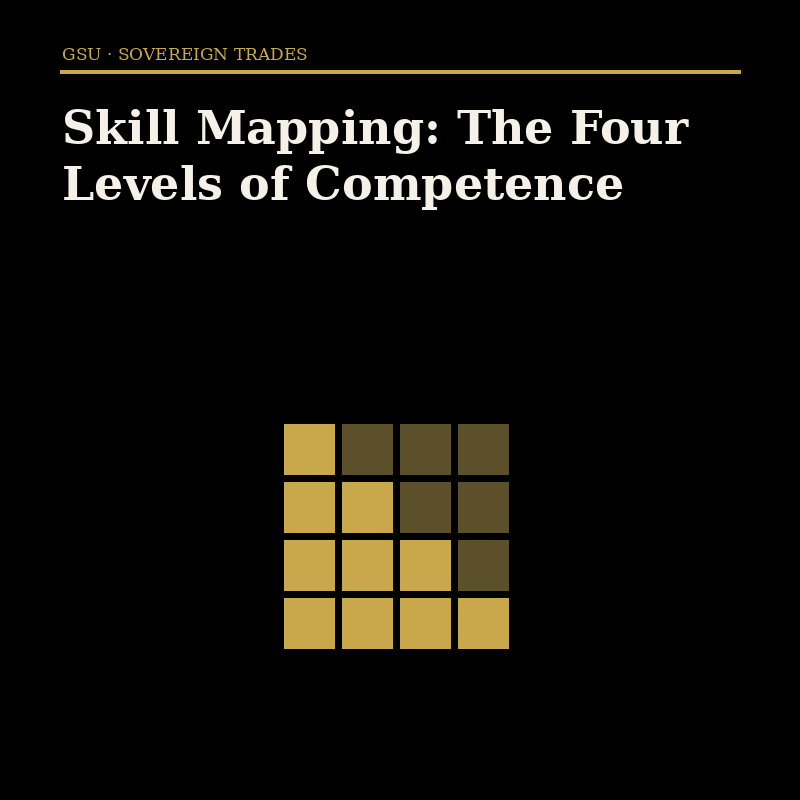
Skill Mapping: The Four Levels Between 'Heard of It' and 'Can Teach It'
'Is she trained?' hides too much. Skill mapping's four levels — from aware to able to teach — reveal exactly where a team is strong, fragile, or ready to grow.