Voice of Sovereignty | Global Sovereign University
For most families, a high school diploma is the key that unlocks the future. For Makena Simonsen, it was the key that locked her out.
In 2022, Makena walked across the graduation stage at Lynnwood High School in Washington state with a 3.87 GPA. By all visible measures, she had succeeded. There was a ceremony, a cap and gown, photographs, and the feeling she described in her own words: "Oh my gosh, I finally made it."
What no one told Makena — or her family — was that she had finished her senior year reading at a first-grade level. And that the diploma in her hand was about to cost her family $160,000.
The Setup: What an IEP Is Supposed to Do
Makena is not a student who gave up or fell through the cracks of indifference. She has a neurodevelopmental disorder, ADHD, dyslexia, dyscalculia, and dysgraphia — a full constellation of learning differences that made every school day genuinely difficult. She had an Individualized Education Program, the legally binding document that is supposed to ensure students with disabilities receive the services and support they need to reach meaningful educational outcomes.
The key word is meaningful.
An IEP sets annual goals. It maps where a student is and builds a plan to move them forward. It is not supposed to be a permission slip to stay in place. It is not supposed to become the floor instead of the launchpad.
Makena worked within her IEP throughout her school years. She attended both general and special education classes. She did what was asked of her. The system, in return, gave her grades that told a story of near-mastery — and then handed her a standard diploma.
The Trap Hidden in the Fine Print
After graduation, Makena had a plan. Washington state offers transition services specifically designed to help special needs graduates move toward independent living and real employment. She was ready to enroll. Her family was ready to support her.
Then someone checked her paperwork.
She had a standard diploma. Under Washington state rules, a standard high school diploma disqualifies a graduate from accessing free special education transition services. Without the diploma, she could have enrolled in a vocational program through the Edmonds School District itself — at no cost — that would have built exactly the bridge she needed between school and adult life. A nearly identical program. Free. Available. Gone.
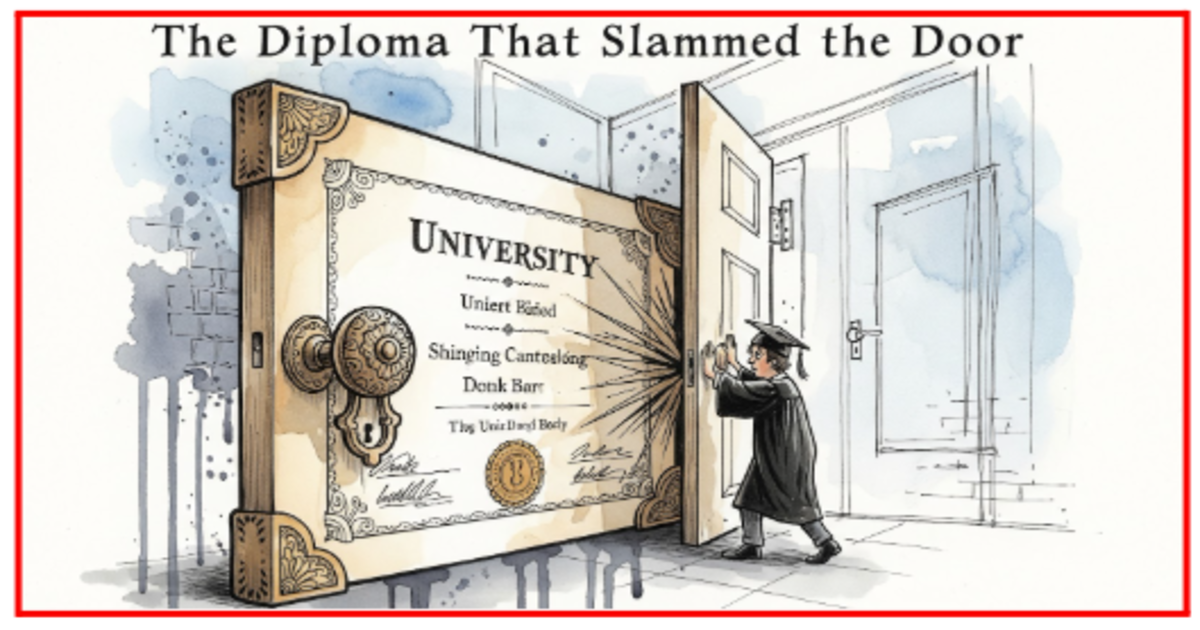
Because she had the diploma, the door was closed.
Her family now pays $43,000 per year in total expenses for Makena to attend Bellevue College's Occupational and Life Skills program. By the time she finishes, she will carry approximately $160,000 in student debt — the bill for a diploma she says she did not earn.
Makena filed a lawsuit against the Edmonds School District in Snohomish County Superior Court. The district has denied any wrongdoing and declined to comment further on the pending litigation.
"Benevolent Discrimination": The Phrase That Changes Everything
Makena's legal team — attorneys Lara Hruska of Cedar Law in Seattle and Alex Hagel — are making two arguments that reach far beyond this single case.
The first is built on Washington state law, which guarantees every student the right to a "meaningful diploma." Her attorneys argue that Makena did not receive one. As Attorney Hagel put it: by giving Makena a diploma she did not earn, the district caused her to miss out on another four years of free education that could have prepared her for independence.
The second argument is the one that should reshape how every educator, administrator, and parent thinks about accommodation: benevolent discrimination.
Benevolent discrimination is harm caused not by malice, but by kindness that replaces expectation. Nobody in the Edmonds School District gathered in a conference room and decided to hurt Makena Simonsen. No one was plotting against her. What happened was softer than that, and in many ways more dangerous.
She was passed along. Her grades reflected completion, not mastery. Her diploma was issued without her meeting the state's own learning standards. And her attorney, Lara Hruska, named it with a clarity that deserves to be quoted directly: the diploma, she said, was "more of a participation trophy."
A participation trophy. For four years of school. With a 3.87 GPA attached to it.
The well-intentioned lowering of the bar did not protect Makena. It disqualified her.
The Credentialing Trap
This is where the story stops being about one student and starts being about a system.
A grade is supposed to be a signal. It is supposed to tell the world — and the student — something true about what has been learned. When we inflate a grade without building the competence behind it, we do not help the student. We hand them a key that does not open the door they believe it opens.
In Makena's case, that key literally closed the door she needed to walk through.
And here is the structural cruelty embedded in that outcome: the system was designed to look like success every step of the way. A 3.87 GPA looks like success. A graduation ceremony looks like success. A diploma looks like success. No mechanism required anyone to stand up at any point and say, "Wait. She is reading at a first-grade level. This credential does not mean what a diploma is supposed to mean."
The fog held — right up until the moment it cost her family $160,000 to clear it.
This is the credentialing trap in its most damaging form. The credential exists to communicate competence. When the system separates the credential from the competence and calls the result an accommodation, it does not serve the student. It manages them. It passes them along to the next building, the next system, the next bill — while the gap between what the paper says and what the person can do continues to widen.
What Parents Are Not Being Told
After Makena's story broke publicly, her mother shared it in local Facebook groups. Hundreds of parents responded with similar experiences. One comment captured the systemic problem precisely: "IEP support is the best shot our kids with disabilities have in the public school system. It has so much potential, but there's so little education for the average parent to know what they're up against and what our rights are."
This is the information gap that makes benevolent discrimination so durable. It does not survive informed parents. It thrives in rooms where families do not know the difference between a standard diploma and a certificate of completion. It thrives when no one explains that the type of credential a student exits with is not just symbolic — it is a legal trigger with real consequences for what services they can access afterward.
Here is what families of special needs students need to know that too few are being told:
In many states, including Washington, a standard diploma and a certificate of completion are not legally equivalent for purposes of accessing post-secondary transition services. A student who exits with a certificate rather than a standard diploma may retain eligibility for free vocational and life skills programs that a diploma holder cannot access. This is not obscure fine print buried in an administrative manual. It is the fork in the road. And it is being reached without a map by thousands of families every graduation season.
Attorney Hagel called this a test case. He said he had never seen a case like it in Washington state. The implication is significant: if this is the first case of its kind to reach a courtroom, it is almost certainly not the first time it has happened.
The Verdict That Will Define What a Diploma Means
The outcome of Simonsen v. Edmonds School District is not just about Makena. It is about what the word "diploma" is legally permitted to mean in this country.
If the court finds in Makena's favor, it establishes precedent. It creates a framework that says a credential without competence is not a protected act of accommodation — it is a harm. It opens a door for the hundreds of families who came forward to say: this happened to us, too.
If the case does not succeed, the system learns something else entirely: that grade inflation dressed as support, and a diploma issued without a student meeting state standards, carries no legal consequence. That the credential can be separated from the competence indefinitely, and the cost will be borne by the family.
That is the verdict this case is asking for. And every parent, educator, and advocate who cares about what the words on a diploma are supposed to guarantee should be watching it closely.
Makena Is Thriving — In Spite of the System, Not Because of It
It would be easy to end this story on the injustice, and the injustice is real. But Makena Simonsen is not a symbol of defeat. She is something more instructive than that.
She is now in her third year at Bellevue College, where she says she is earning her grades — real grades, grades that mean something. She works summers at Kamp Kookamunga in Lynnwood, where she works with children. She described that work with a warmth that should stop anyone who has written her off: "I love seeing them happy and playing and knowing in their little minds that they don't know much about life, and knowing how much I have learned about my life — just connecting with them on that level. It brings out joy."
A young woman who was passed along by a system that confused accommodation with expectation, who was handed a credential without the competence to go with it, and who received a $160,000 bill for the privilege — is now pouring what she learned the hard way into the next generation.
Her mother said it plainly: "I'm just so incredibly angry. And all we're asking for in this lawsuit is to pay for Makena's tuition and my lawyer's fees. There's nothing more."
Nothing more. Just accountability. Just the cost of the gap the system created and refused to name.
Three Things That Must Change
First — diploma literacy must become part of every IEP conversation. Families must be clearly informed, in plain language, about the legal and practical difference between diploma types before the decision is made, not after. This is not a bureaucratic nicety. It is informed consent.
Second — accommodation must never replace expectation. Modified support, differentiated instruction, and IEP goals are tools for moving a student forward. When they become the permanent ceiling rather than the current floor, they stop being support. They become the quiet confirmation that no one believed the student could get there. That belief is not compassion. It is a low bar dressed as kindness.
Third — every parent in an IEP meeting needs to know what they do not know. The comment that spread among hundreds of families said it directly: the average parent does not know what they are up against, or what their rights are. That gap is not an accident. It is the condition under which benevolent discrimination survives.
Real education is not a ceremony. It is not a number on a transcript. It is not the performance of achievement. It is the actual transfer of knowledge and capability that allows a person to navigate their own life with competence and dignity.
Makena Simonsen deserved that. She was told she had received it. She had not.
The lawsuit asks a school district to pay for the gap between those two things.
The rest of us should be asking how many more diplomas are out there doing the same thing — looking like a key, acting like a wall.
The Voice of Sovereignty is a publication of Global Sovereign University — Foundation for Global Instruction. Building a Bridge to Freedom Through Education — Not Handouts. Learn more at GlobalSovereignUniversity.org.






.jpeg)
.jpg)