The Question Nobody Wants to Ask
Every few years a new report lands on the desks of policymakers confirming what most Americans already sense. Literacy rates are declining. Financial competence is rare among graduates. Critical thinking is rarely taught as a structured discipline. Digital safety is almost never addressed before a child holds a device. Civic knowledge—the foundational understanding of how the government that governs you actually works — sits at generational lows.
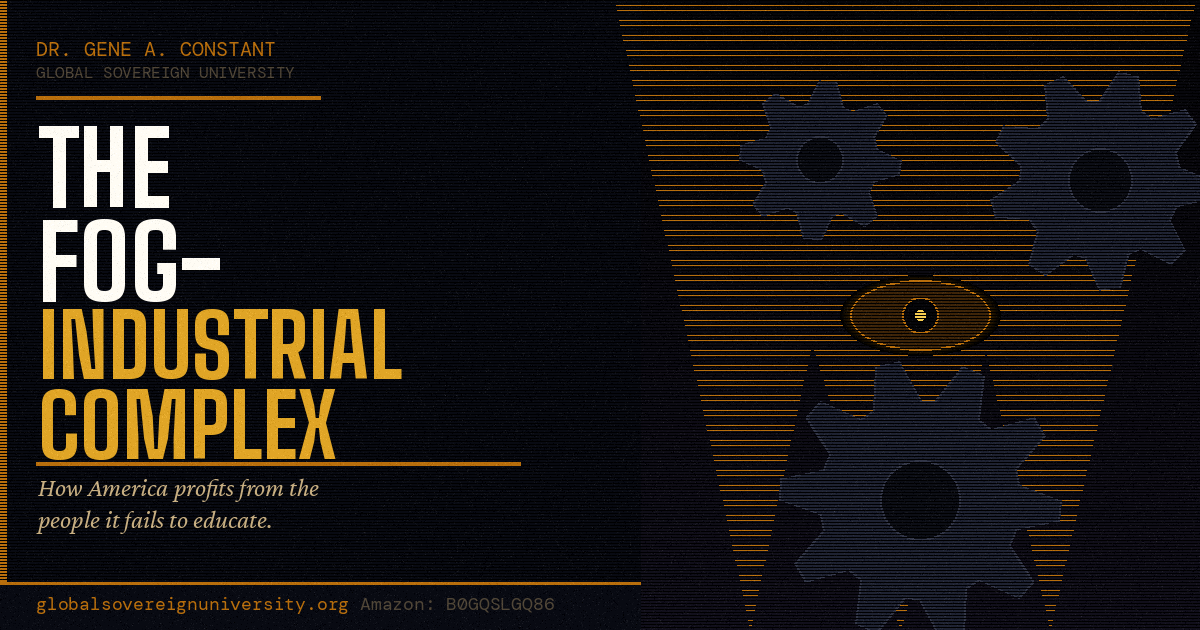
The standard response is a call for more funding, better teachers, or updated standards. Dr. Gene Constant's The Fog-Industrial Complex offers a different diagnosis. The system is not broken. It is producing exactly the outcomes it was designed to produce. The more uncomfortable question is, who benefits from those outcomes?
Follow the Money
The United States spends more per student on K–12 education than almost any nation on earth. That investment has risen, in inflation-adjusted terms, for more than four decades. If money were the decisive variable, outcomes would have improved. They have not. Which means money is not the variable.
What has changed across those same decades is the industrial scale of the systems that profit from educational fog. The Fog-Industrial Complex identifies four by name.
The credential economy. When graduates lack demonstrable, practical skills, economic access requires a credential — a document issued by an institution that charges for the privilege. The credential system's entire value proposition collapses the moment employers and society understand that what actually matters is demonstrated competency, not credentialed seat time. Fog is the product. Clarity is the competitor.
Pharmaceutical marketing. A patient who can evaluate a clinical trial, parse statistical risk, and distinguish a symptom from a diagnosis is a fundamentally different economic actor than one who cannot. One requires persuasion. The other requires evidence. The pharmaceutical advertising budget — one of the largest in the American economy — is calibrated for an audience trained not to ask hard questions.
Political media. Outrage is the revenue model of modern political media, across the entire spectrum. Outrage requires speed — the immediate emotional reaction that precedes analysis. An electorate trained in logical reasoning, source evaluation, and rhetorical pattern recognition is a much smaller market for manufactured crises. That electorate is not being built.
Social media platforms. Engagement-maximizing algorithms do not reward careful thought. They reward reaction — the fastest, most emotionally intense response to a stimulus. Every second of impulsive engagement is a revenue event. Sustained reading and sustained reasoning are its inverse. The attention economy has a clear financial position on literacy. Distraction is profitable.
None of these industries caused the original educational design failure. All of them benefit from it. Not one has a financial incentive to fund its correction.
The Design Problem
The American public school system was not architected around the question, 'what does a capable, self-governing adult need?' It was architected around a different question: 'how do we produce measurable outputs that justify the institution?'
The outputs are grades, attendance records, and standardized test scores. None of these measure whether a graduate can evaluate a pharmaceutical advertisement, navigate a financial contract, protect their digital identity, or hold a local government accountable. The credential is issued. The competency is frequently not built.
Nobel Prize economists Banerjee and Duflo documented a precise version of this failure: classroom math success consistently does not transfer to real-world mathematical reasoning. Students who pass the course cannot reliably apply the skill outside it. A thirteen-year process with that outcome is not an accident. It is a design — and the design serves someone.
This Is Not Conspiracy Theory
The argument Dr. Constant makes is not about shadowy coordination. It is about ordinary economics. Industries do not need to conspire to benefit from a structure that profits them. They simply need to continue operating within a structure that was never redesigned to stop serving them.
The credential economy does not lobby against critical thinking instruction. It does not need to. As long as credentials remain the primary gateway to economic legitimacy, the credential economy is protected. The pharmaceutical industry does not suppress health literacy curricula. It does not need to. As long as patients are not taught to evaluate statistical risk, the marketing machine runs without friction.
That is what makes the fog structural rather than conspiratorial. It is held in place by incentives, not conspiracies. Follow the money, and the mechanism becomes visible.
What GSU Is Doing About It
Global Sovereign University exists as a direct counter to this mechanism. Free. No login required. No prior credential needed. No debt. The education the system withheld is at globalsovereignuniversity.org right now — available to anyone with a device and a willingness to begin.
The Fog Detection game at GSU trains the specific skill this book identifies as most absent from standard curricula: pattern recognition under real cognitive and social pressure. Not the memorization of fallacy names — the trained discipline of pausing before accepting an argument that feels compelling, interrogating what makes it feel convincing, and separating the evidence from the persuasion.
That pause — the practiced discipline of asking before accepting — is what the fog most depends on you never developing. The Fog Detection game builds it. For free. Right now.
Read It. Play It. Clear the Fog.
The Fog-Industrial Complex is available on Amazon, Kindle ASIN B0GQSLGQ86. It is a short book — designed to be completed in a single sitting and carried in the mind for considerably longer. It names the mechanism. GSU's Fog Detection game trains the response. The two are designed to work together.
The fog is the product. The question is whether you are still in the market.
▶️ Watch the video: https://youtu.be/Jm7RwveXDPs
📚 Get the book on Amazon: https://www.amazon.com/dp/B0GQSLGQ86?tag=gsu2026-20
🎮 Play Fog Detection free — no login, no cost: https://www.globalsovereignuniversity.org
🎙️ Podcast: https://buzzsprout.com/2530740



.jpeg)
.jpg)