The Three-Jar Trick: How to Teach a 9-Year-Old Real Money Skills in 30 Days
Last month I watched a nine-year-old receive twenty dollars for her birthday.
She looked at the bill for about two seconds, walked to her mother, and asked, “Can I have cash instead?”
The twenty WAS cash. She didn’t know that.
If you have a kid between eight and twelve, that story either made you laugh or made you nervous. Probably both. Because we all know, quietly, that our children are growing up in a world where every transaction happens through a screen — a tap, a swipe, a parent’s card — and the physical, tactile sense of what money IS has become something we have to deliberately teach. It’s not going to happen on its own.
The good news is that it can happen. Fast. In about thirty days, with a method so simple that children half that age have been learning it for generations in families that did this by instinct.
It’s called the Three-Jar method. And if you’ll give me the next five minutes, I’ll walk you through exactly how it works, why it works, and how to set it up in your kitchen this weekend.
Why most money conversations with kids fail
Most parents try to teach their children about money by talking about it.
“You need to save for the future.” “Money doesn’t grow on trees.” “Think before you spend.” All true. All useless. Not because the ideas are wrong, but because money isn’t learned through ideas. It’s learned through physically handling money, in small amounts, with real decisions attached.
A kid who hears “you should save” ten thousand times across their childhood will still hit age twenty-five and blow their first paycheck in a week. A kid who has physically divided every dollar that came into their hands from age nine onward has a habit so deep it’s indistinguishable from instinct.
The difference is the habit, not the lecture.
The Three-Jar method exists because it’s the simplest possible way to build that habit.
What the Three-Jar method actually is
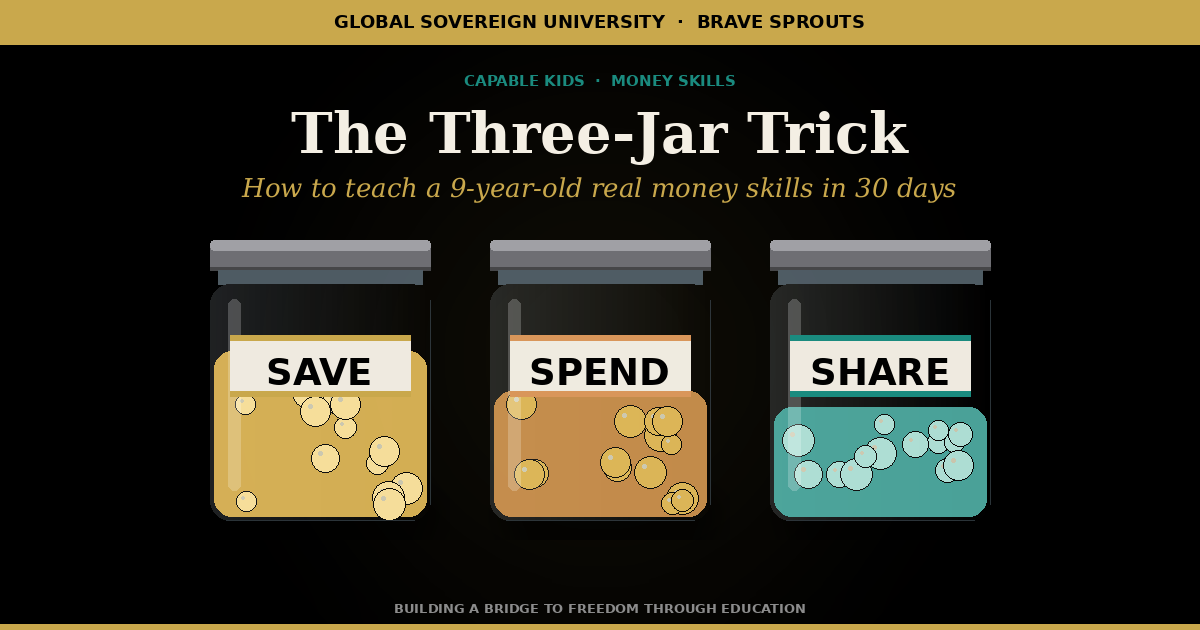
Three clear glass jars, labeled:
- SAVE
- SPEND
- SHARE
Every dollar that comes into the child’s hands — allowance, birthday money, lemonade stand earnings, found on the sidewalk, anything — gets divided among the three jars before any of it gets spent.
That’s it. That’s the entire method.
The specific percentages are flexible and should be age-appropriate. A common starting split for a nine-year-old:
- 50% to Spend — their money to enjoy this week
- 30% to Save — toward a specific goal they’ve chosen
- 20% to Share — charitable giving to a cause they pick
But the percentages aren’t the magic. The magic is the ACT of dividing. Every dollar, every time, before anything else happens.
Why does that small ritual work so well? Because it rewires the order of operations in the child’s brain. Most adults think about money in this order: I want something → how much is it → do I have enough? A Three-Jar kid thinks: I got money → divide it → now what’s available in the Spend jar?
That second sequence is the difference between a lifetime of financial anxiety and a lifetime of financial sovereignty.
Setting it up this weekend: the 15-minute version
Here’s how a parent of a nine-to-twelve-year-old can set this up in about fifteen minutes this Saturday morning.
Step 1: Get three jars. Any clear glass jar works. Mason jars, old pasta sauce jars, whatever. Clear is better than opaque so the child can see the money growing or being spent. Label them SAVE, SPEND, and SHARE with masking tape and a marker. Done.
Step 2: Sit down with your kid for five minutes. Explain the three categories in age-appropriate language. Save is for something bigger you want someday. Spend is for now-stuff. Share is for helping other people or causes the child cares about.
Step 3: Let the child choose their own percentages. This is critical. Do not dictate the split. Guide them, but let them choose. Nine-year-olds usually want most of it in Spend, and that’s fine — the point isn’t perfect budgeting; the point is the habit of dividing. You can adjust the percentages over time.
Step 4: Let them choose a Save goal and a Share cause. Maybe the Save goal is a specific toy, a bike, or concert tickets eighteen months out. Maybe the Share cause is the local animal shelter, a friend in need, or their church. Both have to be SPECIFIC. “Save for the future” is meaningless to a nine-year-old. “Save for a specific pair of rollerblades that cost sixty dollars” is concrete.
Step 5: Starting this week, every dollar that enters the child’s hands gets divided by them in front of the jars. You facilitate. You don’t do it for them. The ritual matters.
In four weeks, you’ll see something remarkable: the child will start thinking about money differently. They’ll weigh purchases. They’ll ask questions. They’ll get excited watching the Save jar fill up. They’ll feel proud the first time they donate from the Share jar.
That transformation took thirty days. It’ll last the rest of their life.
What gets hard (and how to handle it)
About week two, a problem usually shows up. The child sees something they desperately want, and there isn’t enough in the Spend jar to cover it.
This is the critical moment. The parent’s response here determines whether the method takes root or falls apart.
The wrong response: “Oh honey, I’ll get it for you. You can pay me back.”
The right response: “That’s frustrating. What are your options?”
And then you let them work it out. They can wait until next week’s Spend refill. They can move some money from Save — but then their Save goal moves further away, and they have to decide if the immediate want is worth it. They can do extra chores to earn more. They can decide the thing isn’t actually worth what they’d have to trade for it.
You are not teaching them money. You are teaching them trade-offs. The Three Jars are just the container. The decisions are the lesson.
Most adults never learned to make a real trade-off decision with money. They just cover the gap with a credit card, and then the gap gets bigger, and then the card gets bigger, and then they’re forty-five years old and still paying interest on a pair of shoes they bought in their twenties.
Your nine-year-old can skip that entire story.
Where this lives in Brave Sprouts
The Three-Jar method is the foundation of the Money Smarts section of Brave Sprouts Issue 1, the kids’ capability magazine we publish at Global Sovereign University Press.
The Kids Edition explains the method in the child’s own voice, with illustrations, with a kid who’s doing it and talking about what works and what doesn’t. Issue 1 also includes thirteen other sections — the Sunday Chef cooking method, handwritten thank-you notes, the Trust-but-Verify habit for critical thinking, the 30-Day Capability Calendar, the Mistake Museum, Community Heroes, and more.
The Parent Edition is the companion. Every section in the Kids Edition is mirrored with a parent-facing chapter: exact conversations to have, common questions kids ask (and the right answers), how to respond when things go wrong, and the pacing that keeps the habit sticky instead of collapsing.
The two editions are designed as a kit. The Kids Edition alone teaches your child real skills. The Parent Edition turns “my child read a good magazine” into “our family changed how we do Saturdays.”
Both are available on Amazon:
- Brave Sprouts Kids Edition, Issue 1 — amazon.com/dp/B0FTW317BW
- Brave Sprouts Parent Edition, Issue 1 — amazon.com/dp/B0GX2V58J2
If you’re buying for a family member’s kid — a niece, a nephew, or a grandchild — the Kids Edition alone is an excellent standalone gift. You can add the Parent Edition later if the family takes to it.
One more thing
Every dollar from Brave Sprouts sales supports Global Sovereign University, a 501(c)(3) nonprofit offering free education to anyone who wants it. We don’t take a salary. We don’t run ads. We don’t sell a subscription. We publish capable-kid tools, and we use the proceeds to fund free learning for adults in reading, math, trades, financial literacy, civics, and critical thinking.
Your purchase doesn’t just teach your child. It teaches someone else’s parent, somewhere else, for free, tomorrow.
Start the jars this weekend.
About the author: Dr. Gene A. Constant is a Navy and Marine Corps veteran, Doctor of Business Administration, and founder of Global Sovereign University. He is the author of 175+ books, host of the Voice of Sovereignty podcast, and creator of the Brave Sprouts capability magazine for kids ages 8–12.







.jpeg)
.jpg)