There is a piece of technology more powerful than any AI model, any search engine, or any supercomputer on Earth. It was invented 2,500 years ago. It requires no electricity, no subscription, and no login. And almost nobody teaches it anymore.
It's called the trivium.
What Modern Education Left Out
If you went through the American education system in the last fifty years, you were trained to memorize. Dates, formulas, vocabulary lists, state capitals. Sit down. Fill in the bubble. Pass the test. Move on.
What you were never trained to do is think.
Not think about a specific subject—think as a discipline. Think of it as a skill. Think of it as something you can practice, sharpen, and deploy on demand the way a carpenter uses a saw or a surgeon uses a scalpel.
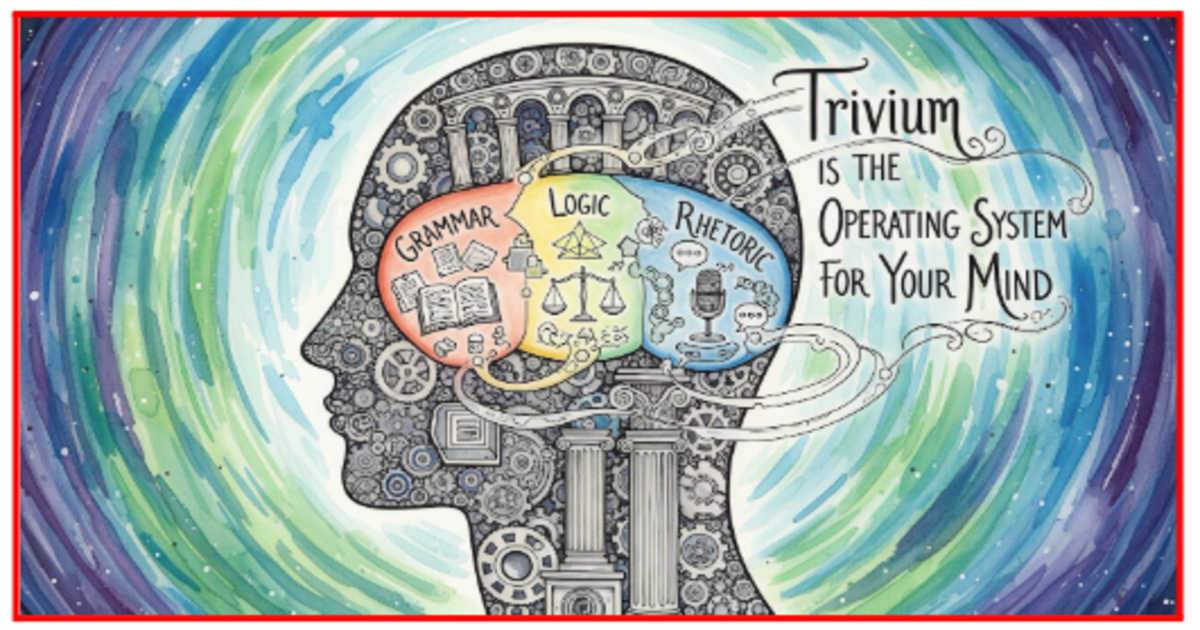
The ancient Greeks didn't make that mistake. They understood that before you could study science, law, philosophy, or anything else, you needed a foundation—a method for processing the world. They called that foundation the trivium, and it consisted of three disciplines that worked together as a single system: Grammar, Logic, and Rhetoric.
For over two thousand years, this framework was the starting point of every serious education. It produced Aristotle, Cicero, Thomas Aquinas, Thomas Jefferson, and Frederick Douglass. It was the operating system underneath every other subject.
Then we stopped teaching it. We replaced a system that produced independent thinkers with a system that produces compliant test-takers. And the consequences are everywhere.
Input, Process, Output
In my book The Sovereign Mind: Input, Process, Output — A 21st-Century Guide to the Trivium, I take the three classical disciplines and translate them into modern language that anyone can use immediately.
Input is Grammar. This is the art of gathering information—but not passively. Real input means learning to verify what you receive. Where did this claim come from? What is the source? Is this data or opinion? In 2026, with AI generating articles, images, and even video at an industrial scale, the ability to evaluate information at the point of entry is no longer optional. It is survival.
Process is Logic. This is where thinking actually happens. You take the information you've gathered, and you reason through it. Does this argument hold up? Are there hidden assumptions? Is this a logical fallacy dressed in emotional language? Logic is the engine of the trivium. Without it, you are a warehouse full of unprocessed inventory—plenty of material, no product.
Output is Rhetoric. This is communication with precision, integrity, and power. Once you've gathered reliable information and reasoned through it clearly, you need to express your conclusions in a way that moves people. Rhetoric is not manipulation. It is the ability to lead with truth. It's the difference between having a brilliant idea and making that idea change the world.
Three disciplines. One system. Input. Process. Output.
Why This Matters More Now Than Ever
We are living through the most significant information revolution in human history. Artificial intelligence can now generate content — text, images, code, music, and video — faster than any human being. That power is extraordinary. It is also dangerous.
Because AI cannot think. It cannot evaluate whether what it produces is true, ethical, or wise. It cannot distinguish a valid argument from a convincing-sounding fallacy. It cannot weigh evidence against values. Only a trained human mind can do that.
The trivium is the training.
When someone shares an article and says "look at this," a trivium-trained mind asks: where did this come from?" What is the original source? That is Grammar — Input.
Then it asks: does the argument hold up? Is the evidence sufficient? Are there logical fallacies or cognitive biases at work? That is Logic — Process.
And when it's time to respond — to persuade, to teach, to lead, to push back—the trivium-trained mind does so with clarity, structure, and integrity. That is Rhetoric — Output.
This is not ancient history. This is the most modern skill set you can possess.
Critical Thinking at GSU
At Global Sovereign University, the trivium isn't just a book — it's the architecture behind our entire Critical Thinking track. We offer nine free interactive games covering logical fallacies, cognitive biases, source evaluation, propaganda techniques, statistics manipulation, and more. Each game is built on the same Input-Process-Output framework, whether the learner realizes it or not.
Fallacy Finder teaches you to spot flawed arguments. Bias Detector reveals the predictable ways your own brain deceives you. Source Sleuth trains you to evaluate evidence like a professional fact-checker. These aren't worksheets. They are simulations. And they are completely free.
Every game earns badges in our Bronze-Silver-Gold-Platinum progression system, and our AI tutor GENO is available to guide learners in 32 languages. This is trivium education made interactive, accessible, and global.
The Book
The Sovereign Mind: Input, Process, Output — A 21st-Century Guide to the Trivium is available now on Amazon. It is published by Global Sovereign University Press.
Whether you're a self-directed learner, a homeschool family looking for a classical education framework, an educator frustrated with modern curricula, or someone who simply refuses to let algorithms do your thinking — this book was written for you.
👉 Get the book on Amazon: The Sovereign Mind
🎮 Play the Critical Thinking games for free: GSU Critical Thinking
🎙️ Listen to the podcast episode: Why the Trivium Is the Operating System for Your Mind
Education should build sovereignty — the ability to think independently, evaluate information critically, and communicate with power. That's not a slogan. That's the trivium. And it's free at GSU.
Building a Bridge to Freedom Through Education — Not Handouts.






.jpeg)
.jpg)