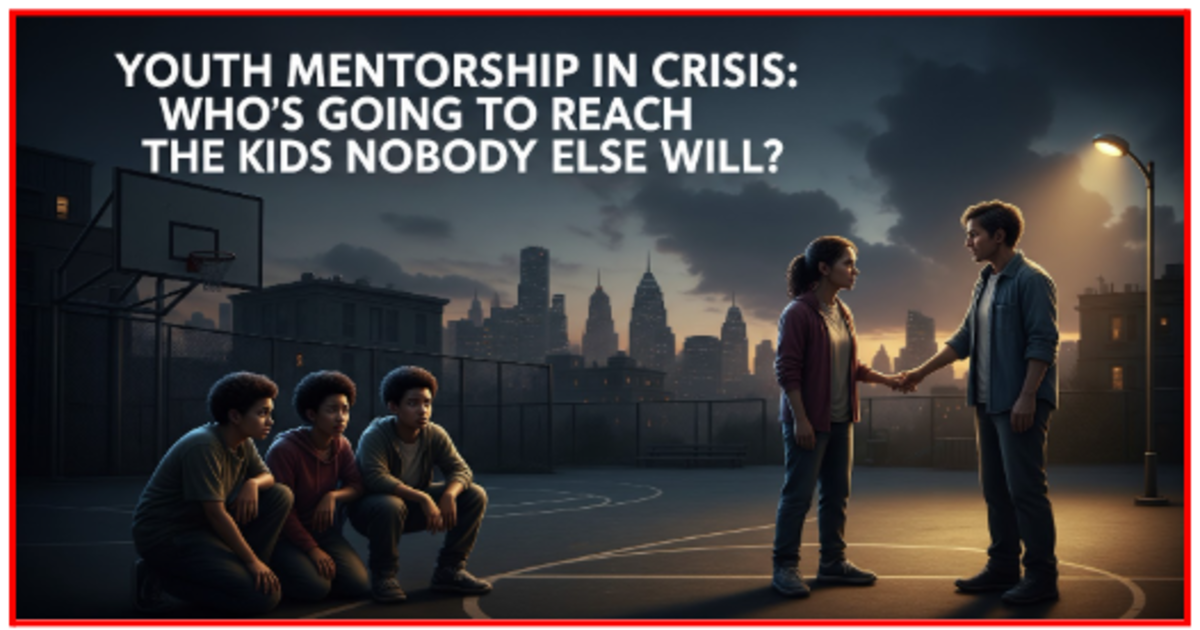
The Number Nobody Talks About
More than 16 million young people in the United States are growing up without a mentor. Not without a good mentor. Without any mentor. Without a single consistent adult outside their immediate family who takes a genuine, sustained interest in who they are and what they could become. That number comes from MENTOR, the national mentoring partnership. And if you sit with it long enough, it stops being a statistic and starts being a crisis—a quiet, slow-moving catastrophe that doesn't make the front page because its damage accumulates over years, not days.
Young people without mentors are 55 percent more likely to skip school. They are more likely to experiment with drugs and alcohol. They are significantly more likely to cycle through the juvenile justice system. These aren't opinions. They are the findings of organizations that have spent decades tracking what happens when young people grow up without consistent, invested adult guidance outside the home. The damage is measurable. The cause is fixable. And almost nobody is fixing it.
Why the Pipeline Dried Up
For most of American history, mentorship happened naturally—not through programs, but through proximity. A young man worked alongside his neighbor. A young woman learned her craft from the woman two doors down. The shop teacher, the coach, the pastor, and the business owner who hired a teenager and actually taught them something—these were the unofficial mentors who shaped generations. They weren't trained. They were present.
That world has been disrupted in ways we are still reckoning with.
Vocational education was stripped from schools in favor of college-prep tracks that serve a fraction of the population. Civic organizations that once connected generations have aged and shrunk. Intergenerational neighborhoods have been replaced by age-sorted digital environments where a 17-year-old and a 60-year-old retired master electrician may live three streets apart and have absolutely no mechanism for connecting. And our young men—particularly our young men—are paying the price. The data on disengaged males between 16 and 24 who are neither in school nor in the workforce is alarming. We are producing a generation of young men who have no older man in their life who models competence, consistency, and purpose. No one who shows up and says: here's how this works." "Here's Here's what you're capable of. Here's what a man looks like when he's operating at full capacity.
The system's response to this? More programs. More assessments. More managed care. What it cannot seem to offer is what these young people actually need: a person.
What Mentorship Actually Does
We tend to talk about mentorship in inspirational terms—the coach who believed in the kid, the teacher who saw something nobody else did. And those stories are real, and they matter. But the mechanism of mentorship is more specific than inspiration. It is what I call reality translation. A mentor takes the gap between where a young person is and where they could be—a gap that looks, from inside the life of a struggling teenager, like an uncrossable canyon—and makes it look like a bridge. Not by carrying the young person across. By walking alongside them. By demonstrating that the crossing is possible because they've done it themselves.
Nobel laureates Abhijit Banerjee and Esther Duflo, in their landmark research on global poverty, documented something that transformed how I think about education. They found that the failure of education in underserved communities is not primarily a failure of information transfer. It is a failure of application. Young people may learn a concept in a classroom and still be unable to deploy it when life requires it. That gap—between knowing and doing—is exactly what a mentor closes. Not by teaching the curriculum again. By showing what the curriculum looks like when it becomes a life.
Research from Harvard's Opportunity The Insights project confirms this in economic terms. The single strongest predictor of upward mobility for low-income children is not school quality or neighborhood safety. It is the presence of adults outside the immediate family who form sustained relationships with young people across class and experience lines.
The most powerful anti-poverty tool in existence is not a program. It is a person.
The GSU Response: Civilization Builders
At Global Sovereign University, we did not write a report about this problem. We built a response to it.
Civilization Builders is our structured mentorship program—and its premise is as simple as the problem it addresses: we have two massively underutilized populations in this country, and they need each other.
On one side: retired professionals. Men and women who spent careers in the trades, in business, in the military, and in education—who carry decades of hard-won knowledge that is in very real danger of dying with them because no one has created a structure for passing it on.
On the other side: young people who are hungry for exactly that knowledge and have no idea where to find it. Young people who are falling through the gaps of a credentialing system that rewards compliance over competence. Young people who need a person, not a program.
Civilization Builders brings these two groups into a structured relationship.
Our mentors teach what they know—not what a curriculum committee decided they should know, but what their actual life of work has taught them. Our learners build real, verifiable competence. And they earn credentials through our Honest Transcript system—not grades based on seat time, but documentation of demonstrated ability, verified by the mentors who can actually assess it. This is how civilization has always been built. Master to apprentice. Elder to emerging. Not managed. Transmitted.
The Books Behind the Mission
GSU's curriculum doesn't emerge from thin air. It is grounded in a body of work that Gene Constant has spent years developing—work that examines, from multiple angles, the failure of conventional education and the path to something better.
The Amnesty Protocol: Reaching the Forgotten is the foundational manifesto of everything GSU does—a direct address to the millions of people who were failed by the education system and are waiting for a second door to open.
The Philosophy of the Rod, The Practice of Teaching, and The Wisdom Bridge—the 'Teach a Man to Fish' trilogy—examine what real teaching looks like, what mentorship demands from the mentor, and how wisdom is transmitted across generations.
And the Sovereign Mind Collection applies the classical Trivium — Grammar, Logic, rhetoric—to the development of the critical thinking capacity that every young person needs to navigate a world engineered to confuse them. All of these titles are available at GlobalSovereignUniversity.org/bookstore. Every royalty from every sale goes directly to the Foundation for Global Instruction—funding the free education, the free games, and the Civilization Builders program itself.
That's what '100% Mission Funded' means. When you buy a book, you build a bridge.
The Invitation
If you are reading this as a retired professional—in any field, in any trade, in any discipline—and you have knowledge that a young person could use, I am asking you to consider becoming a Civilization Builder.
You do not need a teaching certificate. You need a lifetime of competence and the willingness to pass it on. That is enough. That has always been enough.
If you know a young person who is falling through the cracks—who is smart but stuck, disconnected but not lost, searching for direction in a world that has offered them none — point them to us. Our education is free. Our GamesBased learning is available right now at no cost. Our GENO AI tutor is available around the clock in multiple languages. And Civilization Builders is being built for exactly the young person you're thinking of as you read these words.
Youth mentorship is in crisis. But crises are invitations.
They are invitations to the people who refuse to wait for someone else to show up.
Visit GlobalSovereignUniversity.org
Play a game. Read a book. Join the mission. Build civilization.
Dr. Gene A. Constant, DBA is the founder and president of Global Sovereign University and the Foundation for Global Instruction (EIN: 39-2716552), a 501(c)(3) educational nonprofit based in Eugene, Oregon. A U.S. Navy and Marine Corps veteran and author of 177+ published titles, Dr. Constant's royalties support the Foundation's mission of free, gamified education for self-reliance.




.jpeg)
.jpg)