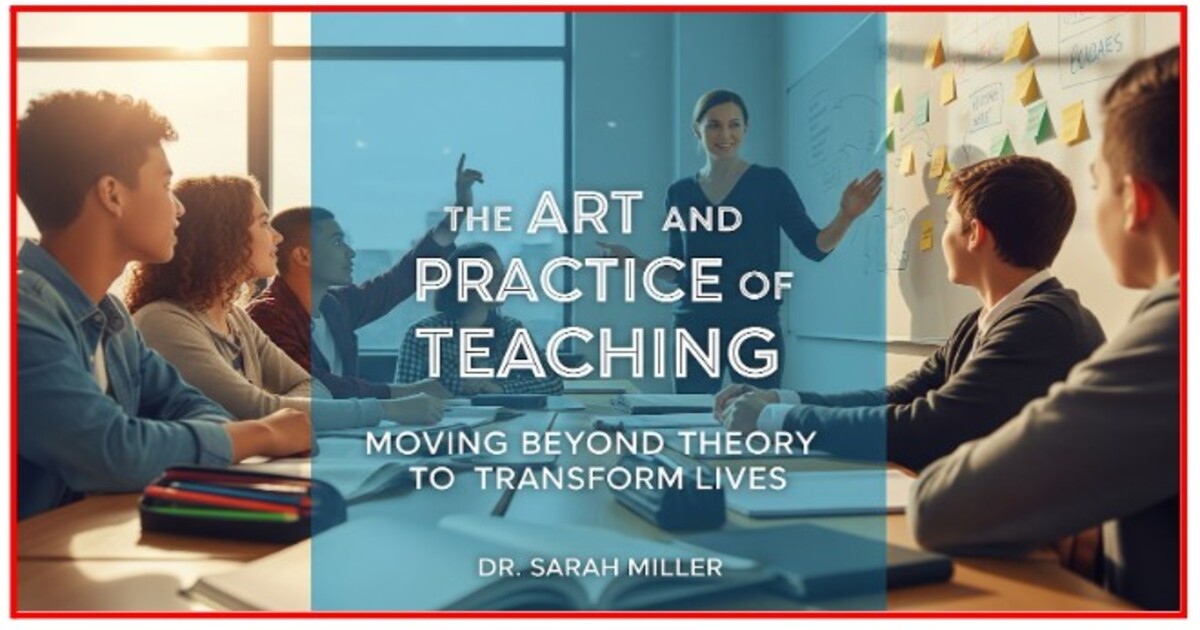
Everyone knows the proverb: teach a man to fish, and you feed him for a lifetime. But here is the question no one asks: who teaches the teachers to teach? And more importantly, how do we move from the philosophy of teaching to the actual practice?
There is a vast difference between understanding that teaching is valuable and knowing how to teach effectively. Universities produce graduates with content knowledge but rarely train them in the craft of knowledge transfer. We assume that knowing something automatically confers the ability to help others know it. This assumption is wrong, and it explains why so much education fails to produce lasting change.
The practice of teaching is exactly that—a practice. Like medicine or law, it requires not just theoretical understanding but developed skill. Like any craft, it improves with deliberate attention and honest assessment. And like all meaningful human activities, it has principles that can be learned and applied.
The first principle of effective teaching is meeting learners where they are, not where you wish they were. This sounds obvious, but it is constantly violated. Teachers prepare their material, organize their presentation, and deliver it according to their understanding—completely ignoring the actual starting point of their audience. Effective teaching begins with assessment: What does this person already know? What do they believe? What misconceptions might they hold? What is their learning style and capacity?
The second principle is making the abstract concrete. Human beings learn through experience, example, and story far more readily than through abstraction and lecture. Every concept, no matter how sophisticated, can be grounded in concrete reality. The teacher who cannot find the example, the metaphor, or the story that makes an idea tangible has not yet fully understood it themselves.
The third principle is active engagement over passive reception. The brain that is simply receiving information is barely learning. The brain that is processing, questioning, applying, and producing is building durable knowledge structures. Effective teaching constantly moves learners from reception to action. It asks questions, poses problems, demands application, and requires demonstration.
The fourth principle is emotional connection. Information that engages only the intellect is quickly forgotten. Information that touches the heart—that connects to values, fears, hopes, and identity—becomes part of the person. This is not about manipulation but about relevance. Why does this matter? Why should the learner care? What is at stake? Teaching that answers these questions teaches material that sticks.
The fifth principle is repetition with variation. Once is not enough. Important concepts must be encountered multiple times, in multiple contexts, through multiple modalities. But mere repetition becomes boring and loses effectiveness. The skilled teacher finds new ways to approach the same essential truths, building understanding through accumulated perspectives.
The sixth principle is graduated challenge. Learning requires appropriate difficulty—not so easy as to bore, not so hard as to overwhelm. The skilled teacher calibrates constantly, increasing challenge as competence develops, providing scaffolding when learners struggle, and removing support as they grow stronger. This is the art of the practice: knowing when to push and when to support.
The seventh principle is modeling, not just telling. Human beings are imitation machines. We learn by watching far more than by listening. The teacher who demonstrates what they teach, who embodies the skills and attitudes they wish to transfer, teaches far more powerfully than the teacher who merely describes.
These principles are simple to state and difficult to master. They require the teacher to simultaneously understand their material, understand their learner, understand the process of learning itself, and adapt in real time to the feedback they are receiving. This is why teaching is a practice—it requires ongoing development, not just initial training.
The Practice of Teaching is designed for everyone who teaches, whether or not they hold that title. Parents are teachers. Managers are teachers. Mentors, coaches, advisors, and friends who share their knowledge—all are teachers. And all can benefit from developing their craft.
In a world that desperately needs more capable people, the multiplication of effective teachers is perhaps the highest leverage intervention available. One person who learns to teach well will impact hundreds or thousands over their lifetime. One person who teaches others to teach well will impact millions.
The philosophy of teaching someone to fish is ancient. The practice of teaching—the actual craft of transferring capability—is where philosophy becomes reality. Master it, and you become an agent of transformation. Ignore it, and your good intentions will produce limited results.
The question is not whether you have something worth teaching. The question is whether you will develop the skill to teach it effectively. The world is waiting for capable teachers. Will you answer the call
Amazon ASIN: B0FTYTH9FM
Amazon Link: https://www.amazon.com/dp/B0FTYTH9FM
practice of teaching, effective teaching methods, practical teaching skills, how to teach effectively, mentor training, teaching for impact, real-world teaching strategies, transformational teaching, hands-on teaching approach







.jpeg)
.jpg)