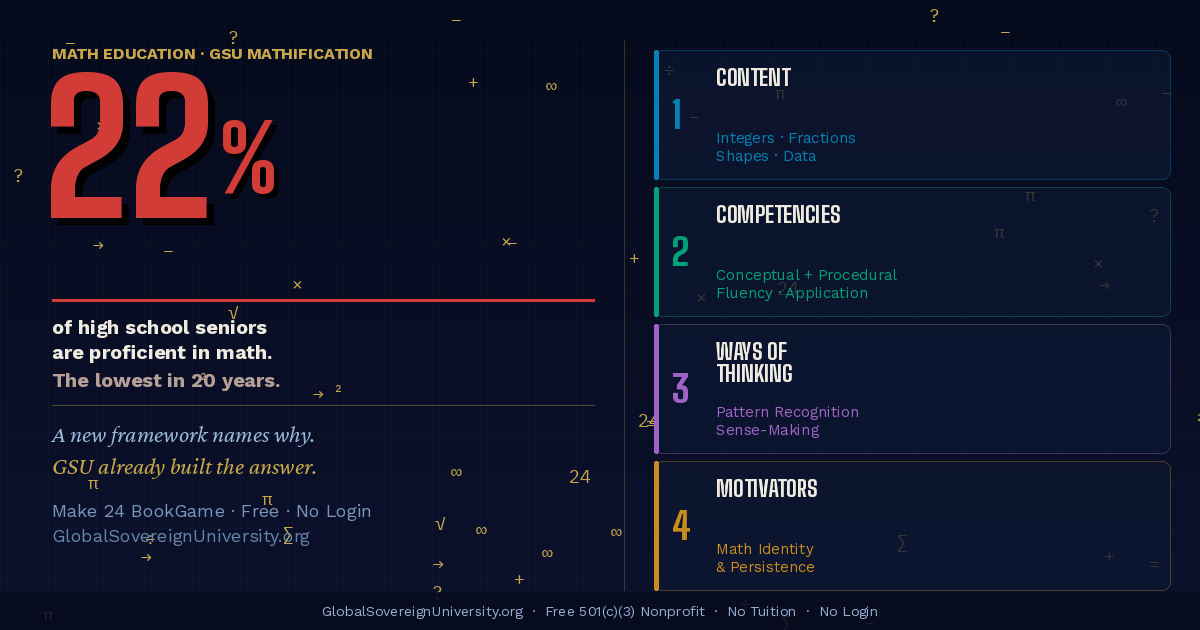
Only 22% of High School Seniors Are Proficient in Math. A New Framework Names Why—and GSU Already Built the Answer.
The number came from the Nation's Report Card. Only 22% of American high school seniors are proficient in mathematics—the lowest score in more than twenty years. Reading is no better: only 35% of twelfth graders meet the proficiency threshold. These are not pandemic anomalies. The decline began before 2020 and has continued through every intervention the system has applied.
The question is not whether American math education is failing. That is settled. The question is what kind of failure it is—and whether the response being proposed will reach the root.
In February 2026, a national education organization called PowerMyLearning published a framework it hopes will guide educators and policymakers toward a different approach to early math instruction. It is worth examining carefully—because it names something the system has consistently refused to name and because GSU has already been building the solution it describes.
The Four Pillars
The PowerMyLearning framework organizes early math education around four pillars, each broken into four subcategories.
The first pillar is content—integers, fractions, shapes, and data. This is what most people mean when they say "math": the subject matter itself.
The second is competencies—conceptual understanding, fact fluency, procedural fluency, and application. This is where the framework gets interesting. It separates conceptual understanding from procedural fluency—treating them as distinct skills that must both be developed, not treated as identical. Most American math classrooms develop procedural fluency almost exclusively. The student learns the steps. They follow the steps. They receive the grade. Conceptual understanding—knowing why the steps work and being able to adapt when the steps don't apply—is rarely assessed and rarely taught.
The third pillar is Ways of Thinking—symbolic understanding, pattern recognition, explaining, and sense-making. Pattern recognition is the cognitive engine of mathematical competence. It is also the skill that Make 24 — GSU's free math puzzle game—builds exclusively. Every puzzle in Make 24 is a pattern recognition exercise with no procedure available. There is no algorithm to follow. There are four numbers and a target, and the player must find a path.
The fourth pillar is Motivators — math identity and persistence. The framework is explicit that math identity must be actively cultivated, that inclusive messages must counter negative ones, and that the belief that "math is for everyone" must be built into the environment, not assumed.
What the Framework Is Actually Saying
Read together, these four pillars constitute a quiet indictment of the way math has been taught in American classrooms for generations. The system has been optimized almost entirely for one quadrant: procedural fluency within the Content and Competencies pillars. It has largely ignored conceptual understanding, neglected the Ways of Thinking pillar almost entirely, and treated the Motivators pillar as someone else's job—a counselor's concern, not a math teacher's.
The result is a student population that can execute a procedure when told which procedure to use and collapses when the procedure isn't obvious. That is not mathematical thinking. It is mathematical mimicry. And it produces a 22% proficiency rate among seniors who have spent thirteen years in a system that called it education.
The Gender Gap Connection
Last week this blog covered research published in the British Journal of Educational Psychology showing that girls are systematically trained toward procedural fluency, while boys are more likely to develop the flexible, inventive problem-solving strategies that predict performance on complex math tasks and high-stakes tests. The PowerMyLearning framework confirms the same finding from the opposite direction: the system is producing procedural fluency at scale and calling it math education, and the students who survive it are the ones who developed the other skills somewhere else.
Bold problem-solving — the capacity to approach a mathematical challenge without a prescribed procedure and generate your own path—is not a personality trait. It is a trainable skill. The framework names it. The research confirms it. GSU built a game that develops it.
What GSU Already Built
Map the PowerMyLearning pillars against the GSU Mathification curriculum:
Content is covered across Division Dojo, Fraction Frenzy, Trade Math Challenge, and the Make 24 Game—integers, fractions, and applied mathematics are all represented in the free BookGame library.
Competencies — Make 24 addresses conceptual understanding and application directly. There is no fact to memorize and no procedure to execute. The player must understand what the numbers are doing and apply that understanding under pressure.
Ways of Thinking — This is Make 24's core value proposition. Pattern recognition, symbolic understanding, and sense-making are what every puzzle demands. GENO's coaching language was specifically updated this week to reinforce this: "Forget the obvious path. Bold solvers find routes the algorithm misses."
Motivators—GENO reads every puzzle aloud. Every player earns badges. The game communicates implicitly and explicitly that mathematical thinking is a skill being developed, not a talent being revealed. That is math identity work.
The Broader Context
The urgency of this conversation is not abstract. Senator Bill Cassidy, chairman of the Senate Health, Education, Labor, and Pensions Committee, has formally asked colleges and universities for data on incoming students' math abilities, citing a crisis in K-12 math education. States including Texas, Illinois, and New York are redesigning their math guidance and mandating new teacher training. Thirteen states have expanded access to Algebra 1 in middle school.
All of this legislative and policy activity is responding to the same underlying problem the PowerMyLearning framework is addressing. The system produced a 22% proficiency rate. The system is now attempting to reform itself. That reform will be slow, uneven, expensive, and filtered through the same institutional structures that produced the failure in the first place.
GSU's answer is faster and costs nothing. The games are free. GENO is available now. No login, no tuition, no waiting for a state legislature to act.
Play Before the Reform Arrives
The PowerMyLearning framework is a step in the right direction. It correctly identifies the problem. It correctly names the skills that have been neglected. It correctly calls for math identity to be cultivated as deliberately as procedural fluency.
GSU did not wait for the framework. The Make 24 BookGame—free, voice-guided, badge-progressive, and built on exactly the pattern recognition and flexible thinking the framework calls for—is live now at GlobalSovereignUniversity.org.
Twenty-two percent is not a data point. It is a verdict. And the appeal has already been filed.
Dr. Gene A. Constant, DBA is the founder of Global Sovereign University, a free 501(c)(3) nonprofit educational platform. Play the Make 24 BookGame free at GlobalSovereignUniversity.org/bookgames/make-24-game. Get the book on Amazon: amazon.com/dp/B0GBSGLS2G.






.jpeg)
.jpg)