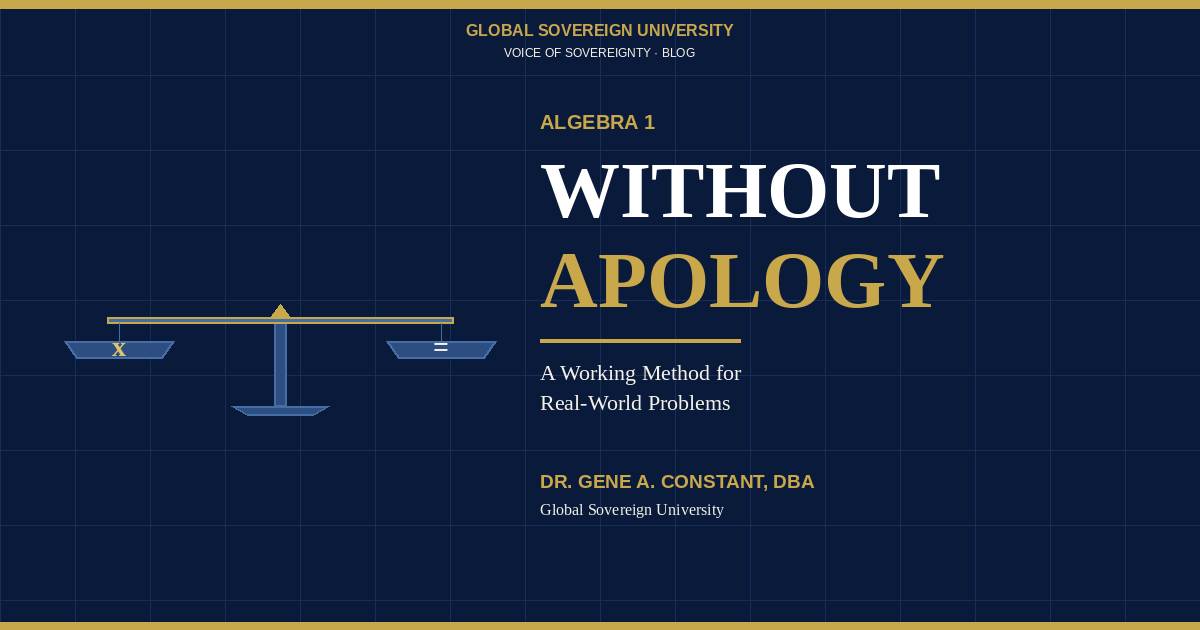
“You Already Do Algebra” — The Sentence That Changes How Adults Should Approach the Most Avoided Subject in Education
There is a sentence that opens Algebra 1 Without Apology, and if you grasp what it actually says, you have already crossed half the distance to being comfortable with the subject:
If you do not know algebra, you still do algebra. You just do it out loud, with guess-and-check, and you pay extra for it.
This is not a clever line. It is a description of how adults move through the world. Every time you split a restaurant check, estimate the tip, figure out whether the bigger size is actually the better value per ounce, or guess how many hours of work it would take to afford a thing — you are doing algebra. You just are not writing the symbols. You are running the same machinery in your head, less efficiently, with less confidence, and in many cases with a worse result.
This article is about why so many capable adults convinced themselves they were “bad at math,” what that conviction actually costs them, and the working approach that Algebra 1 Without Apology takes to fix it.
Most adults who say they are bad at algebra are wrong.
Here is what is actually happening when an adult says “I am not a math person.”
In school, somewhere around seventh or eighth grade, the symbols showed up. Letters started appearing where numbers used to be. The teacher introduced a notation that, for one or two weeks, you did not yet have a frame for — and then the class moved on. You spent the rest of the year trying to keep up while the foundation under you was shaky. By the end of the year, you had developed a story about yourself: I am not good at this.
That story was not true. The truth was simpler and more boring: you needed a different two weeks at the start than you got. The story stuck because it explained the experience and absolved the blame. But it was wrong, and it has been costing you ever since.
The book opens with the wages example: a job paying $17.50 per hour with overtime at time and a half after 40 hours and a paycheck of $787.50. How many hours did you work?
A reader without algebra might guess and check — try 40, try 45, try 44, try 43 — and eventually arrive somewhere. A reader with algebra writes one sentence: if h is more than 40, then 700 + 26.25(h − 40) = 787.50; solves it; and knows the answer. Same problem. Different costs in time, attention, and confidence.
This is the actual difference algebra makes in adult life. It is not whether you can pass a test. It is whether you can stop negotiating with your own uncertainty.
The capability gap is real, and it has nothing to do with intelligence.
In April 2026, EdTrust-New York reported that more than 20,000 New York students who scored proficient on seventh-grade math exams were locked out of Algebra 1 in eighth grade. More than 1 in 4 New York schools did not offer the course at all to eighth graders. The students hit hardest were Black, Latino, and low-income.
This is not a story about who can do algebra. The students were proficient. The schools were the obstacle. The capability gap is a structural problem — schools that delay access to algebra are delaying access to entire downstream pathways: Geometry in ninth grade, Algebra 2 in tenth, Pre-Calculus and Calculus and the science courses that depend on them, and the career pathways that assume formula fluency.
Adults who carry the “I am not a math person” story are often carrying it because somebody, somewhere, decided they did not need access to the course at the right moment. The story they ended up with was an internal explanation for an external structural failure.
This book exists, in part, to argue that the structural failure should not be allowed to close any door it touches.
Algebra is the language of “depends.”
Here is the reframe that makes the whole subject calmer.
Most adults experience algebra as the language of confusing letters and unsolvable problems. That experience is wrong. Algebra is the language of one thing: the conditional. Plan A is cheaper if you send a few texts. Plan B is cheaper if you send a lot. The threshold is at 150 texts.
You already understand the world this way. You know that one option is better in some conditions and worse in others. You know that “it depends” is the honest answer to most questions worth asking. Algebra gives you the symbols and structure to handle “it depends” without freezing.
The phone plan example in Chapter 1 makes this concrete. Plan A: $35/month plus 10 cents per text. Plan B: $50/month with unlimited texting. Where is the break-even point?
Set them equal: 35 + 0.10t = 50. Solve: t = 150. If you send more than 150 texts, the unlimited plan is cheaper. If you send fewer, the cheaper base plan is the better choice.
This is not a school problem. This is a real monthly decision that adults make poorly because they never had a tool for it. Algebra makes the decision boring instead of stressful — which is the highest compliment you can pay a tool.
The validation engine is the most underrated discipline in adult numeracy.
The book’s central pedagogical principle is something it calls the validation engine: never trust one path to truth when a second path is available.
This is the discipline that separates people who are reliable with numbers from people who are confident with numbers. They are not the same thing. Confidence without validation produces overpayment, missed deadlines, and bad decisions explained away after the fact. Validation produces calm.
In practice, the validation engine looks like:
- Solve the problem, then check by plugging the answer back into the original equation
- Solve it once with one method, then verify with a different method
- Estimate the answer in your head before you compute it, so you can detect a wrong answer that is wildly out of range
- Check the units — if you set up an equation about hours and got an answer that does not look like hours, something is broken
- Ask whether the answer makes sense in the real situation — a negative number of hours is a math answer, not a real one
This is not extra credit. This is the discipline that makes you trustworthy. People who do it are not gifted. They are trained. The book is, in large part, about training the reader in this discipline so it becomes automatic across every quantitative situation in adult life.
This is what the book teaches.
Algebra 1 Without Apology covers the standard Algebra 1 curriculum — variables, expressions, equations, inequalities, functions, graphs, systems, polynomials, factoring, and quadratics — but it teaches them differently. Each chapter opens with a real-world situation. Each chapter ends with the validation discipline applied to a problem you might actually face. Each chapter respects the reader as someone who has been solving problems all along, just without the symbols.
The book is free as an eBook at globalsovereignuniversity.org and available in softcover and hardcover on Amazon for readers who want a physical copy on the kitchen table or beside the homework.
If you have ever stalled on a phone plan decision, second-guessed whether a discount was applied correctly, or assumed someone else’s confident guess was correct because you did not have a better method — this is the book.
Capability over credentialism. Free education for all. Without apology.
About Dr. Gene A. Constant, DBA
Dr. Constant is the founder of Global Sovereign University, a 501(c)(3) educational nonprofit, and the Foundation for Global Instruction. A U.S. Navy and Marine Corps veteran with a background spanning photography, apparel export, and education, he is the author of more than 175 published titles and host of the Voice of Sovereignty podcast.





.jpeg)
.jpg)