Before You Can Read the Code—You Have to Hear It
Why phonemic awareness is the missing layer beneath every adult literacy program—and what to do about it right now.
Here is a test. Say the word "rent" out loud. Now say it slowly: rrr—eh—nn—t. What you just produced is not a word. It is four separate acoustic events, assembled in sequence, arriving at your listener's ear as a single signal.
Now say "contract": konn — trakt. Two clusters. Two vowel cores. Six consonant events, each with a specific contact point inside your mouth and a specific relationship to vocal cord vibration.
You have been producing these signals your entire life without thinking about them. The question Signal Decryption asks — and the question that sits beneath every adult literacy challenge — is whether you can hear them. Not produce them. Hear them. Isolate them. Take apart the stream and name the components.
If you cannot, reading becomes guessing. And guessing, dressed up in enough context and confidence, passes for reading until the lease arrives.
The Layer Nobody Taught
Phonemic awareness is the ability to hear, isolate, and manipulate individual sounds in spoken words. It is not phonics — phonics maps sounds to print. Phonemic awareness is the step before phonics, the auditory foundation that makes decoding possible. Without it, learning that the letter "s" represents the /s/ sound is like learning that a traffic light uses the color red without knowing what "stop" means.
The science of reading research has established phonemic awareness as the single strongest predictor of reading success in young children. What it has not adequately addressed is the forty million American adults who were moved through twelve years of compulsory schooling without it being trained at all — and who are now reading lease clauses, medication labels, and job postings with an auditory system that was never calibrated.
Signal Decryption: The Adult Guide to Hearing the Code is the calibration manual.
What the Book Actually Does
The book does not ask you to memorize anything. It asks you to perform physical experiments on your own vocal tract—experiments you can run in a car, at a kitchen table, or in a work break room without anyone knowing what you are doing.
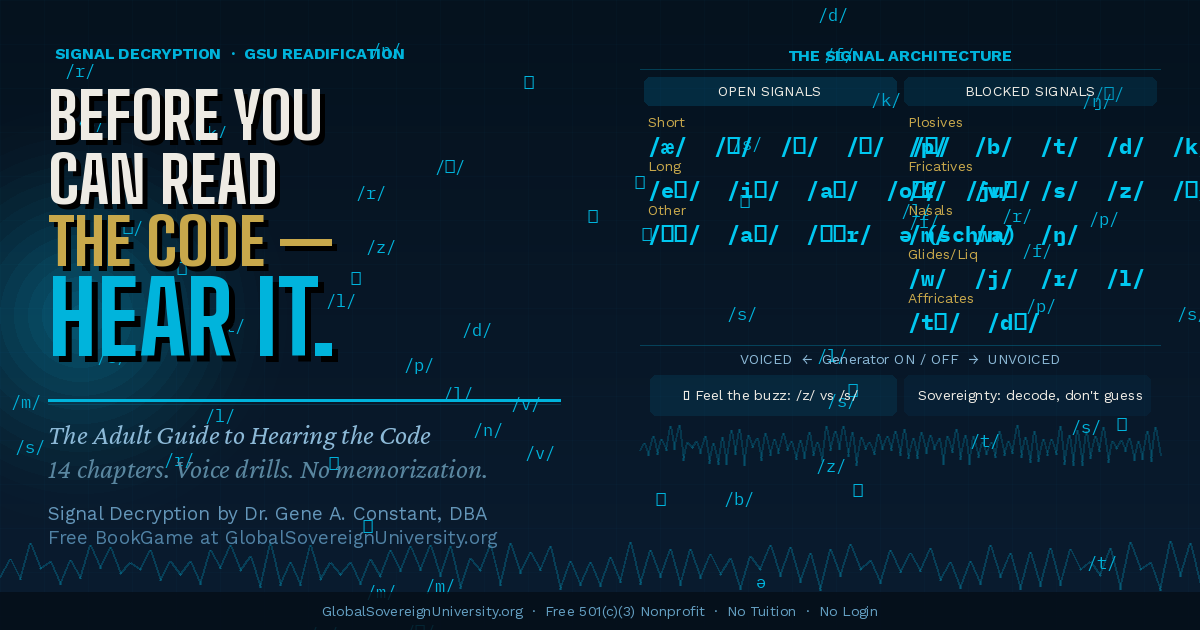
Chapter 1 establishes the foundational distinction: vowels are open signals, and consonants are blocked signals. A vowel is any sound that can be sustained because the airflow through the mouth is unobstructed. A consonant is defined by interference — a full stop, a narrow squeeze, a nasal reroute, or a glide. These are not school terms. They are descriptions of mechanical behavior. You can feel them.
Chapter 2 moves into plosives — the six hard stops: /p/ and /b/, /t/ and /d/, /k/ and /g/. Each is a closure-and-release event. The signal is not the sustain; the signal is the burst. This matters because adults drop final plosives constantly in fast reading, and a dropped final consonant changes words: "require" becomes "required," "file" becomes "filed," and suddenly a legal document means something you did not intend.
Chapters 3 through 6 cover the continuous signals—fricatives like /f/ and /v/, /s/ and /z/, nasals, glides, liquids, and affricates. Chapters 7 through 10 move through the vowel system in layers: short vowels, long vowels, diphthongs, and the r-controlled frequencies that make words like "nurse," "learn," and "firm" behave unpredictably for adult readers who were never taught to hear the r-coloring as its own acoustic event.
Chapter 11 is devoted entirely to the schwa — the unstressed /uh/ sound that hides in thousands of adult-life words. About. Custom. System. Compliance. The schwa is the ghost signal: it appears wherever a vowel is unstressed, regardless of which letter is written there. Adults who learned to read by memorizing word shapes often develop a quiet fear of multisyllabic words because the schwa makes spelling feel dishonest. Signal Decryption explains the mechanism: English is not dishonest. It is efficient. When you understand stress and schwa behavior together, the irregularity disappears.
The Throat Test
Every chapter includes a field test you can run without materials. The throat monitor drill from Chapter 1 is representative: place two fingers lightly on the front of your throat and make the sound /ssss/ — the end of lease. Your fingers should feel nothing. No vibration. Now make /zzzz/ — the middle of zero. You should feel a clear buzz. That is the voiced/unvoiced distinction. The mouth position for /s/ and /z/ is nearly identical. The generator — vocal cord vibration — is the only difference.
This is not a linguistics exercise. When an adult confuses /s/ and /z/ in decoding, they are not being careless. They were never trained to register voicing as a separate variable. The letter provides no information about voicing. Only the ear does. And the ear can be trained in minutes, in any location, with no equipment other than two fingers.
Sovereignty Is Measurable
Chapter 13 — Rhetoric and Sovereignty—is where the book shifts from training to application. By this point, the reader has a stable internal inventory of the 44 phonemes of English. They can isolate them, blend them, delete them, and substitute them. Chapter 13 asks, what does that capacity actually protect?
It protects the lease clause that uses "may" when it means "must." It protects the medication label that distinguishes twice daily from every twelve hours. It protects the job posting that uses "required" in one bullet and "preferred" in another—and whose difference determines whether you apply or walk away.
A lease clause is not forgiving. A medication label does not care about your confidence. A job posting will not rewrite itself to match what you guessed. When you carry an internal inventory of the code, you stop approaching print like a fog bank. You approach it like a signal stream you can segment, verify, and reconstruct.
That is sovereignty. And Chapter 13 makes it concrete.
Chapter 14: Sustaining the Code
The final chapter addresses what happens after the training ends — and this is where Signal Decryption separates itself from every remediation program you have encountered before. Most adult literacy programs treat completion as success. Signal Decryption treats completion as the beginning of maintenance.
Chapter 14 describes the community model: not a support group, not a classroom, but a maintenance network — adults who speak in procedures rather than pity. It looks like one adult saying, "I'm dropping the final /t/ when I read quietly at night," and another answering, "That's boundary decay. Run one deletion drill: must to mus and back to must, ten times." No shame. No theatrics. Diagnosis, correction, return to mission.
The chapter also addresses the most common adult objection directly and without condescension: "I don't want people to know." That sentence is not vanity. It is accurate threat detection based on lived experience. Signal Decryption takes it seriously — and builds a community model compatible with full privacy.
The BookGame
The free Signal Decryption BookGame at GlobalSovereignUniversity.org works alongside the book. GENO, GSU's AI voice tutor, reads every challenge aloud, explains every error in mechanical terms rather than correction-language, and tracks badge progress from Bronze to Platinum. It is the auditory training environment the book describes, available for free on any device, with no login required.
Get the Book
Signal Decryption: The Adult Guide to Hearing the Code is available now on Amazon. The code is not difficult. The training was simply never delivered. It is being delivered now.
Dr. Gene A. Constant, DBA is the founder of Global Sovereign University, a free 501(c)(3) nonprofit educational platform. Play the Signal Decryption BookGame free at GlobalSovereignUniversity.org/bookgames/signal-decryption. Get the book on Amazon.






.jpeg)
.jpg)