The debate over homeschooling is often framed as a values argument — a conflict between traditionalists and progressives, religious conservatives and secular liberals. But beneath the ideology lies three decades of empirical data, and that data consistently points in one direction.
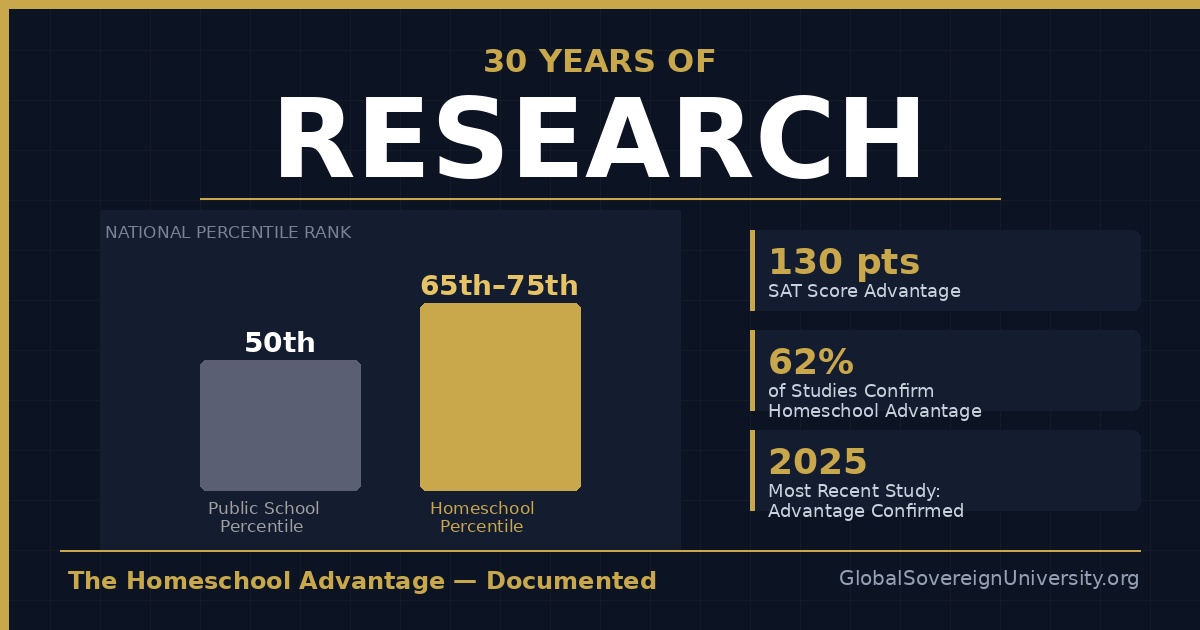
Sixty-two percent of peer-reviewed studies on homeschooling academic outcomes show that home-educated students outperform their institutional school peers. This is not a recent finding manufactured by advocacy groups. It is the accumulated result of longitudinal research conducted by university researchers across multiple countries, spanning from the early 1990s to the present.
THE NUMBERS
Homeschooled students average between the 65th and 75th percentile on standardized tests, compared to the 50th percentile for public school students. This means the typical homeschooled student performs better than 65 to 75 percent of the nationally normed student population.
On the SAT, the gap is measurable and concrete: homeschoolers average 1,190 compared to 1,060 for public school graduates — a 130-point difference on one of the most consequential assessments a young person takes. On the ACT, the gap is 2.6 points: 22.9 for homeschoolers versus 20.3 for their public school peers.
WHAT DRIVES THE GAP
The most significant and most underreported finding is that these gains are not explained by socioeconomic advantages. The performance gap persists across income levels, across racial and ethnic demographics, and across households where parents hold no formal teaching credentials.
This directly dismantles the most common critique of homeschooling research: that outcomes simply reflect the advantages of affluent, well-educated families. The data does not support this interpretation. The variable that consistently predicts performance is the learning environment itself.
COLLEGE AND ADULT OUTCOMES
The advantages compound at the college level. College acceptance rates for homeschooled students reach 87%, compared to 68% for public school graduates. Homeschoolers maintain freshman GPAs between 3.37 and 3.46, while public school graduates average 3.08. They are also 10% more likely to complete their first year.
THE SOCIALIZATION FINDING
87% of peer-reviewed studies on the social, emotional, and psychological development of homeschooled students show they perform statistically better than their institutional peers. Homeschool graduates vote at rates up to 95% in older age brackets, are 33% more likely to volunteer, and report higher levels of political tolerance than the general population.
WHAT THIS MEANS FOR FAMILIES
The research provides a clear starting point: home education is a well-documented, high-performance alternative to conventional schooling with 30 years of peer-reviewed support. At Global Sovereign University, we provide free curriculum, free AI tutoring in 32 languages, and free gamified learning resources across every core subject. No login required. No cost. No barriers.
The bridge is open.






.jpeg)
.jpg)