The Mental Loop That's Quietly Wrecking Your Life — And How to Break It
You've heard the advice. Just relax. Stop worrying. Think positive. And if any of that actually worked, you wouldn't still be reading articles about overthinking at 11 PM.
The real problem has a clinical name: rumination. And understanding what it actually is — not what pop psychology tells you it is — is the first step toward breaking free of it.
Rumination Is Not Overthinking
Overthinking is a casual, culturally accepted word for a problem that is far more serious. Rumination, in clinical terms, is a repetitive, passive focus on symptoms of distress and their possible causes and consequences. It's not just thinking too much. It's a specific mental loop — one that mimics problem-solving while actually producing anxiety, depression, damaged relationships, and decision paralysis. The brain's logic is seductive: if I just replay this situation one more time, I'll find what I missed. I'll be ready. I'll fix it. But the brain doesn't deliver on that promise. Rumination never resolves — it just repeats.
A 30-Day Program Built on Science
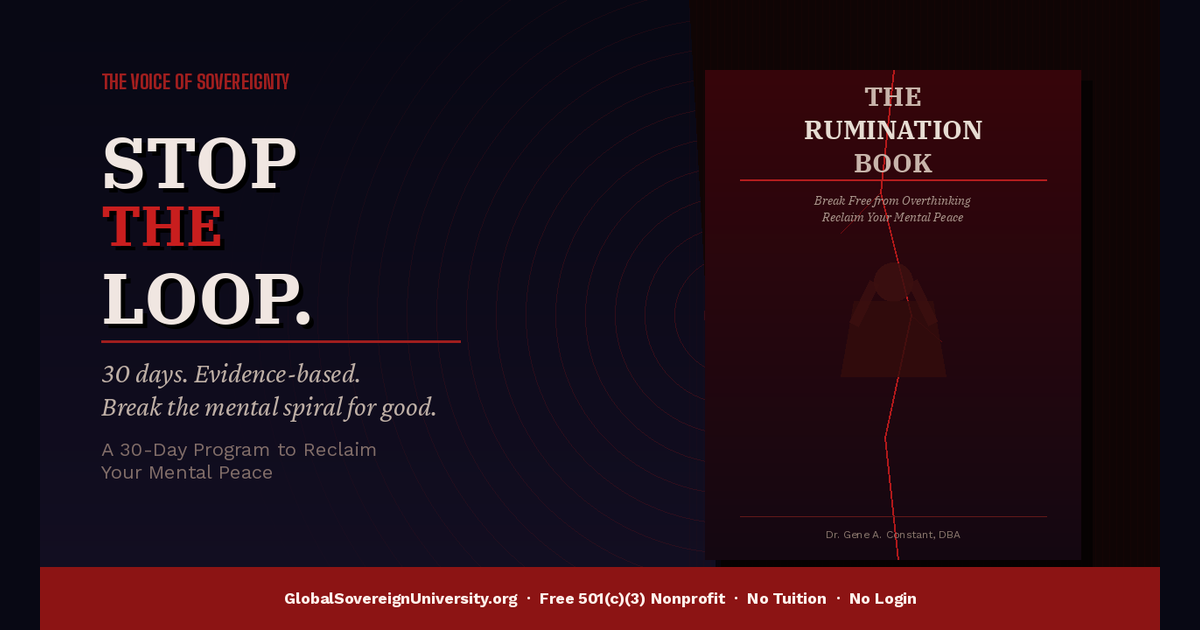
The Rumination Book by Dr. Gene A. Constant, DBA, is not a collection of motivational tips. It's a 30-day structured program built on four pillars of clinical research: Cognitive Behavioral Therapy, Acceptance and Commitment Therapy, Metacognitive Therapy, and neuroscience. Each day includes a real-world scenario, the science behind why your brain defaults to that pattern, specific techniques with step-by-step instructions, and reflection questions that deepen the learning.
The structure is deliberate. The first five days establish what rumination is and where it comes from — your brain's well-intentioned attempt to protect you. Days 6 through 13 address the thought patterns themselves through cognitive restructuring and self-compassion, which research consistently shows outperforms self-criticism as a loop-interruption tool. Days 14 through 17 make the argument — backed by data — that physical interventions, including sleep, exercise, and nutrition, are not peripheral to the problem. They're central to it.
The final ten days build what Dr. Constant calls rumination resilience: the capacity to recognize when the loop starts, interrupt it at the source, and recover faster when setbacks hit.
Why Most People Stay Stuck
The cruel irony of rumination is that the people most afflicted by it are often the most thoughtful, responsible, and high-functioning. They don't ruminate because they're weak. They ruminate because their brains are wired to take problems seriously — and nobody ever taught them where problem-solving ends and destructive looping begins. This book draws that line clearly. And then it gives you the tools to hold it.
No Therapist Required
Dr. Constant is explicit: The Rumination Book is not therapy. It does not replace a clinician. But it translates clinical techniques into language and structure that anyone can implement immediately — at home, at their own pace, without a waiting list or a co-pay. For the tens of millions of people who can't or won't access formal mental health services, this kind of accessible, rigorous self-directed program represents something genuinely rare: a research-backed path forward that doesn't require a prescription.
Get the Book
The Rumination Book is available now on Amazon in Kindle and paperback formats. ASIN: B0G3M98JZ2. You can also explore the interactive GSU BookGame version — with GENO, our AI tutor, guiding you through the concepts with voice, hints, and badge progression — at GlobalSovereignUniversity.org.
Global Sovereign University is a free, nonprofit educational platform. No tuition. No login. No barriers — just the education that builds real freedom.







.jpeg)
.jpg)