The Sound
Before the
Letter
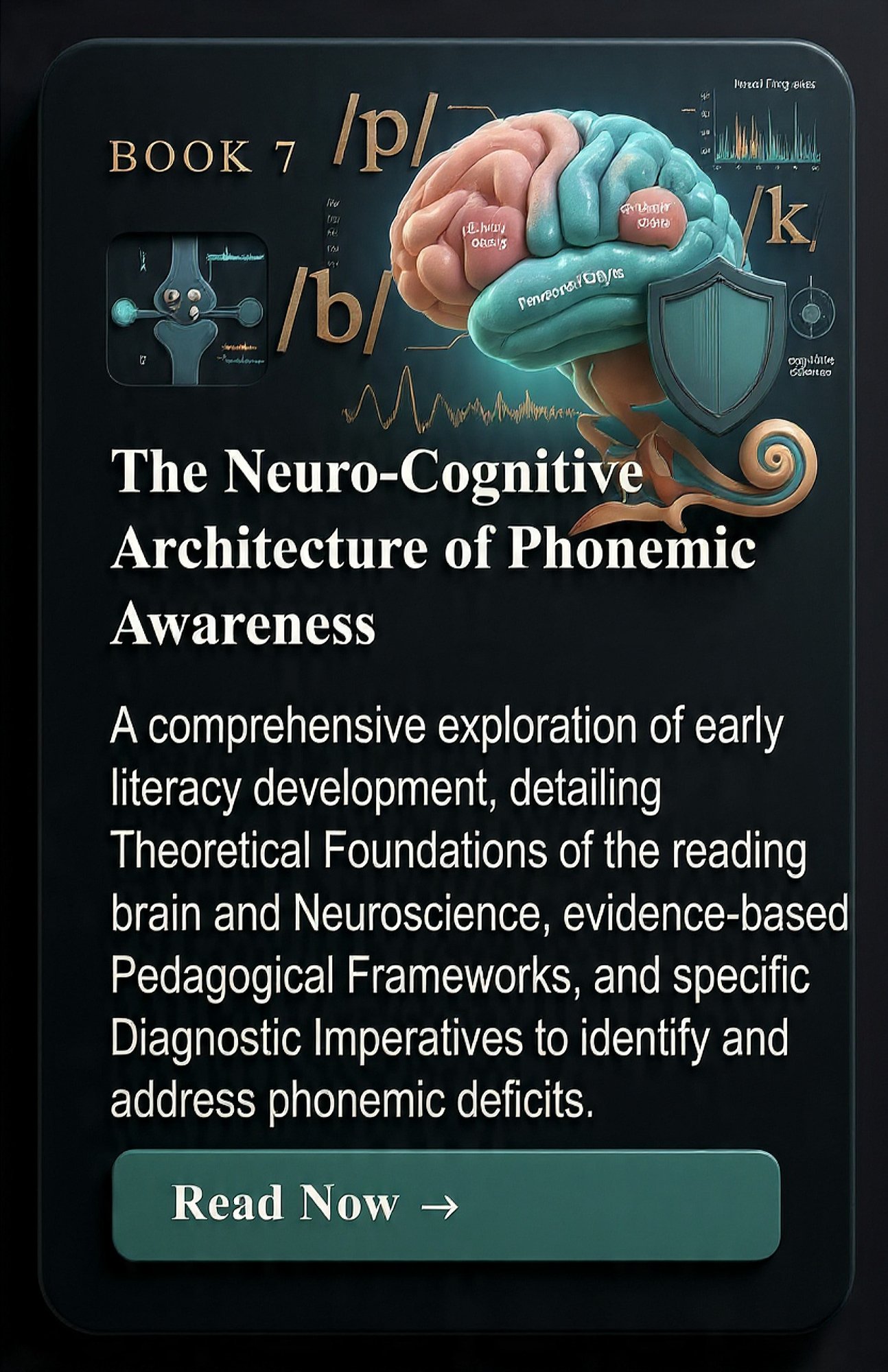
The auditory foundation that reading requires — and that 54 million American adults were never given.
Read The Full Research — Free


The Reading Failure That Was Never About Reading
For generations, children who could not read were told — directly or through the quiet language of labels and remediation groups — that something was wrong with them. Not bright enough. Not trying hard enough. Not a reader.
The research now says something categorically different. In the overwhelming majority of cases, reading failure is not an intelligence deficit. It is not a motivation deficit. It is not a character flaw. It is the entirely predictable result of asking a brain to perform a visual skill — decoding printed symbols — without first building the auditory skill that the visual learning depends on.
That auditory skill is called phonemic awareness — the ability to hear, identify, and consciously manipulate the individual sound units of spoken language. It is the foundation upon which the entire architecture of reading is constructed. And it is a skill that does not develop naturally. It must be explicitly taught.
The educational system did not intentionally skip this step. For most of the twentieth century, literacy researchers had not yet identified phonemic awareness as a prerequisite distinct from phonics instruction. The two were conflated or ignored in favor of competing ideological frameworks. The casualties of that scientific gap are the 54 million Americans who cannot read fluently today — not because their brains failed them, but because their instruction did.
The Four Levels the Brain Must Climb
Phonemic awareness does not exist in isolation. It sits at the top of a developmental hierarchy — a sequence of increasingly refined sound-awareness skills that the brain must progress through before it can reliably decode printed text. Understanding this hierarchy explains both why phonemic awareness is non-negotiable and why its absence is so damaging.
| Level | Skill | Example | Develops How |
|---|---|---|---|
| 1 — Word Awareness | Recognizing discrete words in a speech stream | "The dog ran" = 3 units | Naturally through language exposure |
| 2 — Syllable Awareness | Hearing the rhythmic beats within words | el-e-phant = 3 beats | Naturally through songs, rhymes, rhythm |
| 3 — Onset-Rime | Perceiving the structure inside a syllable | "flat" = /fl/ + /at/ | Partially natural — rhyming activities help |
| 4 — Phonemic Awareness | Isolating and manipulating individual phonemes | "stop" = /s/ /t/ /o/ /p/ | Requires explicit, systematic instruction |
The critical distinction: the first three levels develop through natural language exposure. Phonemic awareness does not.
The transition from phonological sensitivity to phonemic awareness is not a matter of degree — it is a fundamental shift in how the brain processes language. Phonemes in natural speech are co-articulated: blurred together into a continuous acoustic stream to allow rapid communication. The three sounds in "bat" are not three separate events in the acoustic signal. They are one blended event. Making those sounds consciously audible and separable is a learned cognitive skill. Without explicit instruction, most people — and virtually all struggling readers — never develop it.
The Skills That Predict Everything
Within the family of phonemic awareness abilities, research has identified two skills as the most predictive of reading and spelling success. They are blending and segmentation — and understanding what they are explains precisely what is missing in a struggling reader.
Why the System Skipped the Foundation
The Reading Wars — the decades-long conflict between whole-language and phonics advocates — consumed so much of the educational establishment's attention and energy that the foundational question was rarely asked: what does the brain need before phonics instruction can work?
Whole-language advocates believed that children learn to read naturally through immersion in meaningful text — that the drive toward meaning would, with enough rich reading environment, unlock the code. Phonics advocates insisted on explicit, systematic letter-sound instruction. Both camps were partly right. Both camps were missing the prerequisite.
The Science of Reading — the multidisciplinary body of research now driving literacy reform across the United States — has resolved the debate with evidence. Reading is not natural. It must be explicitly taught. And the explicit instruction must follow a specific sequence: phonemic awareness first, then phonics, then fluency, then vocabulary and comprehension. Skip the first step, and none of the subsequent steps build reliably.
Oregon has emerged as one of the national centers of literacy research. The University of Oregon's Center on Teaching and Learning — located in Eugene, GSU's home city — developed the DIBELS assessment battery, the most widely used and rigorously validated early literacy screening tool in the United States. Their research establishes that phonemic segmentation fluency — the ability to quickly and accurately break spoken words into their component sounds — is the best early predictor of reading difficulty, and that universal screening beginning in kindergarten is essential for catching and addressing deficits before they compound.
How a Missing Foundation Grows Into a Lifetime Deficit
Reading failure is not a static condition. It compounds. Researchers call it the Matthew Effect — from the biblical principle that to those who have, more shall be given; from those who do not, even what they have shall be taken away.
A child who cannot decode fluently by the end of first grade reads less than their peers. Reading less means encountering fewer words, which means slower vocabulary growth. Slower vocabulary growth means harder comprehension. Harder comprehension means reading is less rewarding and therefore avoided. Avoidance means less practice. Less practice means widening gaps. By fourth grade, when the curriculum shifts from learning to read to reading to learn, the child who never had a phonemic awareness foundation is falling behind in every subject that requires reading — which is every subject.
The adult version of this story is the 54 million Americans who read below a sixth-grade level today. Many of them were identified as struggling readers in elementary school, cycled through remediation programs that attempted to teach phonics to a brain that had never developed phonemic awareness, and ultimately graduated from the system carrying a verdict — "not a reader" — that the system had no right to deliver and that the science now definitively refutes.
Explicit. Systematic. Multisensory.
The Science of Reading has converged on three non-negotiable characteristics of effective phonemic awareness instruction. Every word in that three-word sequence carries weight.
Explicit means direct. The instructor names the skill, demonstrates it, practices it with the student, and assesses independent mastery. There is no waiting for phonemic awareness to emerge through immersion or incidental learning. The skill is named, targeted, practiced, and verified. Sessions should be brief — ten to fifteen minutes per day — and focused on one or two skills at a time to prevent cognitive overload.
Systematic means following a deliberate progression from simple to complex. Continuous sounds — /s/, /m/, /f/, /n/, sounds that can be stretched without distortion — come before stop sounds like /b/, /d/, and /k/. Two-phoneme words before three-phoneme words. Isolation and blending before segmentation before the advanced manipulation tasks of deletion and substitution. The sequence is not arbitrary. It maps to the developmental architecture of phonological processing in the brain.
Because phonemic awareness is fundamentally auditory, the temptation is to teach it through listening alone. The research consistently shows better outcomes when multiple sensory channels are engaged simultaneously. Physical objects — coins, blocks, pennies — moved one per phoneme make abstract sounds tangible and countable. Hand gestures for segmenting and blending give the body a role in the learning process. Speaking slowly while observing mouth position in a mirror develops articulatory awareness — the physical feel of each sound — which provides a powerful additional anchor for auditory processing.
None of these techniques require specialized materials or professional credentials. They require a voice, a patient listener, a handful of coins, and fifteen minutes per day. The research basis behind them is deep, replicated, and unambiguous. The barrier to implementation, for any committed family, is essentially zero.
The Foundation Can Still Be Built
Perhaps the most important practical finding in the phonemic awareness research is this: the brain retains sufficient plasticity for phonological skill development well into adulthood. The window did not close. The intervention is still available. The foundation can still be poured.
Adult phonemic awareness instruction looks different from child instruction — it is faster, more direct, more explicit about what is happening neurologically and why — but the underlying skill development is entirely achievable. Adults who have struggled with reading for decades, who have assumed the verdict against them was final, who have organized their lives around their reading limitation — those adults can build the phonemic awareness foundation they were never given, and can experience, often for the first time, what it feels like when words begin to unlock.
This is not inspirational language. It is the reported outcome of multiple research interventions with adult populations. The research is not as extensive as the child research — adult literacy has historically received far less scientific attention than early childhood literacy — but what exists consistently shows that explicit, systematic phonemic awareness instruction produces measurable gains in adult phonological processing, and that those gains transfer to improved reading fluency.
Why the Bridge Was Built This Way
At Global Sovereign University, every instructional tool is built around a foundational conviction: the bridge to a capable, self-reliant life runs through education — not handouts. The phonemic awareness research has informed how we build that bridge from the beginning.
GENO — GSU's AI education navigator — speaks. GENO listens. GENO operates in 32 languages. This is not a feature. It is a research-based design decision rooted in the understanding that the entry point to literacy is auditory, not visual, and that a learner who can interact with an AI voice guide in their native language — in Spanish, in Mandarin, in Hindi, in any of thirty-two languages — is receiving the kind of phonologically grounded, language-embedded instruction that the research identifies as optimal for phonemic awareness development.
The cross-linguistic transfer finding — the research showing that phonemic awareness developed in a student's native language transfers to English — means that GENO's multilingual architecture is not a convenience. It is an instructional advantage that conventional literacy programs, almost without exception, cannot provide.
The reading revolution does not begin with a letter. It begins with a sound. And the sound belongs to every learner — in every language — who was told the bridge was not for them.
The Sound Before the Letter Is Free.
The Bridge Is Open.
Global Sovereign University provides free phonemic awareness tools, free AI voice-guided literacy support through GENO in 32 languages, and free curriculum across every core subject. No login required. No cost. No verdict from your past that matters here.
CROSS THE BRIDGE →The Full GSU Deep Research Library
Seven peer-reviewed research reports — free, fully cited, written for anyone ready to understand why the world works the way it does.