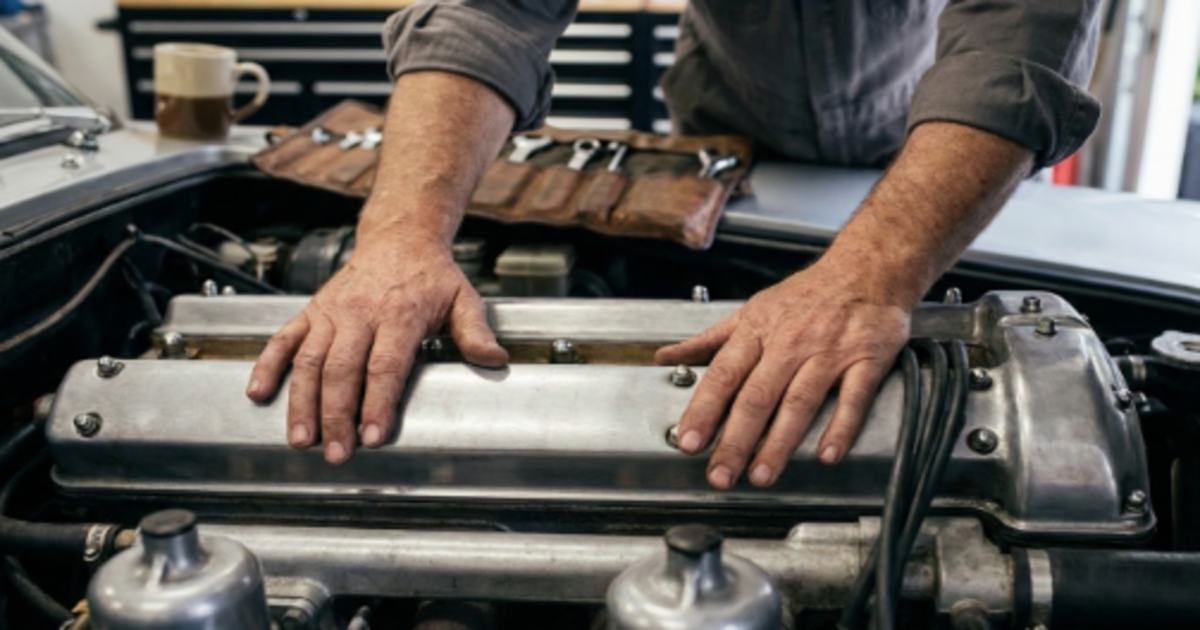
What Your Car Has Been Trying to Tell You — And Why Nobody Taught You the Language
There is a shimmy at highway speed that has been there for three months. There is a sound when you brake — not every time, just on cold mornings. There is a warning light you have learned to ignore because understanding it felt harder than covering it.
You are not a negligent car owner. You are an untranslated one. The car has been speaking. Nobody taught you the language.
Basic Automotive Knowledge exists to teach it.
The Cost of Not Knowing
The average American spends over nine thousand dollars annually on vehicle-related costs. Maintenance and repair account for a significant portion of that — and a disproportionate share of repair spending goes to problems that began as small, readable symptoms and were allowed to escalate because the owner didn't have the vocabulary to name what they were seeing.
A worn brake pad that squeals costs forty dollars in parts and an hour of time. The rotor it destroys if ignored costs three hundred dollars and a visit to a shop where the service writer assumes you don't know the difference. A tire with the wrong inflation wears unevenly for six months and fails at highway speed. A battery that shows load-test weakness drains without warning on a February morning when you're already late.
None of these failures are unpredictable. All of them announce themselves. The vehicle owner who has the vocabulary to hear those announcements catches them early. The one who doesn't pays to have them translated by someone with a financial incentive to find more than you brought in for.
"The repair shop depends on your not knowing. Basic automotive knowledge makes you a negotiator, not a mechanic."
The Four-Stroke Foundation
Everything that happens under the hood of a gasoline-powered vehicle traces back to one repeating cycle: intake, compression, combustion, exhaust. Four strokes. One revolution of controlled explosions per two rotations of the crankshaft, repeated thousands of times per minute, translated through the transmission into the motion that moves you down the road.
You do not need to rebuild an engine to benefit from understanding this cycle. You need to understand it well enough to know why oil matters, why spark plugs matter, why air filters matter, and why the relationship between fuel and air is the single most important variable in your vehicle's health and efficiency. When you understand the cycle, maintenance stops being a checklist of mysterious procedures and becomes a logical system of keeping an internal combustion process running cleanly.
That shift — from checklist to system — is what Basic Automotive Knowledge is designed to produce.
Reading the Warning Language
Your vehicle has been equipped, at manufacturer expense, with a diagnostic system designed to tell you when something is wrong. The check engine light, the ABS warning, the TPMS indicator, the battery light, the oil pressure warning — these are not suggestions. They are direct communications from sensors monitoring the systems most likely to produce expensive failures if ignored.
Most drivers treat warning lights as anxiety objects rather than information sources. They cover them, ignore them, or panic at them — because they were never taught what each light represents, what its trigger conditions are, or what the range of possible causes might be. Basic Automotive Knowledge maps that language systematically. Not to replace a diagnostic scanner, but to give the owner enough knowledge to distinguish between a loose gas cap and a failing catalytic converter before driving to a shop and accepting whatever they're told.
There is a three-question diagnostic framework embedded throughout the book — the same framework that anchors Foundations of Repair and the broader GSU Tradification curriculum:
What is it supposed to do?
What is it doing instead?
What changed recently?
Applied to a vehicle symptom, these questions move the owner from 'something is wrong' to 'the brakes are making a metallic grinding sound on the left front, which started after I drove through standing water last week.' That description is not a diagnosis. It is leverage. A mechanic who hears it knows you are paying attention — and charges accordingly.
The Fluids That Run the System
A vehicle has six primary fluid systems: engine oil, coolant, transmission fluid, brake fluid, power steering fluid, and windshield washer fluid. Five of them are load-bearing — their condition and level directly affect the longevity of expensive components. Basic Automotive Knowledge covers what each fluid does, how to read its condition, when it needs to be changed versus topped off, and what contamination looks like.
Engine oil is the one most people know about. But the viscosity specification matters, the change interval depends on driving conditions not just mileage, and dark color alone does not indicate that oil needs replacement. Coolant is the one most people ignore until the temperature gauge climbs. Brake fluid absorbs moisture over time and should be replaced on a schedule — not because it runs out, but because degraded brake fluid compresses under heat and produces brake fade at the moment you most need it to perform.
Understanding fluids is the entry point into proactive maintenance. It costs nothing to check them. The knowledge to interpret what you see costs nothing beyond the time to read this book.
Tires, Brakes, and the Physics of Stopping
Your vehicle's stopping distance is determined by three variables: the coefficient of friction between the tire and the road, the surface area of the brake pad in contact with the rotor, and the hydraulic pressure your foot generates at the brake pedal. Every one of these variables degrades predictably over time and use. Every one of them announces its degradation before it produces a failure.
Tire wear is visible. A penny or quarter inserted into the tread groove gives you remaining depth in seconds. Uneven wear — more on one shoulder than the other, feathering across the tread, cupping at intervals — tells you about alignment, inflation history, and suspension condition. The sidewall carries a code that tells you the tire's age, load rating, speed rating, and recommended inflation pressure. Basic Automotive Knowledge teaches you to read all of it.
Brake squeal is a built-in warning system — a wear indicator tab designed to contact the rotor when the pad reaches minimum thickness. Grinding means the pad is gone and metal is contacting metal. Pulsation under braking means a warped rotor. Each of these is a distinct communication. Each one has a time window between announcement and consequence. The owner who speaks the language acts in that window. The one who doesn't pays for the rotor.
The Negotiator Advantage
Basic automotive knowledge does not make you a mechanic. It makes you a negotiator — someone who enters a service relationship from a position of informed engagement rather than anxious dependency. The service writer who quotes you a rear main seal replacement when your symptom is a small valve cover oil seep is betting on your ignorance. The service writer who sees you pull up, describe your symptoms precisely, and ask to see the part — they write a different estimate.
The AAA Foundation for Traffic Safety has documented that drivers who can identify basic vehicle symptoms receive repair quotes significantly lower on average than those who cannot describe the problem. Informed customers generate smaller upsells. Knowledge is consumer protection that no regulation can deliver as efficiently as the knowledge itself.
Get the Book
Basic Automotive Knowledge is available on Amazon. It is part of the GSU Tradification curriculum — the body of work at Global Sovereign University dedicated to the practical skills that build personal independence, reduce dependency, and expand the sovereign range of every person who applies them to daily life.
All free GSU resources are at GlobalSovereignUniversity.org. No login. No tuition. No barriers.
Your car has been talking. Now you can talk back.
— Dr. Gene A. Constant, DBA
Founder, Global Sovereign University · Foundation for Global Instruction · 501(c)(3) · Eugene, Oregon







.jpeg)
.jpg)