When the Deep Research vault published DR-141 this morning — Poison Ivy League: The Empirical Case Against the Modern University — its FAQ contained one paragraph that named, in advance, exactly what was about to happen at Harvard:
"In May 2026, the Harvard Faculty of Arts and Sciences debated a controversial measure to cap solid A grades at 20 percent of enrolled students per course."
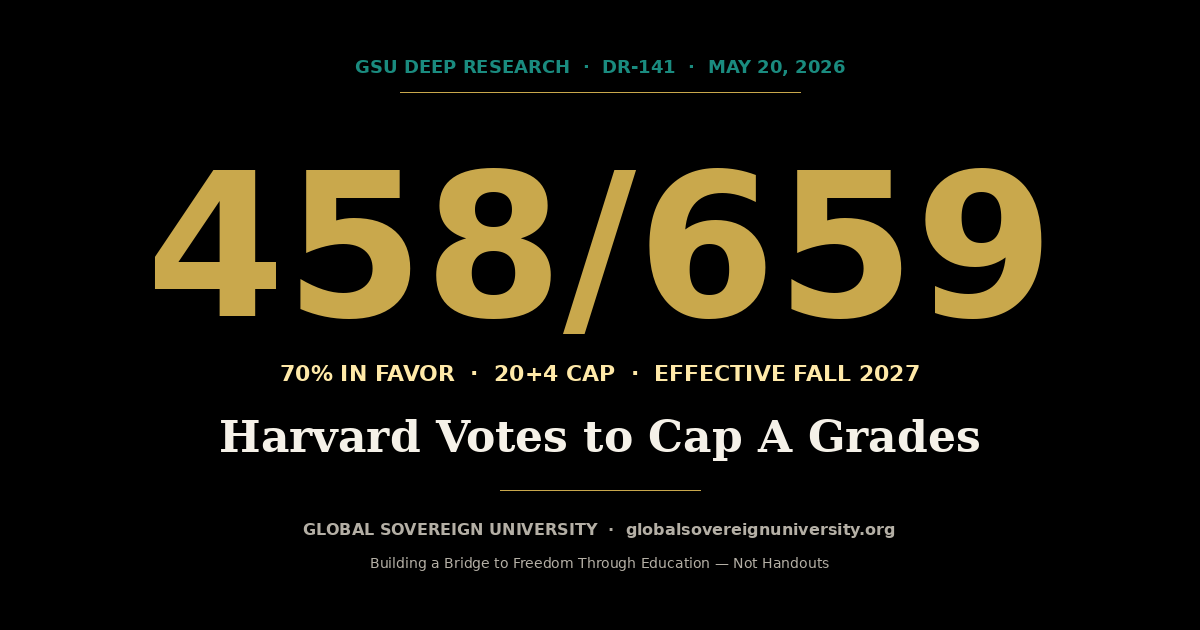
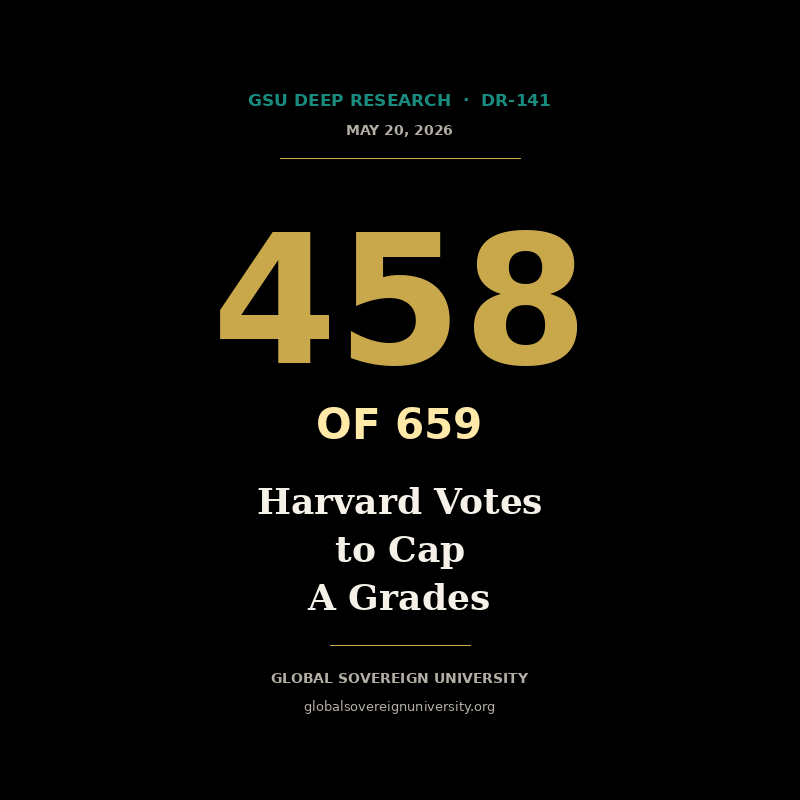
By the end of the same day, the FAS had voted 458 of 659 (about 70 percent) in favor. The "20+4" cap is now Harvard policy. No more than 20 percent of a course, plus four additional students, can receive an A. The change takes effect in the fall 2027 semester with a mandatory three-year trial review. Internal projections from the university's own October 2025 Re-Centering Academics at Harvard College report estimate the new policy will return the A-grade share at Harvard from approximately 60 percent back to roughly 34 percent — the level last seen in 2011.
This is not a coincidence. It is a confession.
The signaling collapse documented in DR-141, traced over forty years of grade inflation data from the Rojstaczer and Healy transcript archive, is not a niche academic concern. It is the central economic event in the credential market. When 60 percent of grades at the most prestigious institution in the United States are solid A's — and when more than 50 students in last year's graduating class held perfect 4.0 GPAs — the credential is no longer doing the work it was hired to do. Employers know this. Graduate schools know this. Now the institutions themselves know this, and the institutions have begun to vote.
The mechanism the DR-141 paper documents is straightforward. Universities receive federal loan dollars upfront. Universities carry no liability when graduates fail to repay. Universities are evaluated by retention metrics that punish rigor. Universities are evaluated by faculty review systems that reward lenient grading. The Bennett Hypothesis — first articulated in 1987 — explained how easy money inflates tuition. The student-as-consumer model explains how the academic standard followed the tuition fee. The Harvard vote today is the first major institutional admission that the entire chain has run far past the point of credibility.
The companion book, Poison Ivy League — The Rise of the Chronically Welfare-Dependent Universities, uploads to KDP next week. The book extends the empirical argument across 14 chapters and 75,000 words, ending — like the DR paper does — with the sovereign alternatives that already work. CIRR-audited coding bootcamps are placing 71 percent of graduates in field within 180 days. The Google Career Certificates program has crossed one million graduates. Ninety-six percent of employers in a 2025 Coursera/Lumina survey now report that microcredentials strengthen a job application. Cornell — Ivy League itself — has formally integrated those microcredentials into its undergraduate CALS curriculum because the four-year curriculum no longer reliably produces employable graduates on its own.
The reform Harvard voted on today is genuine. It is also small. It addresses one symptom of a system that is failing on at least five empirically distinct dimensions, and it takes effect more than a year from now. The deeper question — whether the credential itself still earns the price tag attached to it — is the question DR-141 and Poison Ivy League were written to confront.
Read DR-141 free: globalsovereignuniversity.org/deep-researchPre-order or check availability: Search "Poison Ivy League" by Dr. Gene A. Constant on Amazon (uploads week of May 24). Talk to GENO about the paper: Available 24/7 inside the article, in English, Spanish, Chinese, plus 29 other languages.





.jpeg)
.jpg)