Global Sovereign University · The Architecture of Inquiry
The Ontological OS
Change is a current. You can swim against it until you exhaust yourself, you can float and let it dictate your destination — or you can build a vessel. An ontological architect doesn't just design a curriculum; they design a state of being: a room where the answers must be discovered to unlock the door.
“Learning is not an app you occasionally open. It is an operating system you run.”
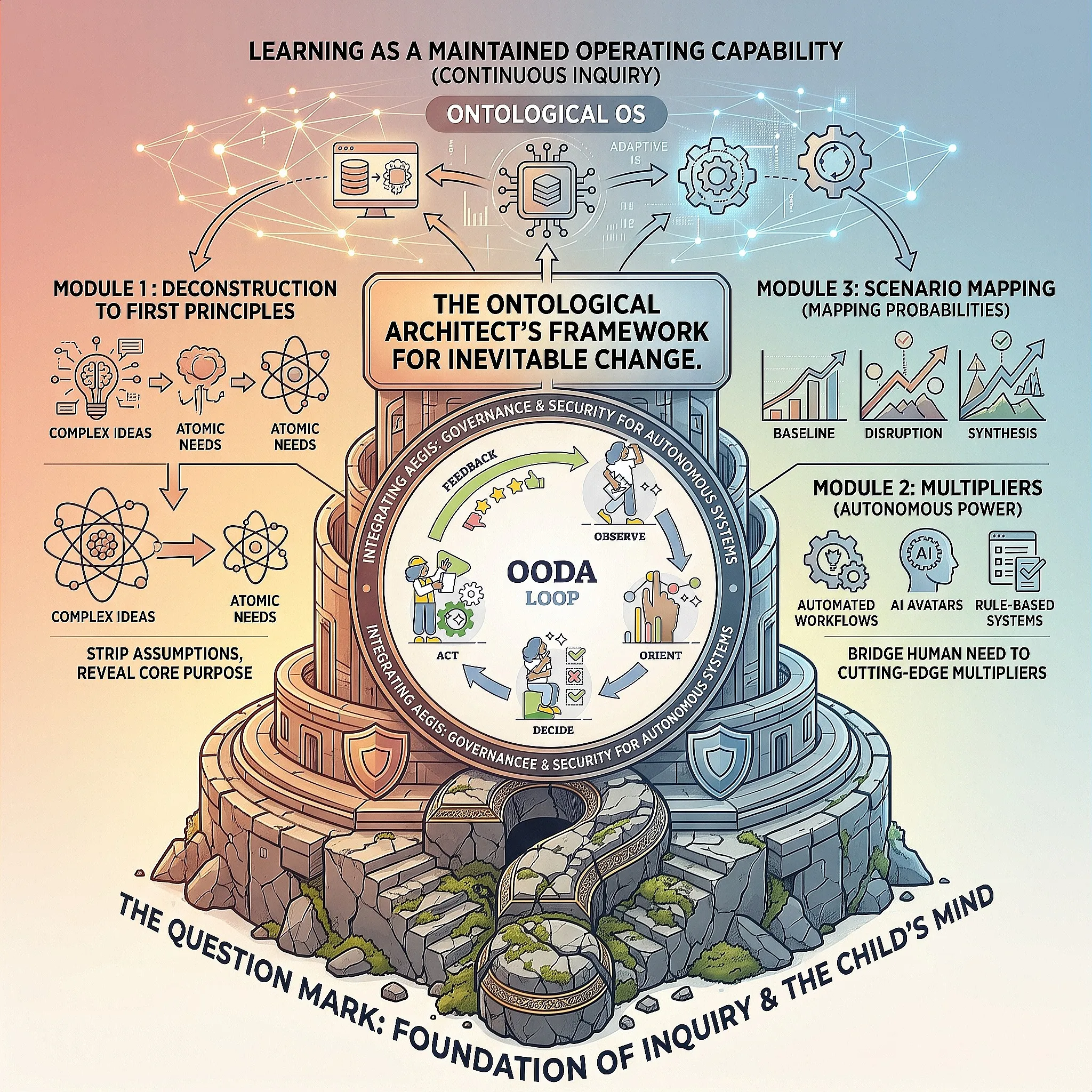
The Architect's Framework — Five Pillars
To take an old idea, innovate it, and create a predictable, high-probability path through a shifting landscape, run all five — most organizations grasp one or two and stall.
01The Question Mark — The Catalyst
Approach the old idea with the pure, unburdened curiosity of a child. Ask “why” until the core human need is exposed. The child's mind is the ultimate first-principle engine — it bypasses the legacy assumptions that bottleneck everyone else.
02Deconstruction — The Blueprint
Strip away decades of accumulated assumptions and separate the core need from the outdated mechanics used to deliver it. A university does not require classrooms, rigid schedules, or tuition. It requires learning.
03The Multipliers — The Tools
Predictability doesn't come from a crystal ball; it comes from spotting the tools that democratize power — automation, AI voice, rule-based software, gamified models — and applying them to your first principle.
04AEGIS — The Guardrails
Autonomy without governance is drift. Like the naval Aegis system, wrap every autonomous tool in strict, rule-based parameters — so your innovation runs at the speed of the future without losing control of the helm.
05Continuous Learning — The Operating Capability
Rapid feedback loops — the OODA cycle: Observe, Orient, Decide, Act — not as periodic check-ins but as a permanent state of being. Most legacy systems fail because their Orient phase is rigid: they see the change, then evaluate it with outdated assumptions.
Engineered Friction — The OODA Trainer
A static environment hands you a manual and tells you to memorize it. This one hands you a problem with a clock running. Each scenario is a live emotional or structural equation drawn from Emotional Algebra — read it, orient, and adjust the one variable that restores homeostasis before the loop times out. Speed of orientation is the skill.
Ontological OS: OODA Trainer
Engineered Friction & Autonomous Response
System Ready
Press Initialization to begin the Calculus of the Soul simulation.
The formulas in this trainer — Resentment, Anticipatory Anxiety, Jealousy — come from the Emotional Answer Key of the Emotional Algebra series (The Architecture of Inquiry). The fourth scenario is pure first-principles routing, straight from the trade floor.
Where This Connects
The Ontological OS is the operating layer beneath everything GSU builds — the question mark that opens the door, the loop that keeps it open.
Coming to the shelf: The Biggest Word — the series built around the one symbol that opens every door (yes, the question mark is a word) — and further volumes of The Architecture of Inquiry, where these equations get their full treatment.