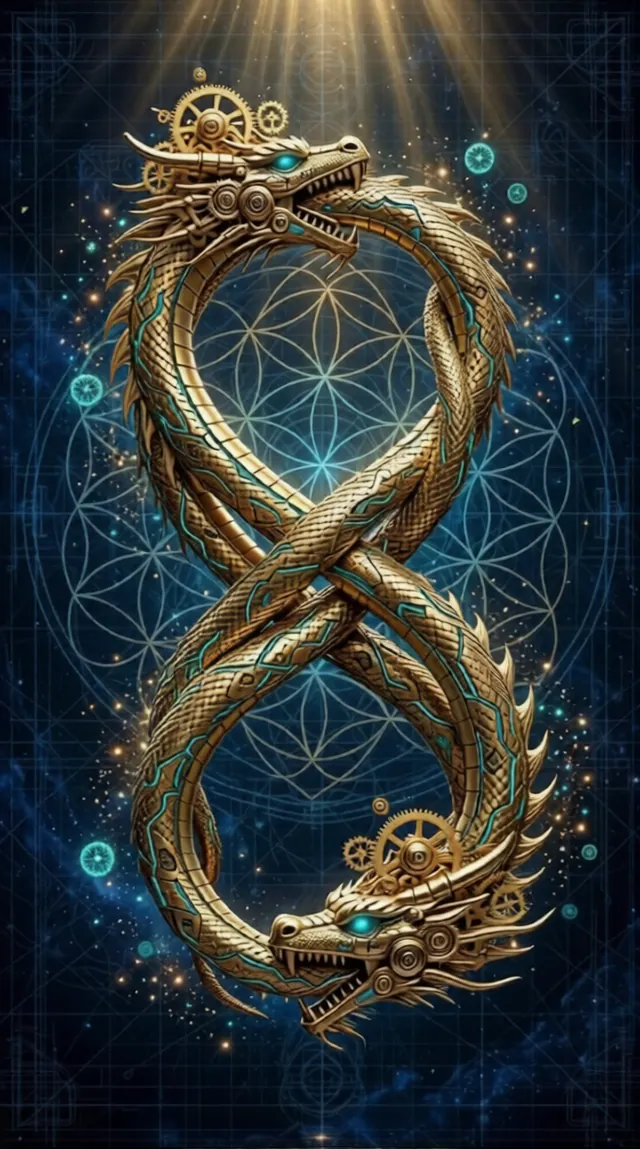
Ouroboros
OO-ruh-BOR-uhs · from the Greek oura, tail, and boros, eating
He has closed the last page of every book this university has ever published. Most readers took him for decoration. He was never decoration. He is a diagram, the oldest one humanity has, of the single idea this campus is built on.
A serpent that eats its own tail
He is carved in the tomb of Tutankhamun, in the Enigmatic Book of the Netherworld, roughly fourteen centuries before Christ. He appears in Greek alchemical manuscripts beneath the words hen to pan: the all is one. He circles the world in Norse myth as Jörmungandr, tail in his mouth, and when he lets go the world ends.
Peoples who never met, across continents and centuries, drew the same closed circle and meant the same thing by it: what goes out must come back, or it is lost.
The five stages of the loop
Everything humans make travels the same road. Ouroboros is the map of it. Tap a stage to follow one copper pipe around the circle, then break the loop and see what stops.
Why he belongs to the trades
The tradesperson is the keeper of the loop.
The world argues about stages one, two, three and five. Mines, refineries, factories, recycling plants: they make headlines and policy and money.
Almost nobody argues about stage four, and stage four is where a civilisation is actually held together. A plumber closes the water loop. An HVAC technician closes the heat loop. A mason repoints a wall so it stands another eighty winters. A flooring installer reads a squeak and repairs a subfloor instead of tearing out a house.
Every year a skilled hand adds to the life of a thing is a year of extraction that never has to happen. That is the strongest argument for the trades that exists, and hardly anyone makes it.
He asks who is going to keep the things you already have.
The Ouroboros Trades Series
As of today the trades catalogue carries his name. Ceilings, plumbing, framing, flooring, stone, trades geometry, HVAC and everything that follows: every one of them teaches a person how to keep something alive that would otherwise be thrown away.
A growing number of the series can be read free in your browser on this campus, with the page read aloud by your own device, a free tutor in GENO, and a free exam that ends in a serial-numbered Certificate of Comprehension anyone can check. Book sales are the only revenue this Foundation receives. There is no tuition, no login, and nothing to upsell you.
The Seventh Room
Six rooms teach you. The seventh asks what you found.
Ouroboros is a closed circle, which means learning cannot only travel one way. The Field Room is where the loop closes on this campus: you take a skill out of a book, use it on something real, and bring back what you found. The university hides rabbits. The learner brings back eggs.
On the name. Within these walls he has long been called the Infinity Snake, and he still answers to it. But the mark is three thousand years older than this university, and it already had a name when the pharaohs were using it. In print, in the books, and here, he is Ouroboros.
Global Sovereign University: Different by Design. Better by Mission.