
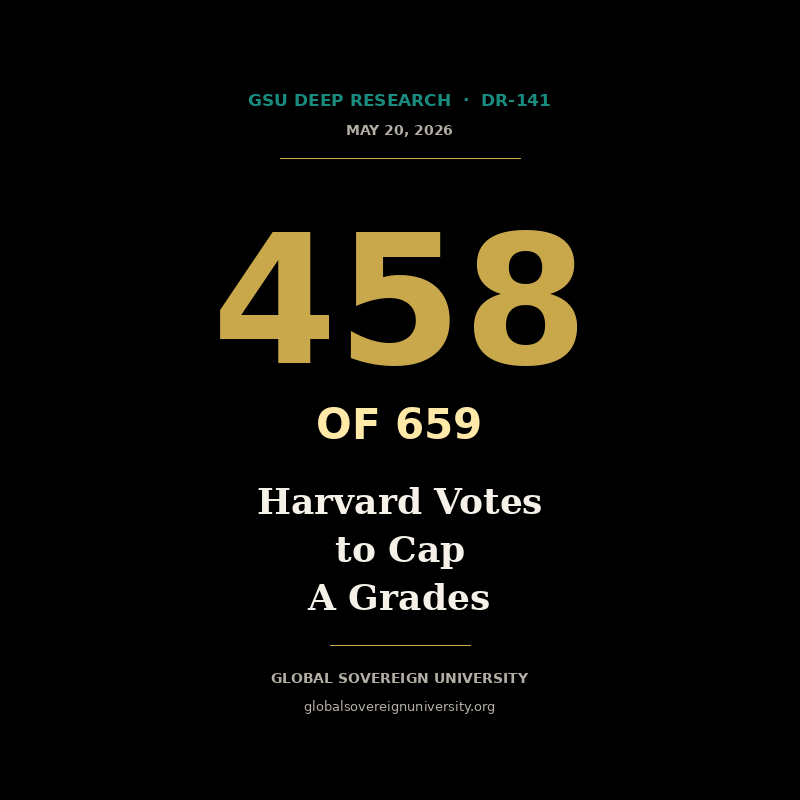
The signaling collapse Harvard’s faculty formally acknowledged on Tuesday — when 458 of 659 voted to cap A grades at 20 percent of a class plus four — is not an Ivy League problem. It is a state flagship problem. And the state flagships, by the data that just landed, may be the worst offenders.
The University of Texas at Austin is the flagship public university of the second-largest state in the Union: more than 52,000 students, R1 research designation, competitive admissions, a faculty roster studded with national academy memberships. By every standard measure, a serious institution.
The Austin American-Statesman analyzed UT Austin’s grade distributions for fall 2025 and found that two-thirds of all grades recorded that semester were A’s, and 87 percent of all grades awarded were a B-minus or better. A decade earlier, in the 2015–16 academic year, the comparable figures were just under 50 percent A’s and about 80 percent B-minus or better. The A-share at UT Austin has grown by roughly eighteen percentage points in ten years — a steeper acceleration than the curve at Harvard, where the same trajectory played out across two decades rather than one.
The university has acknowledged the trend. UT spokesperson Mike Rosen told the Statesman that the school’s own internal figures, which include small courses and late grade entries the Statesman analysis did not capture, show a combined A-plus-B share of 82.4 percent for the 2025–26 academic year. The university, Rosen said, is aware of the grade distribution data and is “assessing it.” “Like other leading universities,” he added, “we will address the matter as we continue with our assessment and gain a fuller understanding.”
The pattern is national. EdTech research firm Scholaro, drawing on data published by the National Center for Education Statistics, reports that A’s now account for between 43 and 50 percent of all undergraduate grades awarded across U.S. four-year institutions. An A has been the most common letter grade in American higher education for at least the past ten years.
The institutional response has finally begun to arrive. The 2026 Report of the Yale Committee on Trust in Higher Education, released in April, drew the issue into national media coverage and called explicitly for action. Harvard’s Faculty of Arts and Sciences vote on Tuesday — the “20+4” cap, effective fall 2027, with a mandatory three-year review — is the first major formal institutional acknowledgment. Internal Harvard projections estimate the cap will return the school’s A-grade share from approximately 60 percent back to roughly 34 percent, the level last seen in 2011. Yale issued a more aggressive recommendation in April, targeting a mean GPA of 3.0.
Now apply the math. If UT Austin — a flagship that admits more than half of its applicants — is awarding A’s at a higher rate than the institution that admits four percent of them, the credential has stopped doing the work it was hired to do. It is no longer functioning as a signal. The state flagships have not yet voted to fix it. Harvard has.
This is the structural problem the GSU Deep Research article DR-141 documents in full, and the structural problem the forthcoming book Poison Ivy League — The Rise of the Chronically Welfare-Dependent Universities names across 75,000 words and fourteen chapters. The book uploads to KDP next week.
Read DR-141 free: globalsovereignuniversity.org/deep-research
Pre-order or check availability: Search “Poison Ivy League” by Dr. Gene A. Constant on Amazon (uploads week of May 24).
Talk to GENO about the data: Available 24/7 inside the DR-141 article, in English, Spanish, Chinese, and 29 other languages.






.jpeg)
.jpg)