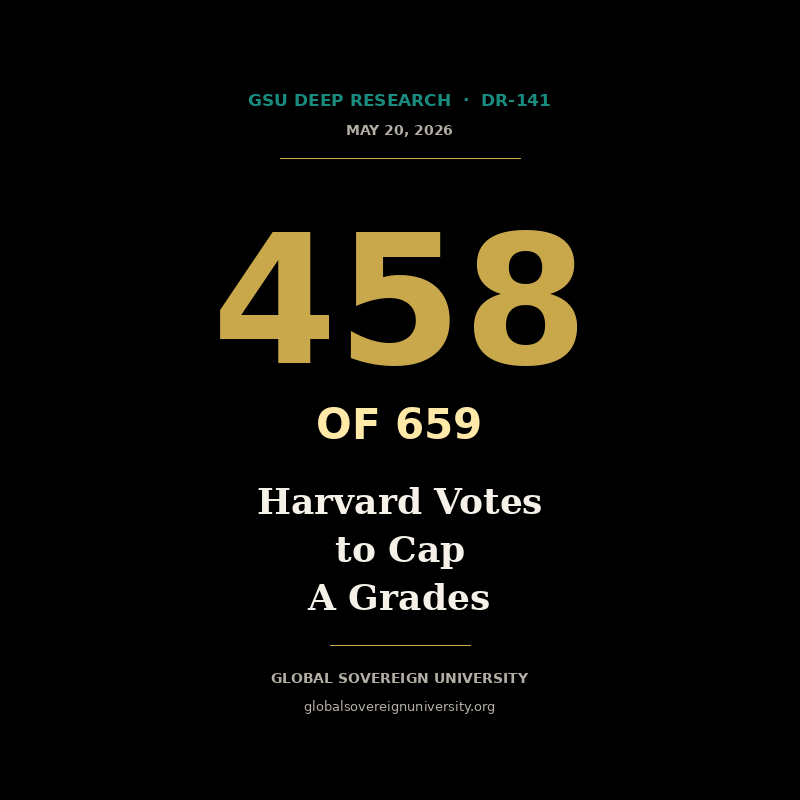
Tuesday: Harvard’s Faculty of Arts and Sciences voted 458 of 659 to cap A grades at 20 percent of a class plus four students, effective fall 2027. Wednesday: the Austin American-Statesman analysis showed UT Austin in fall 2025 awarding A’s at two-thirds of all grades — a higher rate than Harvard at its 2021 peak. Two days, two stories, one diagnosis. Today the question changes. Not how broken is the signal? but what does it cost?
The single best data set on the question is the 2024 Burning Glass Institute and Strada Institute for the Future of Work joint study Talent Disrupted. The number to know:
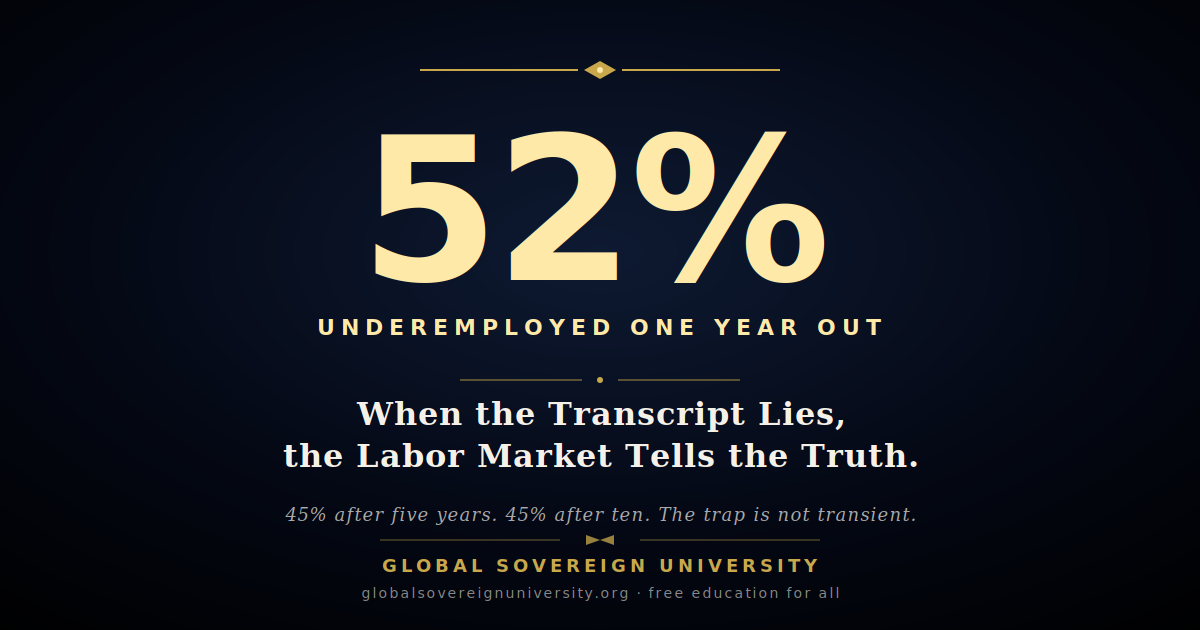
52 percent of bachelor’s degree graduates are underemployed one year after graduation. Working in a job that does not require the degree. Five years later, the rate improves only marginally to 45 percent. Ten years later, the rate is still 45 percent. The early underemployment trap is not transient. It does not resolve over time. For nearly half of all four-year degree holders, the underemployment outcome is the durable outcome the credential delivered.
The lifetime cost is documented. Underemployed graduates earn approximately 33 percent less across their working lives than peers who land in college-level work. Across a forty-year career, that gap exceeds $700,000 — well above the cost of the degree itself, several times over.
The mechanism connecting grade inflation to underemployment is credential inflation. When two-thirds or three-quarters of all grades cluster at the top of the scale and the bachelor’s transcript no longer transmits information that can rank candidates, employers do not stop ranking. They use other signals: institutional brand, internship pedigree, network-driven referrals, high-stakes interview filtering that screens out most of the candidate pool before the actual job decision is made. A 2024 Burning Glass study of 50 million job postings found that 43 percent of postings requiring a bachelor’s degree could be effectively performed by workers with alternative credentials or relevant experience. The labor market is sending a clear price signal: the degree is overstated. Harvard’s institutional reform is correct in direction — and it is not where the action is for graduates already in the workforce right now.
The alternatives are not waiting for the fall 2027 implementation date. They are already running.
CIRR-audited coding bootcamps placing 71 percent of graduates in-field within 180 days, with top programs reaching 90 percent and median first-job salaries of approximately $70,698 — a 51 percent lift over pre-bootcamp income. Google Career Certificates with more than one million graduates and 70 percent of U.S. graduates reporting positive career outcomes within six months. Microcredentials accepted by 96 percent of surveyed employers as positive signals on a job application, with 90 percent willing to pay 10 to 15 percent higher starting salaries for candidates holding relevant ones. Cornell — Ivy League itself — has formally integrated corporate microcredentials into its undergraduate CALS curriculum because the four-year sequence no longer reliably produces employable graduates on its own.
GSU sits inside that alternative ecosystem as the free, no-login, no-ads option. Sovereign Trades for the skilled trades. Financification for financial literacy. Civification for civics. Robot-Proof and the Sovereign Intelligence Series for AI-adjacent careers. Voice of Sovereignty for the audio version. GENO for 24/7 AI tutoring in thirty-two languages. Funded by Foundation donations and 175+ donated titles. Accepting no state money. Charging no tuition.
The next question for any graduate carrying student debt and underemployed five years after the degree is not did the credential work? It is what capability can I build right now that the labor market will actually pay for? The forthcoming book Poison Ivy League — The Rise of the Chronically Welfare-Dependent Universities describes the structural problem in fourteen chapters and 75,000 words. It uploads to KDP this Saturday. GSU was built to answer the question that follows.
Read DR-141 free: globalsovereignuniversity.org/deep-research
Pre-order or check availability: Search “Poison Ivy League” by Dr. Gene A. Constant on Amazon (uploads Saturday, May 24).
Start building capability today: globalsovereignuniversity.org — no account required, free forever.





.jpeg)
.jpg)