Lesson 15 · from Chapter 18
AEGIS: Security for Autonomous Systems
Conventional security protects systems from unauthorised access. An agent does not merely store or display information — it interprets, decides which tools to use, and acts. Which makes the central challenge a different one: preventing unauthorised influence.
Step one
Five ideas
Read each one. Mark it read, or have it read to you. The test at the bottom draws from these five and nowhere else.
Idea one
Capability is never permission
Protecting systems from unauthorised access, data loss and infrastructure disruption remains essential. Agentic systems expand the problem because they do not merely store, transmit or display information — they interpret it, decide which tools to use, invoke those tools, coordinate with other agents, and sometimes take actions affecting customers, employees, records, finances and infrastructure.
An agent with access to a customer platform is not simply another application account. It is a non-human operator capable of acting at machine speed within a semantic environment that can be manipulated.
That is what AEGIS is for — Agentic AI Enterprise Guardrails for Information Security. Not a product, not a compliance checklist, not an after-the-fact monitoring layer, but the security architecture through which an organisation ensures that autonomous capability remains bounded by legitimate identity, purpose, authority, evidence and accountability.
Its central premise is plain: no agent should possess more access, more autonomy, or more opportunity to act than is necessary for its defined purpose at a particular moment.
That is least privilege, extended. For an employee it may mean access only to the folders their role requires. For an agent the questions are more demanding. What may it retrieve? Which tools may it invoke? What actions may it initiate? What instructions may alter its behaviour? What authority may it delegate? How long do its credentials stay valid? Under what conditions must its authority be narrowed, suspended or revoked?
The answer cannot be "whatever access makes the workflow convenient" — and convenience is one of the most persistent sources of agentic risk. A team under pressure grants a new agent access to a shared mailbox, a contract repository, a case platform and an adjustment tool. Each permission may appear individually reasonable. Together, they may create an agent capable of reading sensitive correspondence, interpreting contractual language, communicating with customers and executing financial actions with insufficient separation of duties.
And it may work beautifully. The agent may perform well in ordinary cases. That does not make the architecture sound. It merely means that the latent risk has not yet been exposed.
Idea two
Every agent has a name
The first principle is identity: every agent must have a unique, auditable, non-human identity.
An agent should never operate through a generic shared service account that obscures which workflow acted, which version of the agent was active, what permissions it held, and which person or team accepted accountability for its use. Shared credentials may seem efficient, but they eliminate the traceability required for both security and recovery.
Each agent needs a registered identity linked to a defined owner, a stated purpose, an approved environment, a versioned configuration and a bounded set of permissions. The identity should reveal not only that "an AI system" acted, but that a particular intake agent, contract agent, validator agent or execution agent acted within a specific workflow instance at a known time.
This is what makes backward tracing possible. When an abnormality surfaces, you have to be able to determine which agent touched the affected source, which tools it invoked, which downstream components consumed its output, and whether anything happened beyond its intended scope.
Without this evidence, containment becomes guesswork. With it, you can isolate the relevant identity, suspend its credentials, review its activity and assess its blast radius without shutting down every autonomous process in the enterprise.
Idea three
Evidence to evaluate, not authority to obey
The second principle is purpose limitation. An agent is authorised for a clearly stated operational purpose, not simply given general access to an environment. A contract agent may retrieve approved customer agreements and identify provisions relevant to a case. It should not be free to browse unrelated negotiation archives, search executive correspondence, alter records or initiate customer communications.
Purpose limitation makes authority intelligible. It lets you ask whether an action belongs to the agent's legitimate role rather than merely whether the action was technically possible.
Which matters enormously when an agent meets persuasive language. A document, a webpage, an attachment or a customer message may contain text framed as instruction — and a generative model may treat it as relevant content unless the system establishes clear boundaries between data and authority. This is prompt injection: not merely a model-quality problem, but an attempt to influence an agent through the content it processes. A document that should have been treated as evidence becomes an instruction source.
So the central security challenge is not only preventing unauthorised access. It is preventing unauthorised influence. An agent may be authorised to read a customer's message in order to classify it. That does not mean the customer's message is authorised to instruct the agent. The distinction seems obvious stated plainly, and it is hard in practice precisely because generative systems are designed to interpret natural language as meaningful context.
AEGIS answers with explicit separation of instruction, data and authority. Untrusted content may inform analysis; it must never redefine the rules under which analysis occurs. Deterministic policy controls must remain outside the agent's probabilistic reasoning space. The agent should be able to recognise, in effect: this document is evidence to evaluate, not authority to obey.
And that recognition cannot rest on the model's good judgement. This is where policy-as-code becomes a security control rather than a workflow convenience — requiring verified case identifiers, customer identity, authorisation state, thresholds and source freshness before an action; blocking transmission to unapproved destinations; requiring a human authorisation token before anything becomes irreversible. The model may reason within the permitted workflow. It may not rewrite the workflow's governing rules. Where a request falls outside the defined boundary, the right response is not creative interpretation. It is refusal, containment or escalation.
Idea four
Segmented authority, verified continuously
The third principle is segmented authority. No single agent should be able to retrieve sensitive evidence, determine its own interpretation, validate that interpretation, communicate externally and execute consequential action without meaningful independent controls. That recreates the aligned-failure pattern with security consequences added to epistemic risk.
Role separation reduces it. Intake classifies. The contract agent retrieves from a controlled source. The generator prepares a recommendation. The validator tests source grounding, policy compliance and authority conditions. The communication agent prepares an approved message. The execution agent acts only once deterministic controls and, where required, human authorisation are satisfied. This is not bureaucracy for its own sake. It creates defensible handoffs — each one an opportunity to inspect whether the previous step stayed within its authorised purpose.
Segmentation applies to infrastructure too. Agents operate within trust zones limiting the systems, data classifications and tools available to them. A low-risk internal summarising agent does not need production financial systems. A customer communication agent does not need engineering repositories. An experimental agent should not inherit the permissions of a production workflow simply because both use the same foundation model.
The fourth principle is continuous verification. Traditional access control assumes that once a user authenticates, their activity can be trusted until the session ends. AEGIS takes a Zero Trust posture: every significant request, tool call, delegation and authority transition is evaluated in context — identity, data sensitivity, requested action, destination, workflow state, instruction source, case risk, timing, and any behavioural anomaly.
An execution agent that normally issues a few approved adjustments may need re-verification if it suddenly attempts hundreds, reaches for a new data domain, or invokes a tool it has never used. A contract agent retrieving outside its assigned region may be drifting, misconfigured or compromised. A communication agent attempting to send to an unfamiliar external destination should be blocked before transmission, not merely flagged afterward.
Continuous verification transforms security from a perimeter into an operating discipline.
Idea five
Observability with accountability
The final principle: every consequential agentic action must leave an intelligible trace — the agent identity, model and prompt version, source set, retrieved evidence, policy checks, tool calls, approval state, action outcome and any human intervention.
And these records should not become an unreadable archive of technical events. They exist to support practical questions. What did the agent know? Why was it permitted to act? What rule allowed or blocked the action? Who intervened? Which other systems were affected? Can the decision be reconstructed and challenged?
Which reframes what the security is even for. In CCM this is security in service of epistemic integrity and legitimate authority. The organisation is not protecting information merely because information has value. It is protecting the conditions under which the enterprise can know what happened, contain what went wrong, and defend the actions taken in its name.
So AEGIS does not stand apart from Cognitive Capability Maintenance. It secures the boundaries that let cognitive housekeeping, agentic Kaizen, algorithmic upkeep, epistemic Poka-Yoke, human-AI teaming and dynamic asset governance operate without becoming pathways for uncontrolled autonomy.
Its architecture makes a disciplined promise, and it is the sentence to carry out of this lesson. Agents may be capable, but capability alone will never be treated as permission.
Step two
The permission bundle
Nobody grants an agent a dangerous capability. They grant four reasonable ones. This bench takes each permission you would defend on its own and reports what the combination can do — and whether it all sits inside a single identity.
Try this. Set everything to its most permissive and read the verdict. Then move only the identity slider — don't touch a single permission. Same access, same tools, same untrusted content, and the chain no longer sits in one place. That is what segmented authority buys.
Then take the untrusted share to zero and read the working. The compound capability is still reported, because that number is the least durable of the four. One vendor document, one forwarded attachment, one webpage retrieved during research, and it is no longer zero.
Step three
Show that it holds
Ten situations, two per idea, drawn at random. Two right in a row on an idea marks it solid. A wrong answer tells you why that particular choice fails, and sends you back to the one idea it was testing.
All five hold.
You can state the premise, insist on identity, separate evidence from authority, segment and verify continuously, and say what the trace is actually for. One lesson remains — future-proofing, and the paradox the book is named for.
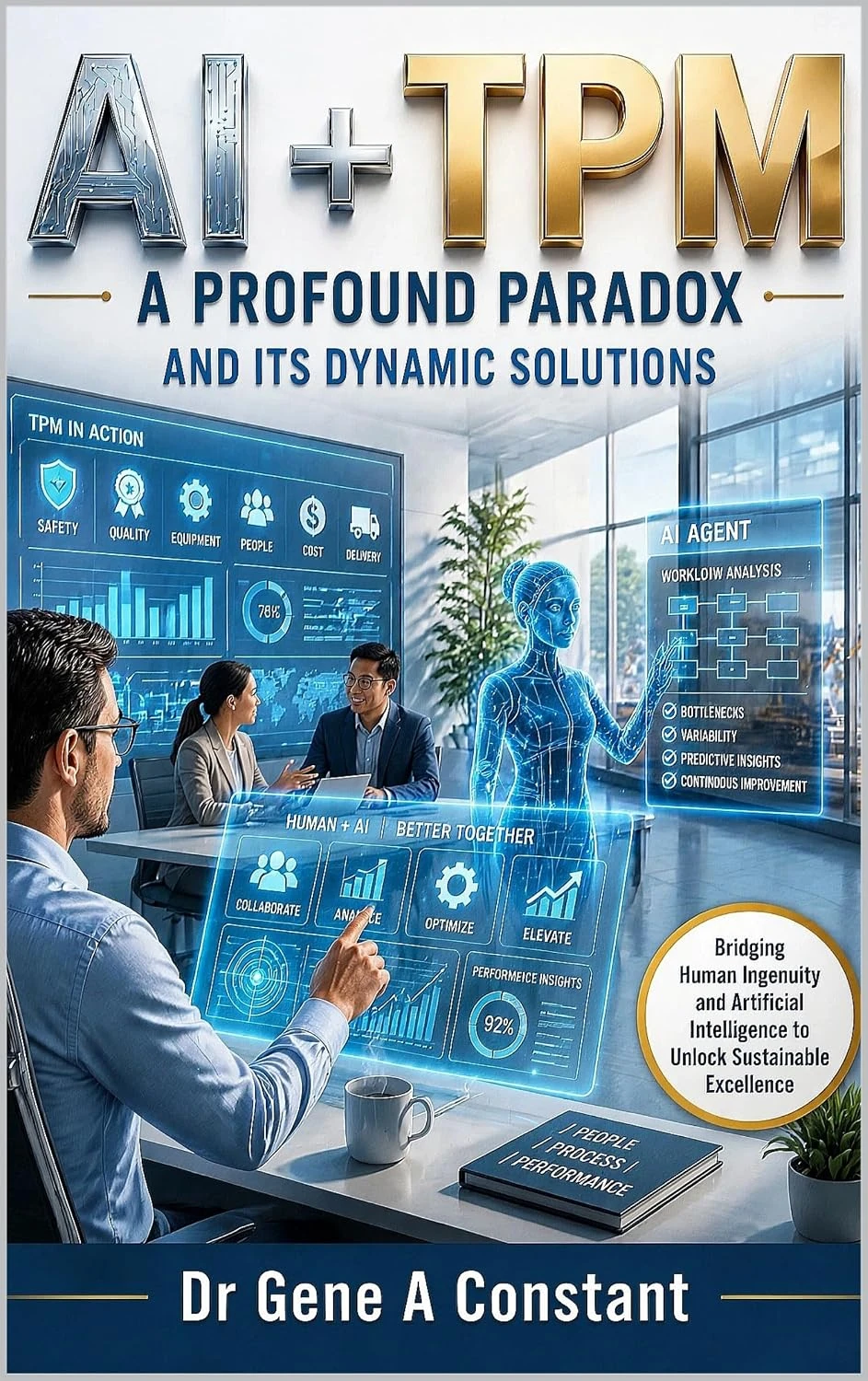
AI + TPM: A Profound Paradox and Its Dynamic Solutions
This lesson teaches chapter 18. The book runs to twenty chapters and sets out Cognitive Capability Maintenance in full — the framework this class is built on. Written and donated to the Foundation by GSU's founder, Dr. Gene A Constant.
Read on Kindle The whole class
The class is free and always will be. As an Amazon Associate, Global Sovereign University earns from qualifying purchases; every cent funds tuition-free education.
Global Sovereign University: Different by Design. Better by Mission.