
Business & Operations
← GSUIn development · Global Sovereign University
Most business education teaches you to describe an organization. This one is being built to teach you to run one — to read a balance sheet and know what to do on Monday, to find the bottleneck rather than blame the department, and to tell the difference between a process that is slow and a process that is broken.
The first book is out, and its class is open.
GSU classes are taught from books, and every other subject on this site was built on titles our founder had already written. These he is writing now, from scratch, one at a time — and rather than put up a page full of doors that do not open, we are publishing each book as it lands and building its class after. Book one landed, and its class opened with it.
Dr. Gene A Constant holds a Doctor of Business Administration, an MBA with a finance major, a BSBA and an ASBA, and business is the field he has spent the longest inside. Book one of ten is below. The other nine are outlined and in progress. A second business title, Surprise Is Constant, is also out, sits just below it, and now has a class of its own.
What follows is the plan, published early and on purpose, so you can see the path we are taking and hold us to it.
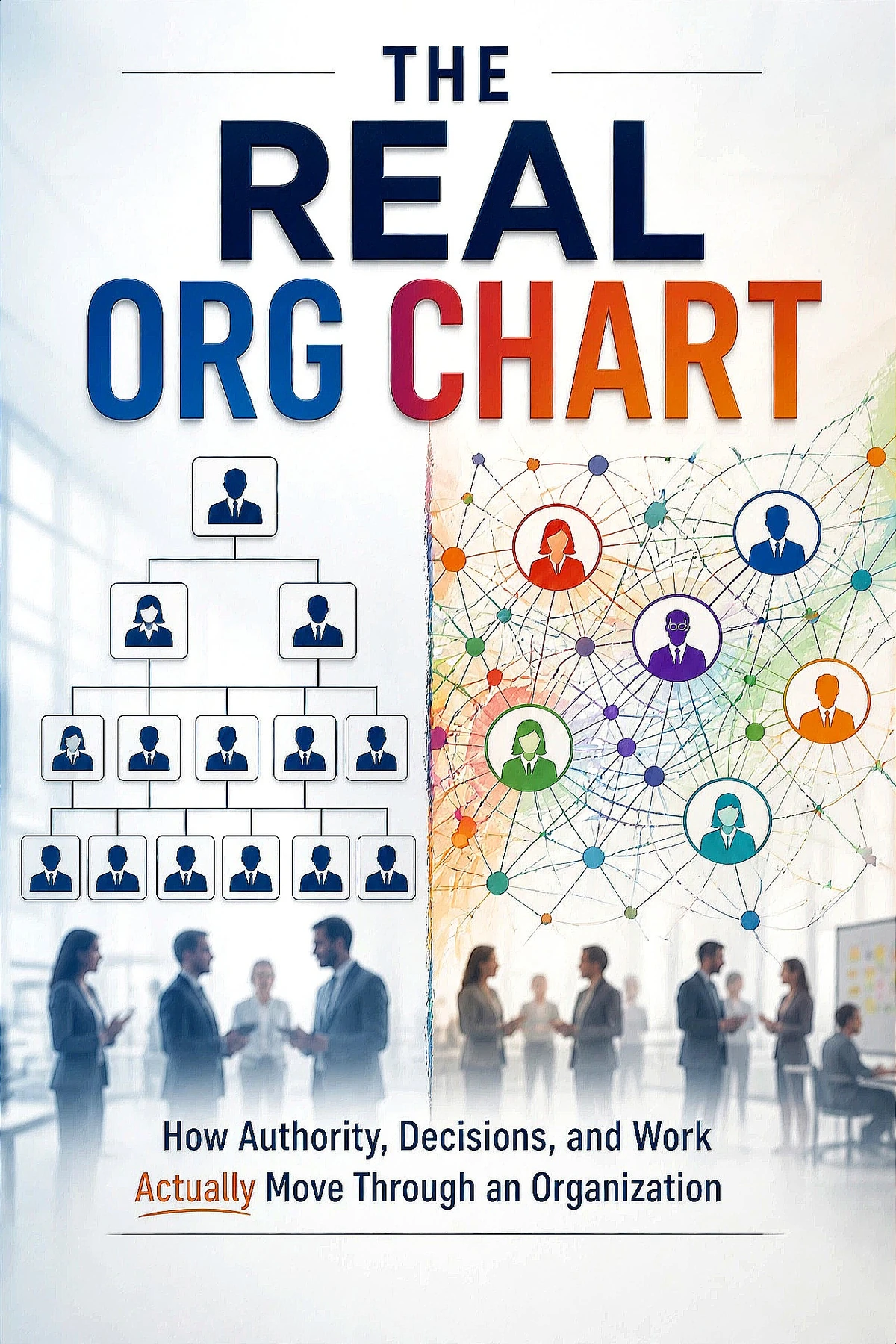
Book one of ten · Out now
The Real Org Chart
How Authority, Decisions, and Work Actually Move Through an Organization
The chart shows reporting lines. The work follows dependency lines.
Every organization has two structures in the same building. One is published, drawn in boxes, and says who manages whom. The other is drawn in decisions, handovers, information and authority — and it is the one that determines whether anything actually gets done.
Fourteen chapters, worked end to end through a single company: how a decision travels from the moment somebody notices something is wrong to the moment a procedure changes; where authority and responsibility come apart; what a handover really costs; and why the gap between the written policy and the real standard is not a compliance failure but the most useful data in the building.
Take the free class Read on KindleFourteen lessons, one per chapter, and all fourteen are open now. You do not need the book to take it.

Also out · Its class is opening now
Surprise Is Constant
The Science of Uncertainty and the Art of Staying Steady
Surprise cannot be planned away.
Every expectation eventually meets a day that does not honor it. Across sixteen chapters, the book explains why the brain treats surprise the way it does, why comfort and incomplete data set the trap, and how to meet disruption with judgment instead of being ruled by it — ending with the Sovereignty Protocol, a practical way to keep the ability to choose a response when the ground shifts.
Take the free class About the book Read on KindleSixteen lessons, one per chapter, opening as they are built. You do not need the book to take it.
Four classes are open today
Free, with nothing to sign up for. Read the ideas, work a bench with your own numbers, then prove it — and a wrong answer sends you back to the exact paragraph that covers it.
Open now · 14 lessons
The Real Org Chart
Two structures in one building. Reporting lines against dependency lines, and how to find the place where work actually stops moving.
New · 16 lessons, opening as they are built
Surprise Is Constant
Surprise is a model meeting a fact it did not contain. The brain as a prediction engine, the mathematics of uncertainty, and how to stay steady when the map fails.
Open now · 10 lessons
Total Productive Maintenance
The discipline that made factories reliable: the six big losses, OEE, and the eight pillars. Read it, work it, prove it.
Open now · 16 lessons
AI + TPM
What changes when the thing that wears out is a capability rather than a bearing. Maintenance for systems that drift.
The ten classes being built
Six on the business itself, four on how work actually moves through it.
One · The Business
Administration, Management and Operations
Open now · The Real Org Chart class
How an organization actually runs: where authority sits, how a decision travels, how work passes from one desk to the next, and why the org chart is never the real structure. This is the most heavily enrolled subject in online business education, and it is the one every other class here hangs off.
You will be able toDraw how your own organization really works, name who owns each decision, and find the place where work stops moving.
Two · The Business
Financial Accounting and Finance
The balance sheet, the income statement and the cash flow statement, read as three documents that tell you three different things — and the discipline of noticing when they disagree. Written for the person who has to make a decision on Friday, not for the person keeping the ledger.
The hardest lesson in this class is the oldest one in business: a company can be profitable and still run out of money.
You will be able toRead a set of accounts you did not prepare, build a budget you can defend, and say what a number means rather than what it is.
Three · The Business
Digital Marketing and E-Commerce
Why a person buys, how they are found, and what an online storefront has to do before it can sell anything. Search, social, the shape of a funnel, and the measurement that tells you which half of your spend was wasted.
It will also be blunt about the parts of this industry that are theater — the metrics that flatter, and the tactics that work once and then poison the well.
You will be able toTake a product nobody knows about and build the shortest honest path between it and the person who wants it.
Four · The Business
Project Management
Scope, schedule, budget, risk, and the people you have to tell. Covers the plan-first tradition and the agile alternative honestly, including the conditions under which each of them fails — because a method chosen for fashion rather than fit is the most common reason projects die.
You will be able toScope a piece of work so it can be finished, spot the risk that will actually bite, and give bad news early enough for it to be useful.
Five · The Business
Entrepreneurship
Testing a business before you fund it. What a business plan is genuinely for, how to validate demand cheaply, and how to tell a real signal from your own enthusiasm.
Aimed squarely at the tradesperson going out on their own and the person starting from a kitchen table — not at a venture pitch.
You will be able toProve or kill an idea for very little money, and know which of those two outcomes you have.
Six · The Business
Leadership and Organizational Behavior
What actually moves a group of people: how culture forms whether or not anyone designs it, why the same instruction lands differently in two teams, and what changes when nobody is in the same room.
The uncomfortable core of this class is that most of what is sold as leadership is personality, and most of what works is structure.
You will be able toDiagnose why a team is underperforming without reaching first for the people in it.
Seven · Operations
Operations Management
Process design, capacity, throughput, and the bottleneck — the single most useful idea in the whole subject. Improving anything other than the constraint makes the numbers look better and changes nothing.
You will be able toFind the true constraint in a process, measure it, and prove whether a change helped.
Eight · Operations
Supply Chain and Logistics
Inventory, sourcing, procurement, and the design of a distribution network. Why holding stock is both an insurance policy and a cost, and why a chain optimized end to end is fragile in exactly the places it is most efficient.
You will be able toSay what a stockout would really cost you, and where a single supplier is a single point of failure.
Nine · Operations
Quality, Waste and the Improvement Method
The method behind Lean and Six Sigma: define the problem, measure it honestly, find the cause rather than the culprit, change one thing, and hold the gain. The statistical tools are taught, but the discipline matters more than the arithmetic.
A plain statement, so nobody is misled: Yellow, Green and Black Belts are awarded by outside certifying bodies. Global Sovereign University does not award them and cannot. This class teaches the method those belts are built on. If you want the belt, you will still need the body that issues it — but you will arrive already able to do the work.
You will be able toRun a real improvement project end to end, and tell the difference between a fix and a workaround.
Ten · Operations
Data Analytics for Managers
Reading the numbers an organization already produces. Which indicators are worth a dashboard, how to forecast without fooling yourself, and how to recognize the far larger class of measures that only look like measurement.
Not a statistics course and not a coding course. A course in deciding what a number is allowed to tell you.
You will be able toChallenge a chart in a meeting and be right.
How these will work when they open
The same way every GSU class works. Read the material, broken into the separate ideas you will be asked to perform. Work something with your own numbers. Then prove it — and if you miss a question, you are sent back to the exact paragraph that covers it rather than simply shown the answer.
Free. No account. Nothing to install. Your progress kept on your own device and transmitted nowhere.
A certificate, when one exists, will state what you demonstrated you can do, carry a serial anyone can verify, and say plainly that it is not a license and not an industry certification. That is what makes it worth having.
Start The Real Org Chart Start Surprise Is Constant Start with TPM Economics Money & Finance EntrepreneurshipGlobal Sovereign University is a tuition-free 501(c)(3) nonprofit. Book sales are its only income, and every title is written and donated by our founder. A purchase is not a tax-deductible donation. As an Amazon Associate, GSU earns from qualifying purchases.
Global Sovereign University: Different by Design. Better by Mission.