Lesson 12 · from Chapter 12
Growth
Growth makes the resemblance between the formal organization and the real one harder to maintain. Early on the gap is small — not because the structure was designed well, but because there is barely any structure to hide behind.
Step one
Five ideas
Read each one. Mark it read, or have it read to you. The test at the bottom draws from these five and nowhere else.
Idea one
Informality is a condition, not a capability
A small business may have a founder, a few employees, a handful of customers, and a great deal of shared urgency. The person who sells may also answer customer questions. The person who delivers may also order supplies, correct invoices and explain problems to clients. Decisions are made by turning around in a chair, walking across a room, or sending a message to the one person who knows the answer.
This can feel unusually efficient. There are few formal handovers because people perform several parts of the work themselves. Information travels quickly because nearly everyone hears about important events. When an unusual issue arises, people know who to ask.
At this stage, the real org chart is often held together by proximity, memory, and personal trust.
That arrangement can work for a time. It may even be the right arrangement. A young organization needs to learn quickly. It cannot afford a meeting, approval process or policy for every possible situation. Employees need enough freedom to respond to customers and solve problems before the opportunity has passed.
The danger is that early-stage success can make founders and managers believe that informality is a permanent capability rather than a temporary condition.
Before Northstar had customer groups, a Finance function, a warehouse and formal Support routes, a customer problem was resolved through a few direct conversations. The organization did not need a sophisticated escalation route because the escalation route was the people in the room.
As the business grows, that route begins to fail. The first signs are usually mistaken for ordinary busyness — people say they need to work harder, communicate better, or become more organized. Those statements are not entirely wrong. But the underlying issue is usually structural: the organization has more work, more customers, more decisions and more dependencies than its old informal arrangements can carry.
Idea two
The desk where work stops
A founder who could once approve every significant choice becomes a bottleneck. Employees wait for answers because they are unsure whether they are allowed to act. They send messages late in the evening because the founder has historically resolved issues quickly. Customers receive inconsistent commitments because different employees have learned different versions of what the business can offer.
The founder may experience this as loss of control. Employees experience it as uncertainty. Both are responding to the same change. The organization has outgrown the amount of authority one person can personally hold.
This is often the first real management challenge in an early-stage business: separating decisions that genuinely require the founder's judgment from decisions that others must learn to make. The founder may still need to decide major pricing changes, important hires, large commitments, partnerships, or risks that could threaten the business. But they should not need to approve every customer goodwill gesture, routine purchase, service recovery or scheduling adjustment.
If nobody else has authority to make these ordinary decisions, growth turns the founder into the desk where work stops.
This does not happen because the founder is unwilling or incapable. It happens because the business has taught everyone that escalation is safer than judgment. In the early days that habit may have protected the company. Later, it prevents the company from responding at the speed its customers and employees require.
A newly promoted manager feels it sharply. They are given responsibility for a team or a customer outcome, and still expected to seek approval for almost every meaningful choice. They are told to "take ownership," yet discover that ownership means collecting information for someone else to decide. This is the authority-responsibility gap in its earliest and most familiar form.
The organization may describe these as isolated delays. In reality, it is beginning to reveal its real org chart: work moves only when particular people are available.
Idea three
Overlap, and the question job descriptions miss
At first, overlap is helpful. People cover for one another. A customer does not care whether a question belongs to Sales, Support, Operations or Finance; they care whether somebody answers. Employees learn broadly because they see work from beginning to end, and the organization can adapt quickly because rigid boundaries have not yet formed.
But overlap becomes harmful when nobody knows where a responsibility starts or ends.
A customer may receive one answer from the person who sold the service and another from the person trying to deliver it. A team member may assume someone else has contacted a customer, ordered a part, followed up an unpaid invoice, or raised a recurring defect. Work is done twice in some places and not at all in others.
The usual response is to ask for clearer job descriptions. That can help, but job descriptions alone are not enough.
The important question is not only, "Who is responsible for this type of work?" It is, "Who owns the next decision when this case becomes difficult?"
It is not enough to say that Sales owns the relationship, Operations owns the repair, Finance owns credit control and the warehouse owns stock. When a critical customer's account is on hold, somebody must know how these responsibilities combine. Who verifies urgency? Who provides commercial context? Who decides the financial exception? Who releases the part? Who tells the customer what is happening?
A small organization may initially answer all of these questions through one experienced person. As it grows, it needs a usable route that does not depend on that person being present.
Idea four
Memory does not scale
Employees remember customer preferences, special pricing arrangements, unresolved complaints, informal promises, supplier issues, and the reasons behind past decisions. This knowledge is valuable. It is often what allows a small team to offer a personal service that larger competitors struggle to match.
But memory does not scale reliably.
When a new employee joins, they may not know that one customer needs a particular service record format, that another has an unusual payment arrangement, or that a third should be treated with care because of a recent equipment failure. They ask colleagues, search old emails, or make their best guess. The answer they receive may depend on who is available and what that person remembers.
So the business creates its first workarounds: private spreadsheets, personal notebooks, message threads, saved emails, and informal lists of "things everybody should know." These tools are often created with good intentions. They fill a real gap. But they also make the organization more dependent on the individuals who maintain them. When those individuals are absent, overloaded, or leave, work slows down.
The solution is not to write a policy for every customer interaction. It is to decide what knowledge must become shared and durable. Customer commitments, decision limits, recurring exceptions, current work status and important risks should not exist only in someone's head. A simple shared record, a defined customer note, or a short operating routine may be enough at this stage.
What matters is that the organization starts to distinguish useful personal knowledge from knowledge that the business cannot afford to lose.
Idea five
When effort starts hiding a process failure
Communication changes too. In a very small team almost everyone can be copied into almost everything, and that creates a sense of openness. As the volume of work rises, copied communication becomes noise. Important requests are lost among updates. Employees do not know whether they are expected to act or merely be aware. The most conscientious people read everything and become overloaded. Others stop reading and miss information that genuinely matters.
The answer is not necessarily more meetings. An early-stage organization usually needs only a few reliable forums — a short operational check-in for immediate obstacles, a regular review of priorities and customer risks, and a clear route for decisions that exceed a manager's authority. But the purpose should be visible. If a team gathers every morning, it should know whether the meeting is for allocating work, resolving blockers, reviewing commitments or escalating decisions. Otherwise, meetings become another way of preserving the founder's central role. Everyone reports upward, the founder gives ad hoc direction, and employees leave without clearer authority than they had before.
And growth exposes capacity problems a small business has been absorbing through effort. People compensate for weak systems by working longer hours. They answer messages at night, manually correct records, make urgent calls, perform tasks outside their formal role. Customers may see dedication. Leaders may see commitment. The work gets done. But the hidden cost is rising.
A manual workaround that takes ten minutes once a week may be sensible. The same workaround taking ten minutes fifty times a day is no longer a sign of flexibility. It is a process failure consuming capacity that should be used elsewhere.
Manually sending a service record may be a thoughtful response to a one-off technical problem. Once Support is handling repeated requests, recording the same information and explaining the same defect every day, the workaround has become part of the operating model. It needs to be measured, owned, and reconsidered.
So early growth requires managers to notice what employees are quietly carrying. Where are people performing the same manual correction repeatedly? Which decisions depend on one person's availability? What promises are being made before delivery capacity is checked? Which customers receive faster help because they know the right employee?
Step two
The ten-minute workaround
One manual step somebody invented because a system did not do its job. This bench counts what it is actually costing, and reports whether anyone can see it.
Try this. Set it anywhere you like, then move only the last slider. The hours do not change. Counting a workaround does not make it cheaper — it only decides whether anybody who could remove it ever finds out it exists.
Then take the third slider from one person to six. The hours do not fall either. Training more people spreads the load and removes the single point of failure; it does not remove the work, and it can make the cost harder to see because no individual is visibly drowning in it.
Step three
Show that it holds
Ten situations, two per idea, drawn at random. Two right in a row on an idea marks it solid. A wrong answer tells you why that particular choice fails, and sends you back to the one idea it was testing.
All five hold.
You can tell a temporary condition from a permanent capability, see how a founder becomes the desk where work stops, ask who owns the next decision rather than who owns the work, separate personal knowledge from knowledge the business cannot lose, and count what effort has been hiding. Lesson thirteen takes up reading a business you have just joined.
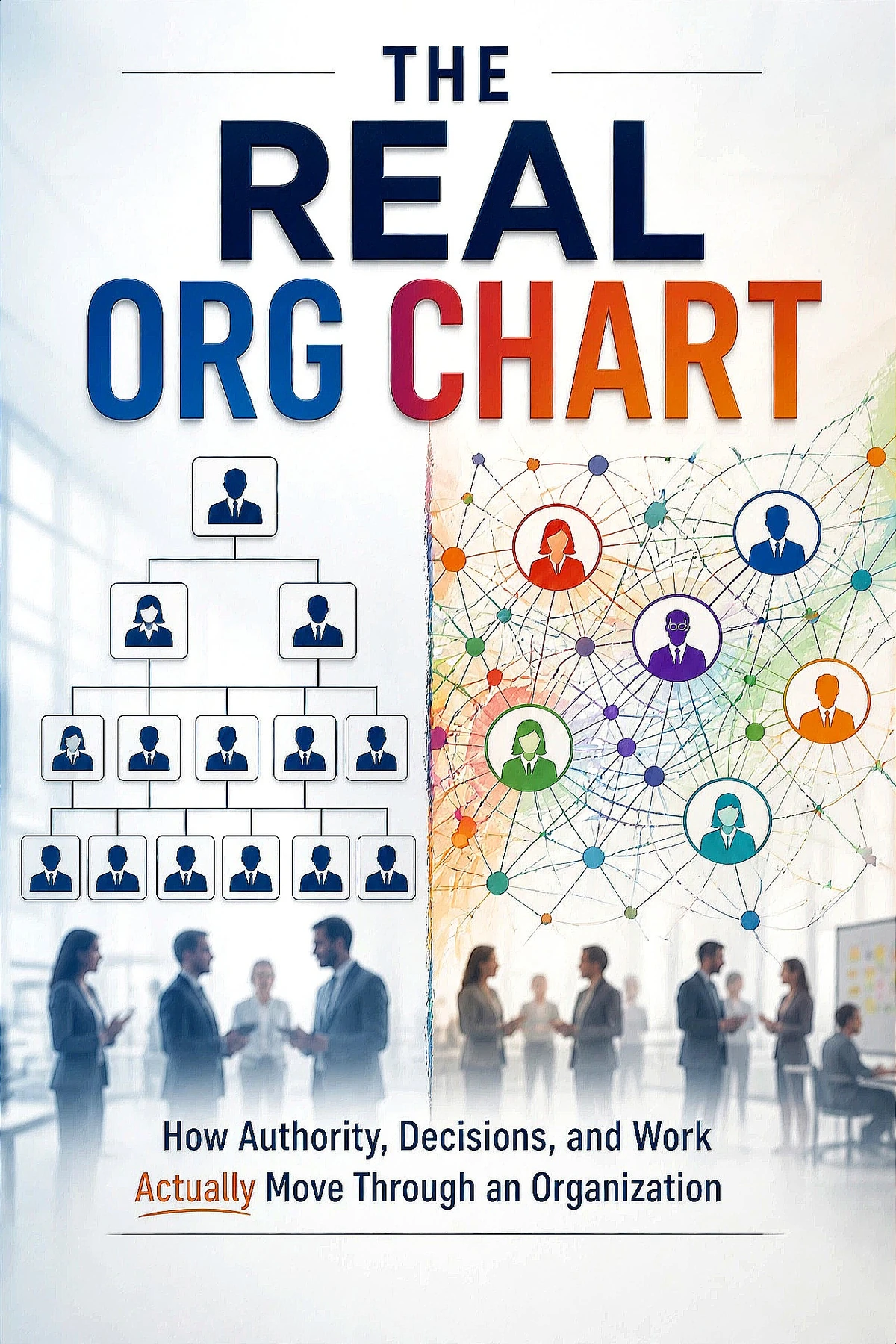
The Real Org Chart
This lesson teaches chapter 12. The book runs to fourteen chapters, worked end to end through a single company — how a decision travels, where authority and responsibility come apart, what a handover really costs, and how to draw the structure your organization actually uses. Written and donated to the Foundation by GSU's founder, Dr. Gene A Constant.
Read on Kindle The whole class
The class is free and always will be. As an Amazon Associate, Global Sovereign University earns from qualifying purchases; every cent funds tuition-free education.
Global Sovereign University: Different by Design. Better by Mission.