Lesson 13 · from Chapter 13
How to Read a Business You've Just Joined
For a manager who has just joined, the first task is to discover whether work can find its way forward at all. The published chart is a useful starting point — and it will not tell you who people call at five o'clock when a repair is blocked.
Step one
Five ideas
Read each one. Mark it read, or have it read to you. The test at the bottom draws from these five and nowhere else.
Idea one
What the chart will not tell you
The published org chart tells you who formally reports to whom, where functions sit, how many management layers exist, and which roles leadership considers important enough to name. That is genuinely useful.
It does not tell you who people call when an urgent customer repair is blocked by a credit hold at five o'clock in the afternoon.
It does not tell you whether the service manager speaks first to Finance, Sales or the warehouse when a critical part is needed. It does not tell you whether Support has a credible route for turning repeated portal complaints into a Product priority. It does not show the experienced analyst who quietly corrects incomplete exception requests before they reach Finance, or the long-serving coordinator who knows which engineer can help when the scheduling system says nobody is available.
Those relationships are the informal org chart, and they are not necessarily signs of dysfunction. Every organization has them. People build trust with colleagues who are knowledgeable, reliable, responsive, or able to explain a complicated issue clearly. Informal relationships can make an organization more human and more resilient.
The difficulty begins when the informal network becomes the only reliable route through important work.
A new manager needs to hold that distinction carefully. If a service manager calls a trusted Finance colleague for advice before submitting a complete request, that may be sensible collaboration. If the service manager must call that colleague because the formal route is too slow, unclear, or unavailable, the relationship is compensating for a structural weakness.
If a Support adviser knows which Product manager will listen seriously to evidence, that may help the company learn quickly. If the adviser can only obtain action by contacting that person privately, while the official feedback process leads nowhere, the organization has created authority on paper and influence somewhere else.
The purpose of mapping the informal org chart is not to expose or eliminate these relationships. It is to understand what work they are doing.
Idea two
Early certainty is dangerous
In the first thirty days, a manager should resist the urge to begin with conclusions. Newcomers often see a confusing organization and immediately diagnose politics, poor communication, weak accountability, or resistance to change. Sometimes those judgments will eventually prove accurate. But early certainty is dangerous.
An unfamiliar organization can look irrational before its history is understood.
A manager may notice that account executives contact Finance directly instead of going through their own sales leader. It may appear that the sales leader has lost control of his team. But the direct route may have emerged because, during a past period of serious customer risk, Finance and Sales created a practical way to resolve urgent exceptions quickly. The route may now be outdated, poorly controlled, or dependent on particular individuals. It may also be carrying a legitimate need that the formal organization has failed to address.
The manager should first ask, "What problem is this relationship solving?"
That question is more useful than asking, "Why are people not following the chart?"
Idea three
Follow real work, not reputations
The fastest way to begin mapping the informal organization is to follow real work.
Do not begin by asking people abstractly who has influence. Most employees will answer cautiously, especially when they do not yet know whether you are looking for a problem. Instead, ask about recent cases.
"What happened when the customer's equipment failed?" "Who did you speak to first?" "What did you need from them?" "Who made the decision?" "What happened when that person was unavailable?" "Where did the case wait?" "What would you do differently next time?"
These questions lead people away from general descriptions and toward the actual path of work.
Select a few recent urgent cases and trace them from the first notice of failure to restoration of service. In one, the service manager may have used the formal route, supplied the required information, and received a timely decision. In another, an account executive may have called a Finance manager directly because the customer was commercially important. In a third, the warehouse supervisor may have prepared the part before approval because experience suggested the decision would eventually be made.
These differences matter. They show whether you have one credible process or several versions of one. They reveal which people are trusted to use judgment, which people are expected to wait, and where formal controls are being supported, bypassed, or quietly recreated through personal relationships.
Write the route down as it actually happened. A simple page is enough — the triggering event, who noticed it, who was contacted, which information moved, which decision was needed, who made it, where the work waited, and what finally changed the customer's situation. Include informal contacts as well as formal ones. The aim is not to create a record of individual failures. It is to make the pattern visible.
After several cases, the real organization begins to appear. Perhaps every urgent repair requires commercial context from an account executive who does not see that as part of their role. Perhaps Finance can decide quickly when requests are complete, and the real delay is that service staff do not know what information is required. Perhaps the named deputy exists on the process document but employees do not trust that deputy with a difficult decision, so everything still rises to the director.
The published chart has not changed. The working authority is somewhere else.
Idea four
Absence, and the names that recur
Absence and delay are especially revealing. Ask what happens when a particular person is on leave, in a meeting, or simply too busy to respond. Does the work continue through a clear deputy or decision route? Does it wait? Does someone bypass the formal process and seek another senior person? Do employees say, "We usually wait until she is back"?
When work stops in the absence of one person, that person occupies a more important place on the real org chart than their title may suggest.
This does not mean they are deliberately hoarding authority. They may be the only person with the judgment, history, confidence or relationships needed to resolve difficult cases. They may have become central because others trust them. But their importance is still a risk if the organization has not made their knowledge, authority, or decision logic available to others.
Pay attention to the names that arise repeatedly. "Ask Maria, she knows how this really works." "Jon can get a decision." "If you need the warehouse to move quickly, speak to Aisha." "Technology will listen if Hannah explains the impact." These comments identify network nodes: people through whom information, judgment, and influence travel. Some hold senior roles. Others do not.
The task is not to label these people as political operators or unofficial leaders. It is to understand the dependency. What knowledge do they hold? What decision do they influence? Why do people trust them? What would happen if they were unavailable? Could the organization make that contribution more visible, shared, or properly supported?
The answers reveal both strengths and vulnerabilities. If Support advisers willingly share evidence with Product because they believe it will be heard, you have a bridge worth protecting. But if the network depends entirely on personal access, it creates unequal service inside the organization. Employees who know the right people get help. Newer, quieter, remote employees, or those outside the established circle, do not. Customers then receive different outcomes not because their needs are different, but because the employee handling the case has different connections. That is one of the clearest signs that an informal route needs to become a more reliable formal one.
Listen, too, for the language people use about decisions. "You need to get Daniel on side." "Priya will want to see that herself." "Officially, the service manager owns it, although the warehouse will not release anything without speaking to Aisha." These are not casual comments. They are descriptions of the real distribution of authority. Do not repeat them carelessly or turn them into accusations — test them against cases. Evidence is more useful than reputation.
Idea five
Who actually decides what
The next question is harder: who actually decides what? This is not the same as asking who has the most senior title.
Formal authority matters, and the published structure should make it visible. But in every organization, decisions are also shaped by people who do not hold the final formal authority. Someone may control the information the decision depends on. Someone may understand the customer history that makes one option sensible and another dangerous. Someone may have technical credibility that means leaders will not proceed without their view. These people are influencers.
Influence is not automatically political or unhealthy. A Finance analyst who understands a customer's full payment history should influence an urgent credit-hold decision. A senior engineer who can explain the safety consequences of releasing a part should influence the service response. The problem comes when influence is hidden, uncontrolled, or confused with authority.
So look beyond the final signature. For each important decision, ask five questions.
Who is formally accountable for the decision? Who supplies the information needed to make it? Whose agreement is needed in practice, even if not on paper? Who can delay or prevent the decision? Who acts on the decision once it is made?
The answers often reveal that a decision has several centers of power.
Take prioritizing a fix for the portal defect. Product may formally decide where it sits on the roadmap. Technology determines the likely effort, technical risk and dependencies. Support holds evidence of how many customers need manual records and how much staff time the workaround consumes. Sales knows which customers are becoming frustrated. Finance can show the cost of continued manual work. The quality and speed of that decision depend on whether these contributors can make the problem visible in a form the decision-maker can use.
If Support records portal contacts inconsistently, the manual workload appears small. If Sales describes concern only through individual escalations, the commercial risk appears anecdotal. If Technology presents effort without explaining options, leaders treat the issue as an unavoidable technical burden rather than a trade-off against customer harm.
In such a case, the person with the greatest influence may be the individual who translates scattered evidence into a clear decision. Notice that role. It may be essential coordination work. It may also be a dangerous dependency if only one person can make the organization see the issue clearly.
Step two
Trace the cases
Your first month. This bench takes the cases you have actually traced and reports what they can honestly tell you — which, early on, is usually less than you would like.
Try this. Start with one traced case and read the verdict. The bench will not draw a conclusion from it, whatever the other three sliders say — because one case is a story and a pattern needs several. Add cases and watch the reading change from "not yet" to something you could take to a room.
Then set the deputy to "named on the document, not trusted with a hard case" and compare it with having no deputy at all. They are the same. A route that exists only in writing is not a route.
Step three
Show that it holds
Ten situations, two per idea, drawn at random. Two right in a row on an idea marks it solid. A wrong answer tells you why that particular choice fails, and sends you back to the one idea it was testing.
All five hold.
You can say what the chart cannot tell you, hold off on early conclusions, trace real work instead of collecting reputations, read absence as evidence, and run the five questions over a decision. Lesson fourteen is the method chapter — drawing the real org chart of the organization you actually work in.
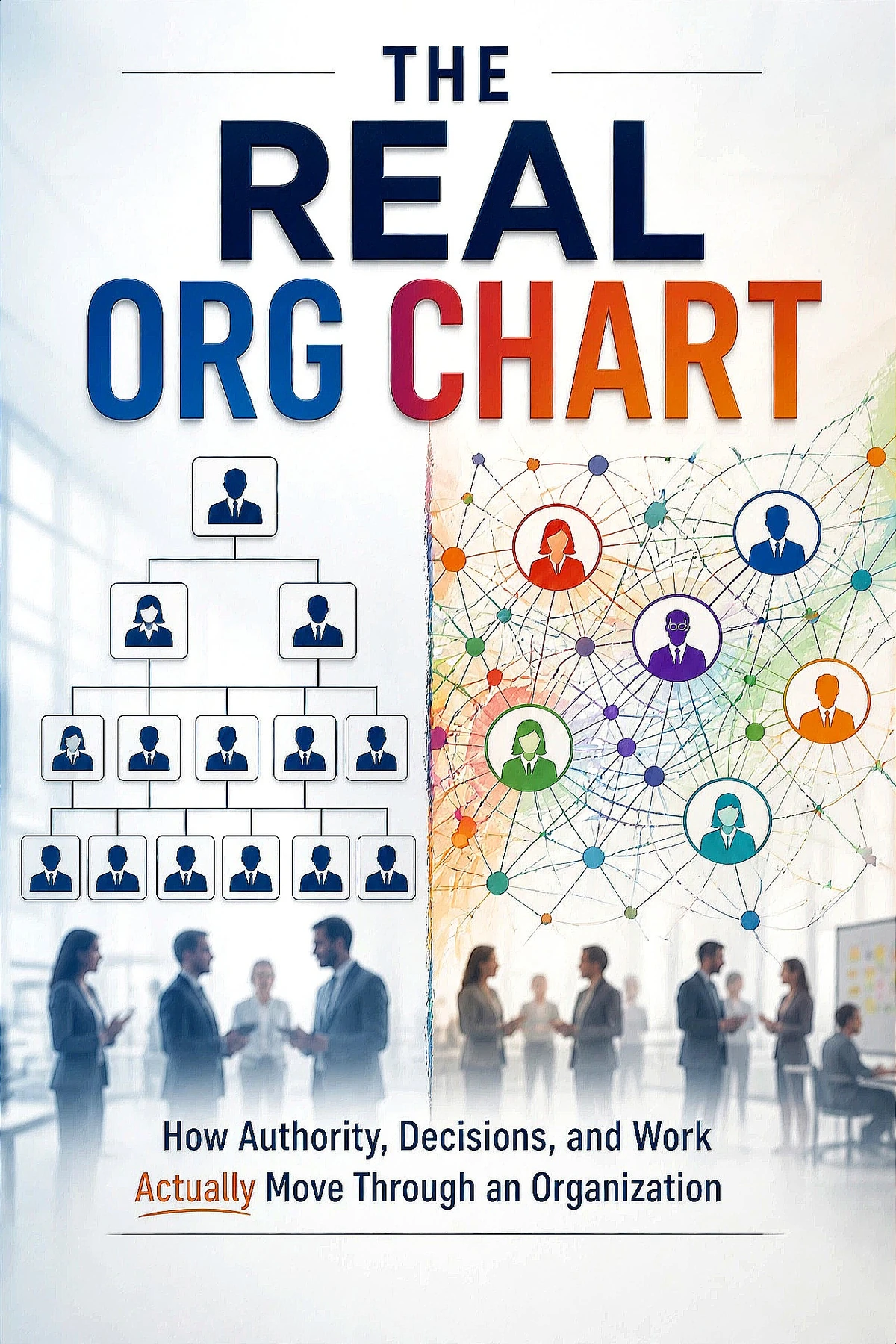
The Real Org Chart
This lesson teaches chapter 13. The book runs to fourteen chapters, worked end to end through a single company — how a decision travels, where authority and responsibility come apart, what a handover really costs, and how to draw the structure your organization actually uses. Written and donated to the Foundation by GSU's founder, Dr. Gene A Constant.
Read on Kindle The whole class
The class is free and always will be. As an Amazon Associate, Global Sovereign University earns from qualifying purchases; every cent funds tuition-free education.
Global Sovereign University: Different by Design. Better by Mission.