Lesson 3 · from Chapter 3
Authority, Responsibility, and the Gap Between Them
The decision journey ends with a requirement so basic it is easy to overlook: somebody must be able to act. Much of what people call organizational frustration is the sound of that requirement going unmet.
Step one
Five ideas
Read each one. Mark it read, or have it read to you. The test at the bottom draws from these five and nowhere else.
Idea one
Two words that are not the same
A person is expected to deliver an outcome but cannot approve the spending, set the priority, obtain the information, change the process, or resolve the conflict required to deliver it. Another person has the power to make those choices but is too far from the work, too busy, or too unclear about the issue to use that power well. The first person has responsibility. The second has authority.
Authority is the legitimate right to make a decision, direct work, commit resources, approve an exception, or require an action within a defined area. Responsibility is the obligation to carry out work, achieve an outcome, or make sure that something is attended to. The words are often used as though they mean the same thing. They do not.
Northstar's service manager is responsible for restoring a customer's failed equipment — assessing the problem, assigning a qualified engineer, making sure the part is available, communicating with the customer, confirming the site is operating safely again. But she may not have authority to release a part to an account on credit hold. She may not be able to approve overtime above a limit, or accept a commercial loss to retain a customer. Those belong to Finance, Sales, or a more senior operations leader.
And that division is not automatically a problem. No organization can give every person unlimited authority. Financial controls exist for good reasons. Safety rules should not be waived casually. A manager should not be able to spend without limit because a customer situation feels urgent.
The problem is not that authority has limits. The problem is when responsibility is assigned without a workable route through those limits.
Clear authority does not mean one person controls every part of a complicated situation. It means people understand which decisions they can make, which decisions they must refer, what information is needed for referral, and who has the final right to decide. In the urgent case, the service manager establishes the operational facts; the account executive explains the commercial consequence of delay; the finance manager assesses the account and approves within agreed limits; Daniel accepts responsibility for commercial follow-up; Priya makes the final call when exposure exceeds what her team may approve. The decision required several people. It did not require confusion.
Idea two
Stated authority and usable authority
Stated authority is what the role description, policy, or senior leader says a person is allowed to do. Usable authority is what they can actually do without being blocked, overruled, ignored, or punished.
A manager may technically have authority to set their team's priorities. But if every priority shift triggers objection from another department and nobody will resolve the conflict, that authority is weak in practice. A product manager may formally own a roadmap, but if Sales can promise features directly to customers and senior leaders routinely support those promises, the product manager's authority exists only on paper.
Usable authority depends on more than a policy document. It depends on clarity, support, information, access to resources, and the willingness of more senior people to let delegated decisions stand.
Which is where the informal network can either help or hide the problem. An experienced service manager knows exactly whom to call when a credit hold threatens an urgent repair; her relationships with the finance manager, the warehouse supervisor and Daniel let her move fast. In the moment, that is valuable.
Now picture a newly promoted service manager facing the same situation. She knows she is responsible for the customer. Nobody has explained the exception route. She sends a request to the shared Finance mailbox and gets an automated reply saying requests are reviewed within one business day. The warehouse will not release the part. Daniel is traveling. The customer is waiting.
The experienced manager's network made the organization appear more capable than its formal design really was. The new manager reveals the gap.
So a healthy organization does not eliminate judgment or personal contact. It makes the essential parts of authority visible enough that competent people can act without needing private knowledge or personal favors. Which is also why authority needs boundaries. "Use your judgment" can be empowering when people understand the limits within which judgment is expected. It can be evasive when leaders use it instead of defining those limits. The thresholds differ between organizations. What matters is that people know where they stand before a crisis begins.
Idea three
Outcomes downward, decisions upward
Authority is what gives responsibility practical force. A manager responsible for customer response times may need authority to adjust staffing, redistribute work, approve limited overtime, change local priorities, or challenge another team whose delay is affecting customers. Without some ability to influence those conditions, the manager is being asked to own a result while others control the means.
This is one of the most common organizational errors: leaders assign outcomes downward but keep all meaningful decisions upward.
They tell a new manager, "You own this area now." Then they require approval for every new hire, every change in working hours, every supplier conversation, every pricing exception, every change to a customer promise, and every decision that might upset another department. The manager has been given responsibility in language but not authority in practice.
At first they cope by escalating. They ask their director for permission, copy senior colleagues into messages, wait for decisions before making commitments. Their team complains that nothing moves. The director then complains that the manager lacks confidence or initiative.
But the manager has learned the real rule: independent action is risky because the organization may reverse it later.
Responsibility is also heavier than a task list, because it asks for attention to dependencies — not merely to complete your own step, but to notice what must happen before and after it. The service manager did not drive the part to the site or repair the equipment. She was responsible for coordinating the response. If the warehouse had the part but no engineer was assigned, or an engineer arrived without the right certification, she could not reasonably say the failure belonged only to another team.
When authority and responsibility are aligned, people can say "This is mine to handle," and mean it. When they are not, people say something else: "I am responsible, but I cannot do anything about it." That sentence is one of the clearest signs that the real org chart needs closer attention.
Idea four
Authority without responsibility
The imbalance runs the other way too, and it is discussed far less. Authority without responsibility is also dangerous.
A senior leader may have the power to intervene in any decision, change priorities, or demand urgent work from a team. If they exercise that power without carrying responsibility for the consequences, they can create disorder below them.
A director who repeatedly inserts new urgent requests into a team's workload may feel decisive and responsive. But if nobody is required to decide what work will be delayed, which commitments will change, or how the team's capacity will be protected, the director is using authority without owning its effect.
The pattern that follows is familiar: every request is urgent, teams work harder, deadlines slip, and managers are blamed for poor delivery despite having been unable to defend priorities.
So the rule runs in both directions. Authority should be accompanied by obligation — the person who can make a decision should be expected to consider its consequences, make trade-offs visible, and stand behind the outcome. Responsibility should be accompanied by enough power to act — the person expected to deliver should know what they can decide, what they can request, and what route to use when a dependency is outside their control.
And over time both imbalances damage trust in the same way. Employees with too little authority stop using judgment. They escalate small decisions, wait for instructions, and protect themselves with emails and approvals. Leaders with too much unchecked authority may intervene impulsively, change direction frequently, and assume that others will absorb the consequences. Neither group is necessarily uncommitted. Both are adapting to the real organization around them.
Idea five
Very often, it is design
The gap between authority and responsibility rarely appears because someone deliberately designed an impossible job. More often, it grows gradually.
An organization starts small. The founder makes most decisions personally — inefficient in theory, workable in practice, because everyone is close to the work. As it grows, work is divided. Managers are appointed, departments form, policies arrive. Responsibilities are handed down because senior leaders cannot carry every task themselves.
But authority often remains where it has always been. The founder still approves significant spending. A director still wants to be consulted before a customer exception. Finance retains control over decisions affecting cash. Technology retains control over systems and risk. Each division can make sense on its own. The difficulty emerges at the points where the work crosses between them.
A manager is told to take ownership of a result that depends on decisions controlled by several other people. Responsible for what the customer experiences, unable to approve the resources to fix it. Responsible for a team's delivery, unable to alter the priorities imposed from above. Nobody has necessarily acted badly. The structure has simply failed to keep pace with the work.
Which is why the first step in closing the gap is to stop treating it as a weakness in individual character. When someone says "I am responsible, but I cannot do anything about it," do not immediately ask why they have not shown more initiative. Ask what outcome they are expected to deliver. Ask what decisions they need in order to deliver it. Ask which of those they can make themselves, which belong elsewhere, and what happens when the answer is delayed. The answers will show whether the problem is confidence, capability, workload, or design.
Very often, it is design. That is good news, because design can be changed.
Not quickly in every case, and not by issuing a memo that says managers are now empowered. The aim is not to give everyone freedom to make every decision — it is to make sure the people held responsible for an outcome have enough authority, information, access and support to move the work forward. And the first step is to name the outcome before discussing the authority. Not "manage field engineers" but "restore customer equipment safely, reliably, and within an agreed response time." Once the outcome is clear, the necessary decisions become easy to identify. Some should sit with her, some elsewhere — but all should have a defined route.
This is the practical test: if this person is responsible for the outcome, what must they be able to decide, request, influence, or escalate in order to achieve it? The answer should be specific.
Step two
The decision list
Name one outcome somebody is answerable for, then list every decision it needs. This bench sorts that list into what they may decide, what they must refer, and what has no route at all — then discounts the first pile by how often it gets reversed.
Try this. Set the no-route pile to zero by taking the third slider to a hundred, and watch the verdict change without a single extra decision moving into their hands. Most of the fix here is not delegation. It is deciding, in advance and in writing, where a referral goes and how long it may take.
Then run it on a real job. Name one outcome a person in your organization is answerable for — the outcome, not the job title — and list every decision it depends on. Mark each one: theirs, referred with a route, or referred into nothing. The third pile is the whole conversation.
Step three
Show that it holds
Ten situations, two per idea, drawn at random. Two right in a row on an idea marks it solid. A wrong answer tells you why that particular choice fails, and sends you back to the one idea it was testing.
All five hold.
You can separate authority from responsibility, tell stated authority from usable, recognise outcomes assigned downward while decisions stay up, name the opposite fault where authority carries no obligation, and read the gap as design rather than character. Lesson four takes up span of control — the arithmetic of how many people one person can actually lead.
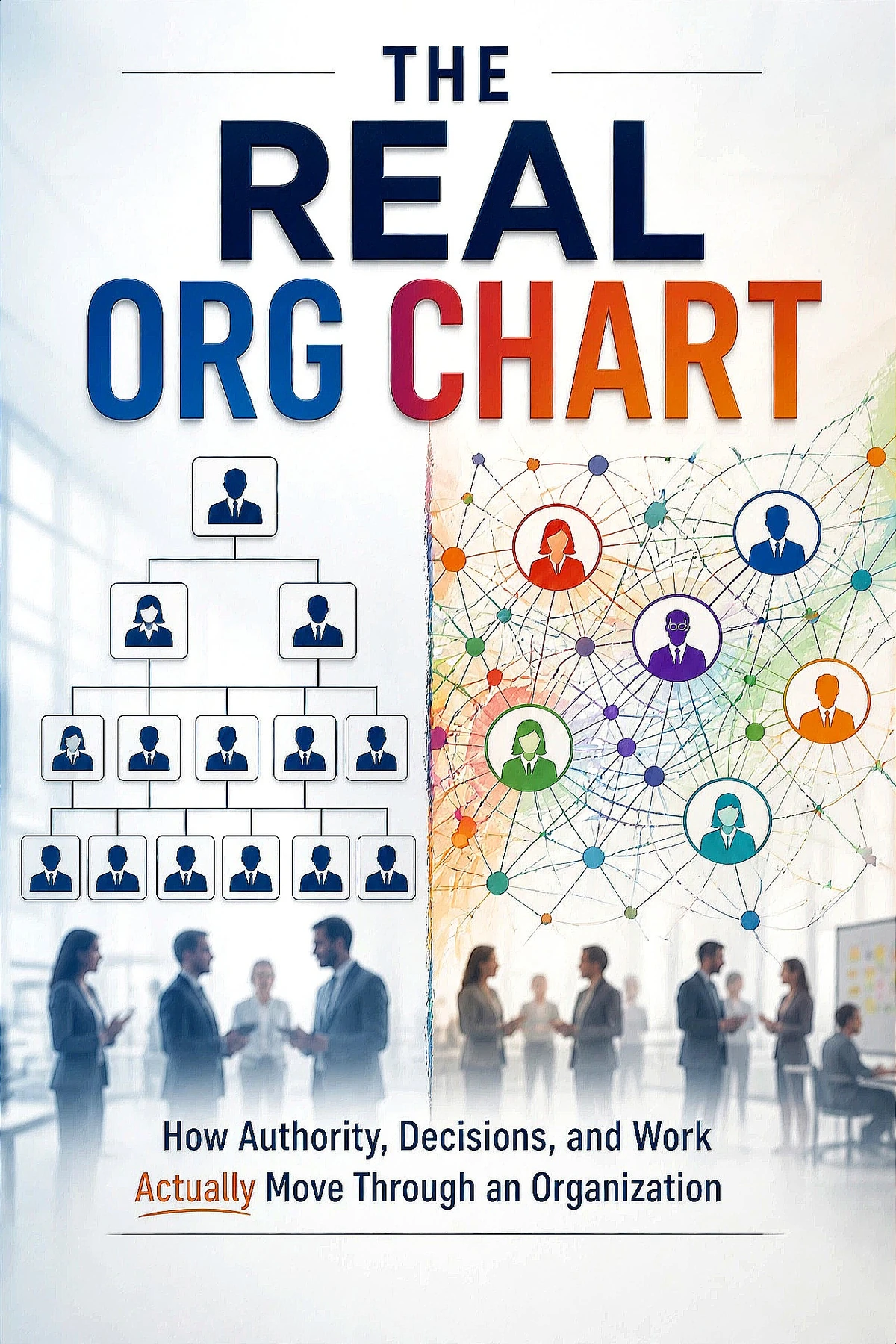
The Real Org Chart
This lesson teaches chapter 3. The book runs to fourteen chapters, worked end to end through a single company — how a decision travels, where authority and responsibility come apart, what a handover really costs, and how to draw the structure your organization actually uses. Written and donated to the Foundation by GSU's founder, Dr. Gene A Constant.
Read on Kindle The whole class
The class is free and always will be. As an Amazon Associate, Global Sovereign University earns from qualifying purchases; every cent funds tuition-free education.
Global Sovereign University: Different by Design. Better by Mission.