Lesson 4 · from Chapter 4
Span of Control
Clear authority helps work move. But authority still has to be exercised by someone with enough time and attention to use it — and that is a question with an answer you can actually calculate.
Step one
Five ideas
Read each one. Mark it read, or have it read to you. The test at the bottom draws from these five and nowhere else.
Idea one
There is no universal number
A manager may have the right to set priorities, approve overtime, coach employees, resolve disagreements and escalate blocked work. None of those rights matters much if the manager is responsible for so many people that every conversation becomes rushed, every problem arrives late, and every decision is made from a distance.
It is tempting to look for a single correct number. Some organizations aim for five or six direct reports; others operate with ten, fifteen or more. In highly standardized environments a supervisor may oversee a much larger group. There is no universal number because people do not need equal amounts of management.
The arithmetic begins with a simple fact. A manager has a finite amount of attention. Every direct report creates a claim on it: regular conversations, decisions, feedback, support, performance issues, development, absence, conflict, workload changes, and the ordinary human need to be seen and understood by the person responsible for their work.
With four direct reports, a manager can know each person's work in detail. They notice small changes in performance. They can teach, plan, and intervene early when a relationship is deteriorating or a workload is becoming unrealistic.
With fourteen, the work changes even if every employee is capable. One-to-one meetings are shortened or postponed. Feedback becomes general rather than specific. The manager learns about problems through dashboards, complaints or missed deadlines rather than through regular contact. The loudest issue receives attention, while quieter risks wait.
At twenty, the manager is still formally responsible for everyone, but in practice they are managing exceptions — sickness, complaints, urgent escalations, performance concerns, approvals. The people who are doing acceptable work receive very little management at all. This may be tolerable for a short period. It is rarely a strong long-term design.
Idea two
What actually sets the number
The number of people a manager can carry depends on the work they are managing. A large span works where tasks are stable, employees are experienced, standards are clear, and much of the coordination is built into the work itself. A smaller span is needed where work is varied, risk is high, people are inexperienced, or the manager must coordinate heavily across teams.
And a scheduling system does not close the difference. A system can show where people are. It cannot reliably show whether they understand a new instruction, whether they are losing confidence, whether they are taking unsafe shortcuts to keep up with demand, or whether they have stopped raising concerns because they do not expect anyone to act.
Then there is the part most often left out of the sum. A common mistake is to count only direct reports and ignore everything else expected of the manager. Northstar's service manager may have ten engineers, which sounds manageable. She may also attend daily operational meetings, handle customer escalations, coordinate with the warehouse, supply Finance during credit-hold exceptions, complete safety reviews, recruit, prepare performance reports and contribute to improvement projects. If those consume most of her week, the practical span is larger than ten. Her people have ten names beneath her on the org chart, but each receives only fragments of her attention.
This is why span of control cannot be judged by a number alone. It must be judged by the work required to lead well.
A useful way to test the arithmetic is to begin with time. Twelve direct reports, a meaningful forty-five-minute one-to-one every two weeks: that alone requires nine hours a month, before preparation, follow-up, team meetings, ad hoc support, performance conversations, absence, recruitment, training, escalation and planning. The manager's calendar may look full before they have done any of the wider coordination expected of their role.
The answer is not necessarily to cut the team to six. It may be to simplify the work, clarify decision rights, create stronger peer support, remove unnecessary reporting, or appoint a team lead with a genuine role rather than a title without authority. But the calculation should be honest. If the organization expects managers to know their people, develop capability, notice risks early and make good decisions, it must give them enough capacity to do so.
Idea three
The arithmetic that grows quickly
There is a second arithmetic problem, and it grows faster than headcount. Relationships.
A manager with five direct reports has five direct relationships to maintain. With ten, there are ten. But those ten people also have relationships with one another. They may need coordination, shared standards, conflict resolution, and help understanding how their separate work fits together.
As the group grows, the manager is not merely adding one more person. They are adding another source of information, another set of dependencies, another perspective on fairness, workload, and priorities.
Which matters most when the work is interdependent. If Northstar's engineers work largely alone, completing planned maintenance to clear standards, the service manager can lead a relatively broad team. If those same engineers must constantly exchange jobs, share scarce parts, coordinate specialist capability and respond to urgent failures, her coordination burden rises sharply. The work is no longer a collection of individual tasks. It is a moving system.
The same holds in office-based teams. A manager can oversee a larger number of people when each has a clear, independent portfolio and well-understood boundaries. The span needs to narrow when employees are working on shared projects, competing priorities, or problems that require frequent trade-offs.
Idea four
Efficiency is not the same as leadership
The cost of an excessive span is not simply that a manager feels busy. It is that the quality of management changes.
When a manager has more people than they can genuinely lead, they do not usually stop managing. They adapt. They shorten conversations, rely more heavily on reports, deal with the most visible issues first, and postpone whatever does not seem urgent today. They become efficient at administration and reactive problem-solving. But efficiency is not the same as leadership.
From a distance the team can appear well managed. Every person has a named manager. The calendar is full. Reports are submitted. Targets are reviewed. The missing quality is harder to see. It appears in the engineer who has been struggling for months before anyone notices; the capable employee who leaves because nobody discussed their development; the new starter who receives instructions but not the context needed to make good judgments; the small conflict that becomes a lasting division because there was no time to address it early.
It appears, above all, in the difference between a manager who knows what is happening and a manager who knows what the dashboard says is happening.
A report may show an engineer completed a high number of jobs. It may not show that he achieved this by skipping breaks, rushing customer explanations, or avoiding the more complicated jobs that take longer. It may show another completed fewer — and not show that she spent much of the day helping a newer colleague, handling a difficult customer carefully, or identifying a fault before it became a safety issue. The manager who knows the people and the work can interpret the numbers. The manager who has too little time may use the numbers as a substitute for understanding.
And that substitution changes behavior throughout the team. Employees quickly learn what their manager has time to see. If output is visible but quality is not, output becomes the safest thing to optimize. If response time is watched closely but customer understanding is not, people end calls quickly while leaving the issue unresolved. If the manager notices only missed targets and major complaints, employees conceal early difficulties until they become impossible to hide. This is not because employees are careless. It is because they are responding to the system around them.
Idea five
The signs, and what to do before redrawing anything
Managers usually discover an unhealthy span through symptoms rather than a calculation. They stop having regular conversations with some team members. They know the work of their most vocal employees but little about the quieter ones. They hear about problems only after customers complain. They spend their days approving small decisions because nobody has had time to develop confidence and judgment. Their team says "We cannot get hold of you," while senior leaders ask "Why are so many issues being escalated?"
These are not always signs of a weak manager. They may be signs that the organization has given one person more managerial work than can be done properly.
Watch for four patterns. Dependence: people call her for decisions they should be able to make themselves, and she is the only one who knows which engineer handles which equipment. That knowledge makes her valuable. It also makes the team dependent. Uneven attention: she knows a few employees in detail — usually the most vocal, troubled or visible — while a reliable engineer appears to need little support and so receives almost none, and a quieter one carries a growing workload until absence, error or resignation makes the pressure visible. Development disappearing: one-to-ones postponed repeatedly, training deferred until demand reduces, but demand never reduces. Delayed escalation: problems arrive only once urgent. A manager who hears about everything late is not necessarily failing to pay attention. They may be operating beyond the point at which attention can be sustained.
And watch what happens when the team compensates. The strongest employees answer questions, explain unwritten rules, calm customers and help newer colleagues. If those people are doing management work without the time, authority, or support to do it well, the organization has not solved its span problem. It has moved it sideways.
The same when the manager becomes the routing point — assigning jobs, answering routine calls, checking stock, chasing Finance, approving every minor deviation. Work does not travel through a reliable system. It travels through her. That is a span problem, and it may also be a decision-rights problem, a systems problem, or a handover problem. Adding another manager without addressing those conditions may simply create two people chasing the same work.
So before changing reporting lines, make a simple map of the manager's actual week. How much time goes on leading people — coaching, feedback, planning, development, early support? How much on coordination that clearer routines should handle? How much on decisions that could safely be delegated? How much on repairing failures elsewhere: unclear priorities, missing information, poor systems, late approvals, cross-functional disputes? How much on doing the technical work because the team lacks capability, capacity, or confidence?
Step two
The manager's week
Forty hours. This bench spends them the way the chapter says to — one-to-ones first, then the coordination the team's interdependence creates, then everything else the role demands — and reports how many people are actually being led.
Try this. Take the one-to-one minutes to zero. The arithmetic suddenly fits — and read what the bench calls it. That is the adjustment overloaded managers actually make, and it is the reason a span problem can run for years without ever appearing on a report.
Then map a real week. Not the calendar; the week that happened. Coaching and early support in one column, coordination that a routine should handle in another, decisions that could be delegated in a third, and repairing failures elsewhere in a fourth. The shape of those four columns is the answer.
Step three
Show that it holds
Ten situations, two per idea, drawn at random. Two right in a row on an idea marks it solid. A wrong answer tells you why that particular choice fails, and sends you back to the one idea it was testing.
All five hold.
You can say why there is no correct number, name what actually sets one, show why coordination grows faster than headcount, tell efficient administration from leadership, and read the symptoms without blaming the manager. Lesson five takes up the choice between centralizing and delegating, and the real costs on both sides of it.
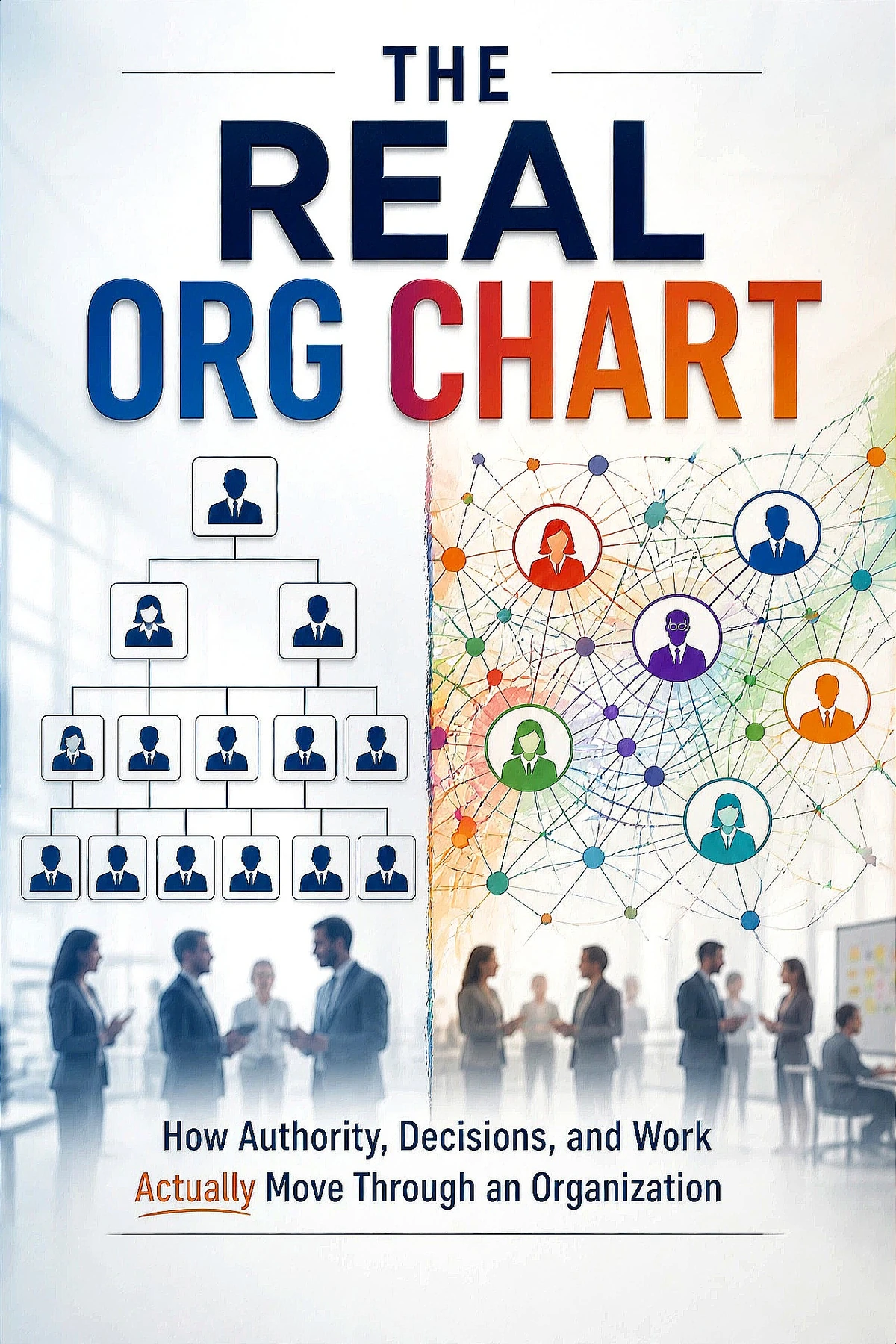
The Real Org Chart
This lesson teaches chapter 4. The book runs to fourteen chapters, worked end to end through a single company — how a decision travels, where authority and responsibility come apart, what a handover really costs, and how to draw the structure your organization actually uses. Written and donated to the Foundation by GSU's founder, Dr. Gene A Constant.
Read on Kindle The whole class
The class is free and always will be. As an Amazon Associate, Global Sovereign University earns from qualifying purchases; every cent funds tuition-free education.
Global Sovereign University: Different by Design. Better by Mission.