Lesson 9 · from Chapter 9
Meetings
Meetings are one of the places where a written rule meets the real work. They are usually treated as a problem of personal productivity. They are actually a structural feature — and when one is missing, the work it was meant to do does not disappear.
Step one
Five ideas
Read each one. Mark it read, or have it read to you. The test at the bottom draws from these five and nowhere else.
Idea one
A meeting is a structural feature
Meetings are often treated as a problem of personal productivity: too many people in a room, too many slides, not enough action. There is truth in that complaint. Many begin without a clear purpose, drift across several subjects, and end with people uncertain about what was decided.
But organizations do not hold meetings only because managers enjoy filling calendars. Meetings are a structural feature. They are part of the machinery through which an organization coordinates work, makes decisions, checks control, resolves conflict, and creates a shared understanding of what matters now.
When a meeting is absent, poorly designed, or given no authority, the work it was meant to coordinate does not disappear. It moves elsewhere. It appears in copied emails, private calls, repeated chasers, side conversations, emergency escalations, and senior leaders being asked to settle issues they should not need to see.
The question is not whether an organization should have meetings. The question is whether its meetings perform a necessary organizational function.
One urgent credit-hold case does not need a meeting. It needs a defined urgent route — calling a meeting for every urgent case would add delay to a situation that requires speed. But when the same exception occurs repeatedly, and Operations says Finance is holding up repairs, and Finance says requests arrive incomplete, and Sales says it is told too late, and the warehouse says it keeps preparing parts for releases that are never approved, this is no longer one decision. It is a coordination problem.
That needs a forum where people who see different parts of the system can examine the pattern. Its purpose is not to allow every team to explain why it has done its own job properly. Its purpose is to make the combined outcome visible — how many exceptions, how long from verified failure to decision, which customers appeared repeatedly, what happened to the customer while the company was deciding, whether the thresholds still make sense. These questions are not administrative. They are how the company finds out whether its policy is functioning in the real organization rather than only in the written one.
Idea two
Coordination, and control
Meetings perform two related functions. Coordination means bringing together work that is divided between people or teams — sharing information, identifying dependencies, setting priorities, agreeing who does what next. It is needed because no individual sees the entire organization. The service manager sees the equipment failure. Finance sees payment exposure. Sales sees the relationship. Technology sees system constraints. Support sees the volume and character of recurring complaints. A meeting can create a fuller picture when those partial views need to become one decision.
Control means checking whether the organization is operating within its intended standards, risks, commitments, and priorities. It is how leaders make sure important decisions are being made by the right people, exceptions are visible, risks are not hidden in informal workarounds, and agreed actions actually happen.
Control is sometimes misunderstood as mistrust. A manager who asks for an update may be accused of micromanagement. A team asked to report exception volumes may feel monitored for failure. A meeting that reviews open actions may appear bureaucratic.
But absence of control does not create freedom. Often, it creates uncertainty. Employees then seek more approvals because they do not know what they are permitted to decide. They copy senior people into messages because no one is confident that a decision will stand. Problems remain unrecorded because there is no place to raise them safely. The informal organization becomes stronger precisely because the formal organization has stopped providing reliable oversight.
Good control gives people room to act within known boundaries. It makes exceptions visible without treating every exception as misconduct. It lets the company see when a workaround is becoming a permanent operating cost rather than a temporary customer service measure.
Idea three
Reporting is not deciding
A meeting should not exist merely because people have information to share. Information can often be shared through a dashboard, a written update, or a short conversation. Bringing several people together is justified when they need to interpret information together, make a trade-off, coordinate dependent action, or review a risk that cannot be understood from one perspective.
Many meetings become wasteful because they confuse reporting with deciding.
A weekly meeting may consist of each manager describing activity in turn. Finance has closed the month, Operations has completed a number of service visits, Sales has progressed several opportunities, Technology has delivered planned work. The group listens politely. No priority changes. No conflict is resolved. No action depends on anyone else's contribution. The meeting may create a feeling of connection, but it is not necessarily performing a structural role. A written update may be sufficient.
By contrast, a meeting in which two divisions and Technology must decide how to allocate scarce specialist engineers is doing real work. The participants hold competing but legitimate priorities. If the organization has not clarified how this trade-off will be made, the conflict will simply reappear in individual requests and escalations.
The meeting is not the work. It is the place where the organization decides how the work will proceed.
So every recurring meeting should have a clear place in the real org chart. People should be able to answer: what is this meeting for? Which decisions can be made here? Who must attend because they contribute information, authority, or implementation capacity? What happens to issues that cannot be decided here? How are actions recorded and followed through? If the answer is vague, the meeting is likely to become a ritual. People attend because the invitation exists, not because the organization needs the forum to make work move.
And the authority must be clear. A group that reviews priorities but cannot make or recommend a decision is a discussion group. A group that reviews exceptions but cannot change thresholds, assign follow-up, or escalate is a reporting mechanism. Both may have value; neither should be mistaken for a decision forum. This matters most for newly promoted managers, who may be invited to several meetings and assume that attendance means influence. It does not. Some inform, some coordinate, some decide, some control risk. A manager needs to know which is which, because the preparation, contribution, and follow-up are different in each case.
A bad meeting adds another handover. A good meeting removes one.
Idea four
Name the decision, name the owner
To remove a handover, a meeting must be designed around decisions — not around updates, attendance, or habit.
Many agendas are made of subjects: "Operations," "Finance," "Customer issues," "Technology update." These headings tell people what may be discussed. They do not tell them what must be decided.
Instead of "Portal update," the agenda should state: "Decide whether the portal defect should displace planned roadmap work, based on customer impact, manual workload, technical risk, and delivery effort." The difference may appear small, but it changes the behavior in the room. People prepare evidence rather than status reports. They identify the trade-off rather than describe their own activity. The person with authority understands that a conclusion is required, not merely a conversation.
A meeting designed for decisions starts with a simple question: what will be different when this meeting ends? If the answer is unclear, the meeting may not be necessary.
Then it identifies the decision owner — the person with authority to make the final call, or a defined recommendation to someone who does. The decision owner is not necessarily the most senior person attending. Nor are they necessarily the person who has done the most preparation. Their role is to weigh the input, choose within their authority, and ensure the outcome is recorded.
The important point is that contribution is not the same as decision rights.
If every attendee believes they have a veto, the meeting will become a negotiation without an end. If nobody believes they have authority, the group will produce a recommendation that must be discussed again elsewhere. If the decision owner is not present and no one knows how the decision will be made afterwards, the meeting has created another handover.
A useful invitation makes this clear in advance: the decision required, the owner, the contributors, the evidence to be reviewed, and the outcome expected. It can also distinguish between people who need to be there and people who simply need to be informed afterwards.
Idea five
Attendance has a cost
Too few people, and the meeting lacks the information or authority to decide. Too many people, and the discussion becomes slower, more cautious, and harder to conclude. People begin to attend to protect their interests rather than contribute to the decision. They repeat background information for colleagues who are not directly involved. They raise adjacent issues because it is the only time they have access to senior leaders.
The right attendees are those who bring one of four things: authority to decide, information needed to decide, expertise needed to assess the options, or responsibility for implementing the outcome.
Everyone else may need the decision record, not a seat in the room.
That is difficult where meetings have become a signal of status. A manager may feel excluded if not invited. Another may invite a large group because they do not want to be accused of deciding without consultation. But consultation should be designed, not confused with attendance. A service manager may need to provide information about how a defect affects customer recovery without attending the whole prioritisation discussion. A warehouse supervisor may need to explain the practical effect of revised release rules without sitting through the review. Their insight should be sought. Their time should also be respected.
Preparation is another essential part of decision design. Meetings fail when participants first encounter the relevant facts while someone is presenting slides. The group then spends its time reading information, clarifying basic points, or debating whose figures are accurate. The actual decision is postponed because the evidence has not been understood.
Participants should receive the core facts early enough to consider them. This does not require long documents. In many cases, a short decision brief is more useful than a large slide deck — what is happening now, what decision is required, why now, what options exist, what each would cost or risk, what is recommended, and what authority is needed. That information allows the meeting to address the real question. Without it, the conversation becomes vague.
And this is what the strongest meetings are for. They make the invisible organization more visible. They reveal where work is waiting, where authority is unclear, where an exception has become routine, and where one team's success is creating cost for another. They create a place to resolve the tensions that cannot be solved by a policy document, a reporting line, or a ticket alone.
Step two
What will be different when this meeting ends
One recurring meeting. This bench asks the chapter's design question of it — and reports what the room can actually conclude, which is often nothing at all.
Try this. Leave the decision right on "nobody in the room" and push everything else to its best setting — a small room, every person there for a reason, the brief circulated in full. The verdict does not change. A well-prepared meeting without an owner still ends by handing the decision somewhere else.
Then try the middle setting, where everyone believes they can block it. That one never concludes at all, however well it is run. Contribution is not the same as decision rights, and no amount of preparation converts one into the other.
Step three
Show that it holds
Ten situations, two per idea, drawn at random. Two right in a row on an idea marks it solid. A wrong answer tells you why that particular choice fails, and sends you back to the one idea it was testing.
All five hold.
You can read a meeting as structure rather than as a calendar problem, tell coordination from control, separate reporting from deciding, name a decision and its owner, and judge who actually needs a seat. Lesson ten takes up measurement — and what a measure changes simply by existing.
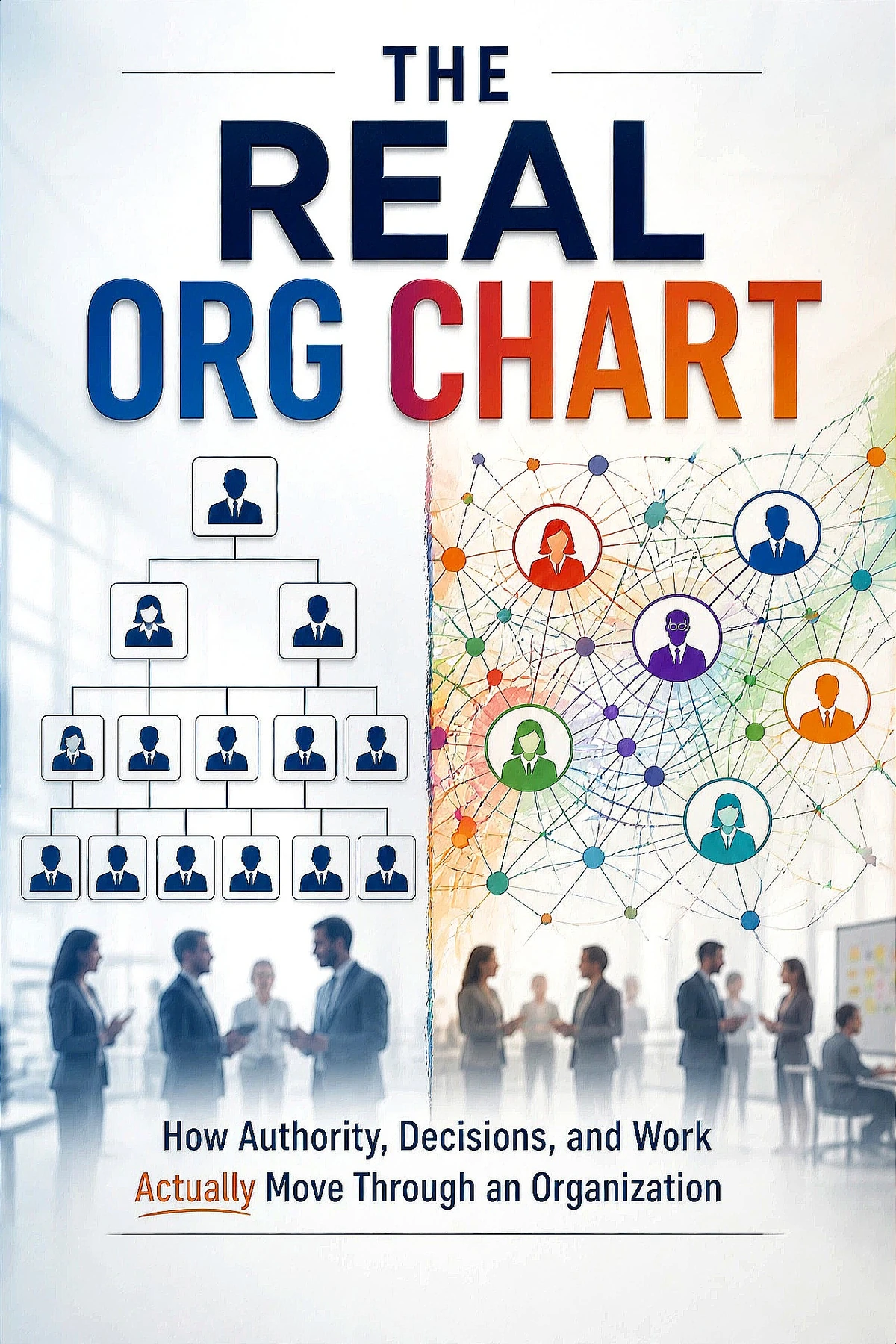
The Real Org Chart
This lesson teaches chapter 9. The book runs to fourteen chapters, worked end to end through a single company — how a decision travels, where authority and responsibility come apart, what a handover really costs, and how to draw the structure your organization actually uses. Written and donated to the Foundation by GSU's founder, Dr. Gene A Constant.
Read on Kindle The whole class
The class is free and always will be. As an Amazon Associate, Global Sovereign University earns from qualifying purchases; every cent funds tuition-free education.
Global Sovereign University: Different by Design. Better by Mission.