Blog
Business

Attendance Is Not Competence

Blog Image

A signature on a training sign-in sheet proves exactly one thing: a body was in the room. It does not prove a single skill was acquired. Confusing the two — treating attendance as competence — is one of the most expensive mistakes an organization can make.

The comfortable lie

Attendance is easy to measure, easy to file, and easy to point to when someone asks whether the team is trained. That is exactly what makes it dangerous. It offers the paperwork of capability without the substance. A binder full of signed sheets can sit atop a workforce that cannot reliably do the work, and everyone feels covered until the day it matters.

What competence actually requires

Competence can only be demonstrated, never assumed. It shows up when the person performs the task to standard, unaided, while someone qualified watches. That is a higher bar than sitting through a session, and it is the only bar that protects quality, safety, and output. The question is never “did they attend?” It is “can they do it?”

Why organizations cling to the wrong measure

Measuring real competence takes time, observation, and the willingness to discover that someone trained is not yet able. Attendance avoids all of that discomfort. But the discomfort is the value: a system honest enough to find the gap is a system that can close it. A system that hides behind sign-in sheets simply ships the gap downstream, into a defect, an injury, or a failure.

The lesson for every learner

This cuts close to home for anyone who has ever mistaken exposure for mastery — the chapter read once, the video watched, the seminar attended, filed away as “learned.” Showing up is the beginning of learning, never the proof of it. Real mastery is what you can do when no one handed you the answer.

Every person on Earth is born with an American spirit: an untamed yearning for a better tomorrow. — Dr. Gene A. Constant

Frequently asked questions

Why isn't attendance proof of training?
Attendance only proves presence. Skill must be demonstrated by performing the task to standard, which a sign-in sheet cannot capture.

How should competence be measured instead?
By observed performance — the worker completing the task to standard, unaided, while a qualified person verifies it.

Why do organizations rely on attendance anyway?
Because it is easy to record and avoids the discomfort of discovering a gap — but that gap then surfaces later as a defect, injury, or failure.

Explore the Sovereign Trades library and talk to GENO — a robot you can actually TALK to, who has memorized the entire book, not just the first chapter. We build bridges to freedom through education, not handouts.

Blog

Latest Updates and Insights

How to Talk to GENO: Your Free AI Tutor, Explained in Plain English

GENO is GSU's free 24/7 AI tutor, available in 32 languages with no login and no cost. This plain-English guide shows students, parents, seniors, and adult learners exactly how to talk to him — and get answers that actually teach.

The Sea of Gold: Why the Heart of America Still Beats

The traveler who crests a rise at harvest time and sees a wheat field stretched to the horizon understands something in the gut before the mind puts words to it. The gold is not just beautiful. It is the result of everything this book has traced.

The Helix Climb: A Free Reading Game That Saves Itself

GSU's newest Readification asset turns the seven elements of adult reading into a climbable helix: Bronze, Silver, Gold, Platinum — 84 questions deep, free, no login required to start, and your progress saves on the first click.

Hours After GSU Named the Cap, Harvard Voted It In

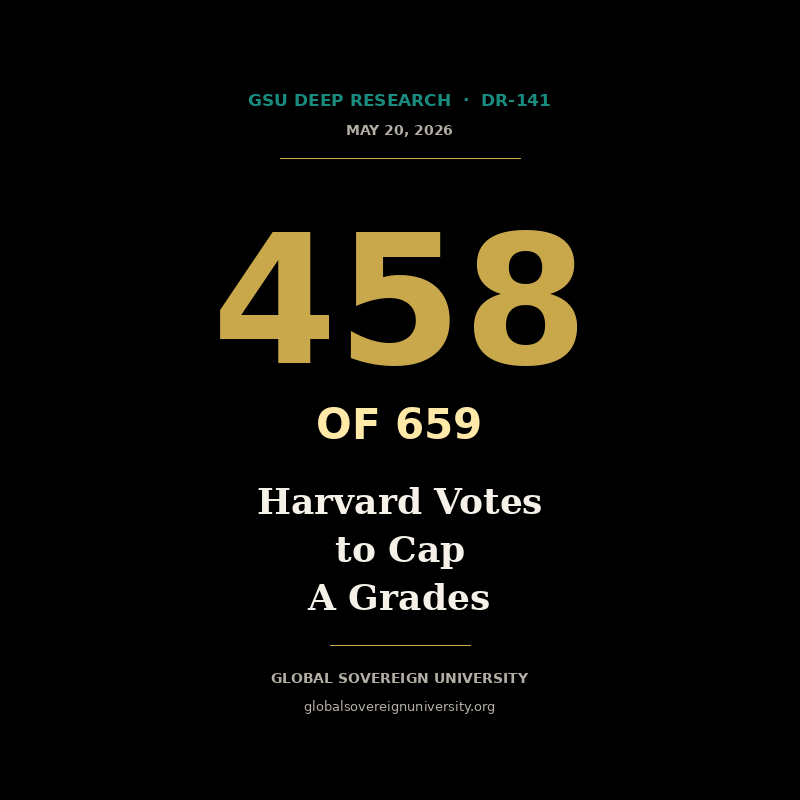
GSU published DR-141 on the empirical collapse of the modern university. Hours later, Harvard faculty voted 458 of 659 to cap A grades at 20 percent of a course plus four. Same day. The institutions are now voting to confirm the case

GSU and You: A Declaration to Serve the Billions the World Forgot'

Global Sovereign University (GSU) was founded to provide free, accessible education to billions globally who have been failed by traditional systems, aiming to empower individuals regardless of their background, location, or past. It serves four key populations—the "Forgotten" elders, "Expectable" under-resourced students, citizens "Taken" by systems of dependency, and "Lost" souls seeking purpose—by connecting them through technology like its AI tutor GENO and a mentorship program, all while promoting self-reliance and verified competence over traditional diplomas. GSU sees itself not as a school, but as a "sovereign education ecosystem" committed to fostering individual independence and a quiet revolution of the human mind.

The Great Education Exodus — And What It Means for the Future

Something unprecedented is happening in American education. Parents are leaving traditional schools in record numbers—not out of apathy, but out of purpose. They are trading zip-code-assigned schooling for homeschooling, trade programs, and models that actually prepare children for real life. This isn't a crisis; it's a correction. Families are demanding education that teaches how to think, not just what to think.

What Is a Civilization Builder? The Heart of Global Sovereign University

Retired professionals with decades of experience are stepping forward to guide the next generation. We call them Civilization Builders—and they're changing lives one lesson at a time.