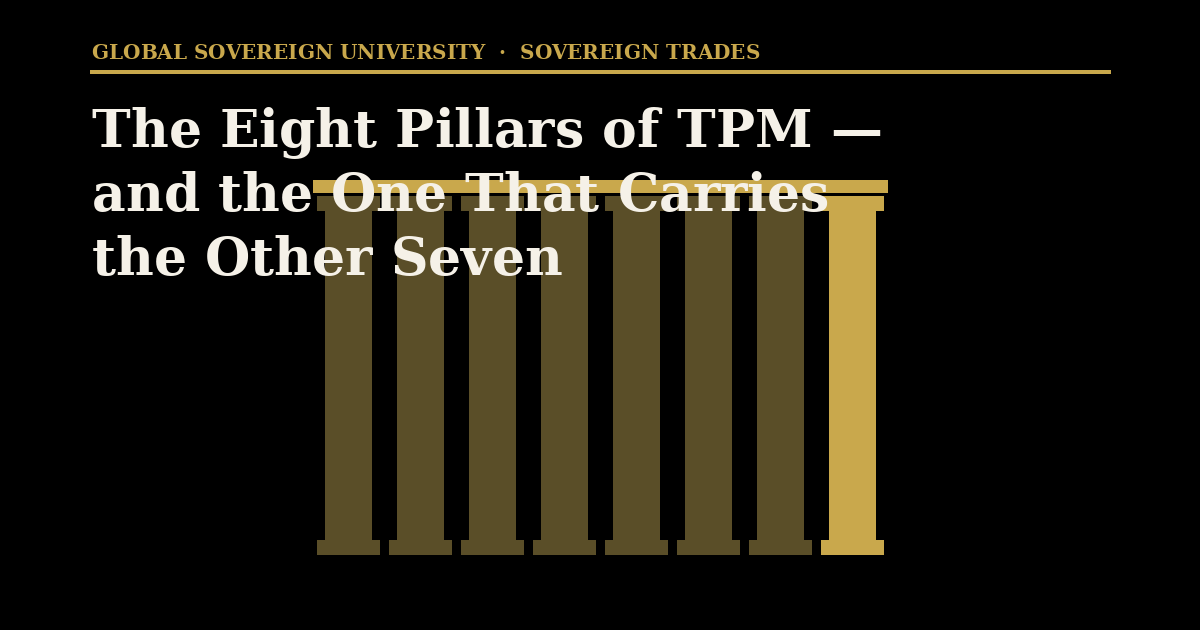
Walk into almost any plant that has tried Total Productive Maintenance and you will hear the same eight words taught as eight separate programs: Autonomous Maintenance, Planned Maintenance, Focused Improvement, Quality Maintenance, Early Equipment Management, Safety-Health-Environment, TPM in Administration, and Education and Training. They get drawn as a row of pillars holding up a roof labeled “world-class manufacturing.” Eight pillars, eight committees, eight binders. It is a tidy picture. It is also why so many TPM programs quietly die in their second year.
The picture is wrong in a specific way
The pillars are not parallel. Look closely at any one and you find the same hidden dependency. Autonomous Maintenance asks operators to own routine care of their equipment — but a cleaning standard carried out by untrained eyes is janitorial work, not inspection. The whole point is that the operator sees the loose bolt, the weeping seal, the bearing that runs a few degrees too warm. Sight like that is taught. It does not arrive with the coveralls.
Planned Maintenance has the same secret. It only prevents failure if the technician carries genuine diagnostic skill, not merely wrench time and a calendar. Focused Improvement teams stall the moment they need a structured analytical method nobody gave them. Quality Maintenance depends on people who understand the live relationship between machine condition and product defect. Even Safety — especially Safety — is a trained capability, not a laminated poster by the time clock.
What every pillar actually stands on
Strip each pillar down and the same foundation appears underneath all of them: people who know how. That is what makes Education and Training not the eighth pillar but the load-bearing one — the enabler without which the other seven are organizational charts describing work nobody on the floor is equipped to perform. You can pour money into tools, software, and consultants, and if the capability behind those tools was never built, you have constructed a very expensive house of labels.
Plants discover this the hard way. They launch TPM as a “tools rollout,” push hard for eighteen months, watch the gains flatten, and conclude that “TPM doesn’t work here.” What didn’t work was asking people to execute methods that were never developed in them. The philosophy was sound. The sequence was backwards.
Sequence is the whole game
The practical instruction follows directly: before each pillar’s tools are deployed, the capability behind those tools must be deliberately built, verified, and maintained. A training pillar is not a once-a-year compliance exercise. It is the engine room. It carries a living skill map of who can do what, at what level, on which equipment, and it identifies the gap before the gap causes a breakdown. Build the people, and the seven pillars stand on their own. Skip the people, and no amount of structure will hold the roof up.
The deeper point for anyone outside a factory
Here is why this belongs on a university blog and not just a maintenance manual. The lesson generalizes to every institution a person will ever build or join. A school, a family, a business, a nation — each gets drawn as a set of pillars. And in every case the same quiet truth holds. The pillars are only as real as the capability of the people standing beneath them. Train the people first, and the structure becomes sovereign — able to stand, repair itself, and outlast the person who built it.
Every person on Earth is born with an American spirit: an untamed yearning for a better tomorrow. — Dr. Gene A. Constant
Frequently asked questions
What are the eight pillars of TPM?
Autonomous Maintenance, Planned Maintenance, Focused Improvement, Quality Maintenance, Early Equipment Management, Safety-Health-Environment, TPM in Administration, and Education and Training. Education and Training functions as the foundation the other seven depend on.
Why is Education and Training called the load-bearing pillar?
Because every other pillar requires a trained human to execute it. Without deliberate skill-building, the other seven pillars describe work nobody is equipped to perform.
Why do TPM programs fail?
The most common cause is sequencing: organizations roll out tools before building the capability those tools require, the program stalls, and leaders wrongly conclude TPM does not work for them.
How should a plant sequence a TPM rollout?
Build, verify, and maintain the capability behind each pillar before deploying that pillar’s tools, treating workforce competence as a tracked, living asset rather than a one-time onboarding event.
Explore the Sovereign Trades library and talk to GENO — a robot you can actually TALK to, free, any hour, in 83 languages. We build bridges to freedom through education, not handouts.







.jpeg)
.jpg)