Blog
Business

Arteries of Commerce: The Railroad That Rewrote the Map

Blog Image

Long before most Midwestern farmers ever heard a locomotive whistle close enough to rattle a windowpane, the railroad existed in their lives as rumor, promise, and threat. It was the first technology that tried to overrule the prairie's vote — not by negotiating with the landscape the way trails did, but by cutting a fixed path through it and insisting the nation move to its rhythm.

The transcontinental railroad was not laid. It was financed, argued over, and imagined into existence with a mixture of private ambition and public policy. Land grants offered alternating sections of public land to railroad companies — a checkerboard of incentive stretching along proposed routes.

On the ground, construction was an industrial project in the raw. Grading crews carved a level bed across uneven ground, bridging rivers, blasting cuts, filling low places. Timber for ties. Iron and then steel for rails. And an endless appetite for labor — Irish immigrants, veterans, freedmen, Chinese workers recruited into some of the hardest tasks. Accidents were common. The expectation of replacement was baked into the system.

When the rails arrived, they changed what a town meant. A siding appeared where water could feed engines and crews. A depot followed. Then a store, a school, a church. Towns that landed on rail lines flourished. Towns a few miles away faded into memory. The sorting power of steel was as consequential as the steel itself.

The railroad also re-taught time itself. Trains cannot tolerate ambiguity about noon. "Railroad time" became standardized time. Clocks adjusted. Towns adjusted. People who had measured their day by chores and weather now lived under a grid not only of land sections but of synchronized minutes.

Read the full story in The Epic Heart of America by Dr. Gene A. Constant — available on Amazon or as a free PDF at globalsovereignuniversity.org.

Blog

Latest Updates and Insights

How to Talk to GENO: Your Free AI Tutor, Explained in Plain English

GENO is GSU's free 24/7 AI tutor, available in 32 languages with no login and no cost. This plain-English guide shows students, parents, seniors, and adult learners exactly how to talk to him — and get answers that actually teach.

The Sea of Gold: Why the Heart of America Still Beats

The traveler who crests a rise at harvest time and sees a wheat field stretched to the horizon understands something in the gut before the mind puts words to it. The gold is not just beautiful. It is the result of everything this book has traced.

The Helix Climb: A Free Reading Game That Saves Itself

GSU's newest Readification asset turns the seven elements of adult reading into a climbable helix: Bronze, Silver, Gold, Platinum — 84 questions deep, free, no login required to start, and your progress saves on the first click.

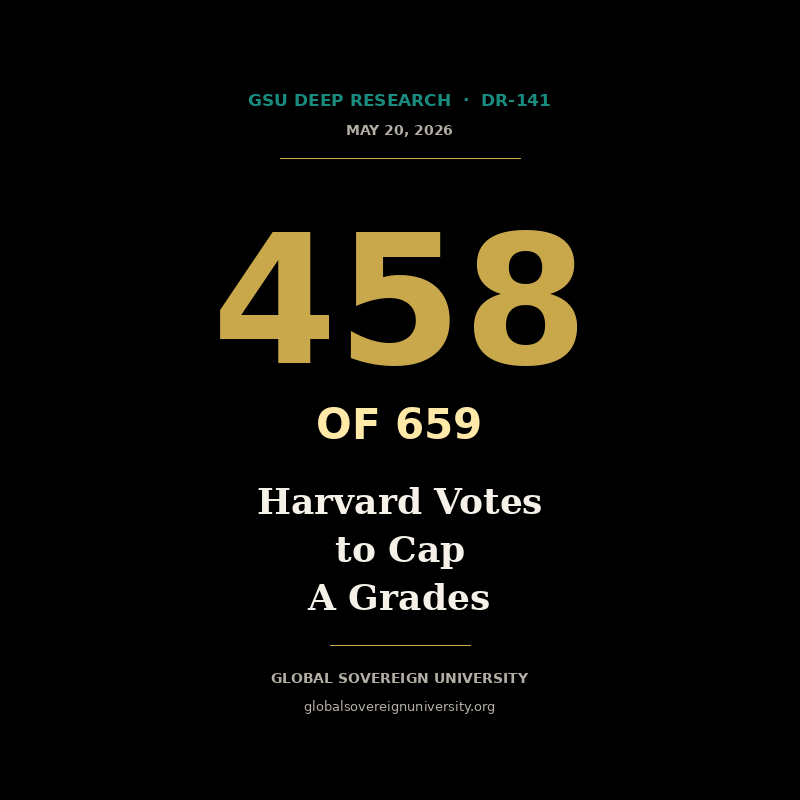
Hours After GSU Named the Cap, Harvard Voted It In

GSU published DR-141 on the empirical collapse of the modern university. Hours later, Harvard faculty voted 458 of 659 to cap A grades at 20 percent of a course plus four. Same day. The institutions are now voting to confirm the case

GSU and You: A Declaration to Serve the Billions the World Forgot'

Global Sovereign University (GSU) was founded to provide free, accessible education to billions globally who have been failed by traditional systems, aiming to empower individuals regardless of their background, location, or past. It serves four key populations—the "Forgotten" elders, "Expectable" under-resourced students, citizens "Taken" by systems of dependency, and "Lost" souls seeking purpose—by connecting them through technology like its AI tutor GENO and a mentorship program, all while promoting self-reliance and verified competence over traditional diplomas. GSU sees itself not as a school, but as a "sovereign education ecosystem" committed to fostering individual independence and a quiet revolution of the human mind.

The Great Education Exodus — And What It Means for the Future

Something unprecedented is happening in American education. Parents are leaving traditional schools in record numbers—not out of apathy, but out of purpose. They are trading zip-code-assigned schooling for homeschooling, trade programs, and models that actually prepare children for real life. This isn't a crisis; it's a correction. Families are demanding education that teaches how to think, not just what to think.

What Is a Civilization Builder? The Heart of Global Sovereign University

Retired professionals with decades of experience are stepping forward to guide the next generation. We call them Civilization Builders—and they're changing lives one lesson at a time.