Blog
Business

The Ocean of Grass: What the Prairie Refused to Provide

Blog Image

The first thing most newcomers noticed was not what the prairie contained, but what it refused to provide. No mountains to grab the eye. No dense forests to promise shade and shelter. On the Great Plains, the horizon did not end so much as it simply kept going — an unbroken ring that made even a confident traveler feel briefly unmoored.

To someone arriving from the wooded East, the grass could feel like an ocean turned upright. It moved in long, synchronized ripples, bending and rising with the wind, shifting color with the light. Early travelers returned to a familiar language to describe the unfamiliar: waves, swells, seas. The prairie did not offer the stillness of a meadow. It offered motion — it hummed with it, whispered with it, roared with it when storms rolled in.

Those storms were among the first lessons the land delivered. Clouds gathered with a speed that seemed impossible over such a flat expanse. In the distance, a dark line would form, like ink in water, then race toward you until the sky overhead turned the color of iron. Lightning on the plains was not a polite flicker behind distant hills. It was a vertical crack that split the world open, followed by thunder that arrived with nothing to soften it.

Heat was another kind of assault. In summer, the sun pressed down without obstruction. A stand of cottonwoods that looked close enough to reach by noon could remain stubbornly out of reach until late afternoon. On a land where a single wrong decision might mean dehydration, exposure, or losing the trail, the prairie's apparent simplicity could become a test of discipline.

And yet, for all its scale, it was not empty. The grassland was a system — intricate and resilient, shaped by cycles of drought and renewal, by grazing herds, by fire, and by the deep roots of plants adapted to survive extremes. Some prairie grasses sent their roots down farther than a person was tall, anchoring soil and storing moisture. The surface could look delicate, even fragile, but beneath it the prairie held itself together with a web of living cords.

To understand the heart of America, you have to start here: in the moment when a traveler crests a rise and sees nothing but grass and sky, and realizes the frontier is not a line on a map. It is an experience. And it starts with learning how to live in the open.

Read the full story in The Epic Heart of America by Dr. Gene A. Constant — available on Amazon or as a free PDF at globalsovereignuniversity.org.
Blog

Latest Updates and Insights

How to Talk to GENO: Your Free AI Tutor, Explained in Plain English

GENO is GSU's free 24/7 AI tutor, available in 32 languages with no login and no cost. This plain-English guide shows students, parents, seniors, and adult learners exactly how to talk to him — and get answers that actually teach.

The Sea of Gold: Why the Heart of America Still Beats

The traveler who crests a rise at harvest time and sees a wheat field stretched to the horizon understands something in the gut before the mind puts words to it. The gold is not just beautiful. It is the result of everything this book has traced.

The Helix Climb: A Free Reading Game That Saves Itself

GSU's newest Readification asset turns the seven elements of adult reading into a climbable helix: Bronze, Silver, Gold, Platinum — 84 questions deep, free, no login required to start, and your progress saves on the first click.

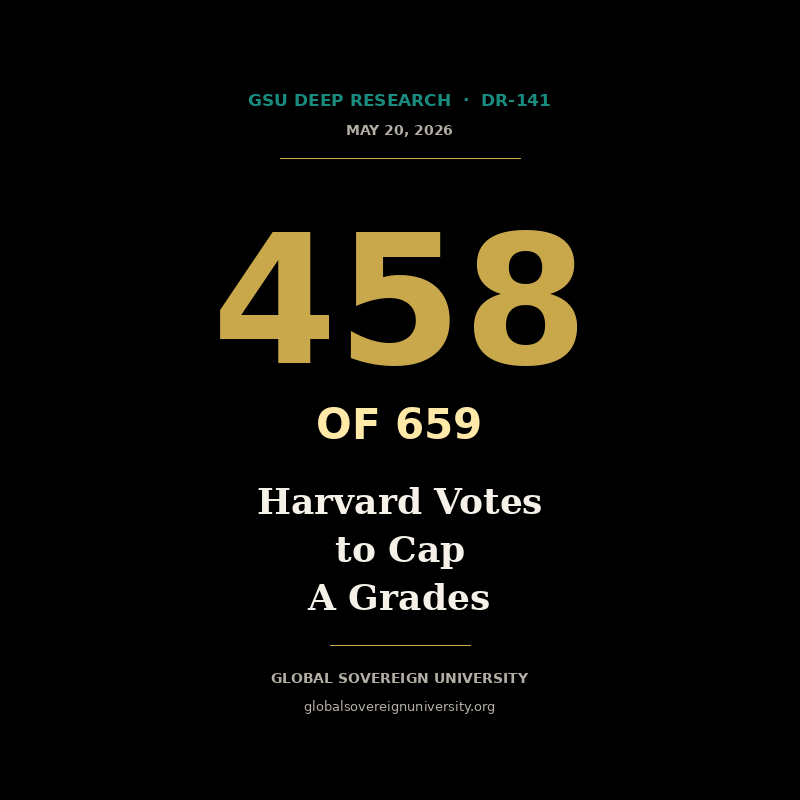
Hours After GSU Named the Cap, Harvard Voted It In

GSU published DR-141 on the empirical collapse of the modern university. Hours later, Harvard faculty voted 458 of 659 to cap A grades at 20 percent of a course plus four. Same day. The institutions are now voting to confirm the case

GSU and You: A Declaration to Serve the Billions the World Forgot'

Global Sovereign University (GSU) was founded to provide free, accessible education to billions globally who have been failed by traditional systems, aiming to empower individuals regardless of their background, location, or past. It serves four key populations—the "Forgotten" elders, "Expectable" under-resourced students, citizens "Taken" by systems of dependency, and "Lost" souls seeking purpose—by connecting them through technology like its AI tutor GENO and a mentorship program, all while promoting self-reliance and verified competence over traditional diplomas. GSU sees itself not as a school, but as a "sovereign education ecosystem" committed to fostering individual independence and a quiet revolution of the human mind.

The Great Education Exodus — And What It Means for the Future

Something unprecedented is happening in American education. Parents are leaving traditional schools in record numbers—not out of apathy, but out of purpose. They are trading zip-code-assigned schooling for homeschooling, trade programs, and models that actually prepare children for real life. This isn't a crisis; it's a correction. Families are demanding education that teaches how to think, not just what to think.

What Is a Civilization Builder? The Heart of Global Sovereign University

Retired professionals with decades of experience are stepping forward to guide the next generation. We call them Civilization Builders—and they're changing lives one lesson at a time.