Isabel Beck, the University of Pittsburgh reading researcher whose three-tier vocabulary framework now anchors most evidence-based vocabulary instruction in American schools, was once asked what the single strongest predictor of reading comprehension is. Her answer was not what most people expected.
Not phonics. Not fluency. Not background knowledge, though that comes close.
Vocabulary. The size and depth of a reader's word knowledge is the single strongest predictor of reading comprehension once decoding and fluency are in place. A reader who decodes well, reads fluently, and does not know the words still does not understand. This is not a controversial finding. It has been replicated for sixty years.
The three tiers. Beck's framework divides English vocabulary into three layers. Tier 1 is everyday conversational vocabulary — table, run, happy, cold. Most children acquire Tier 1 vocabulary through ordinary speech. Tier 2 is the high-utility academic vocabulary that opens up most non-fiction reading — analyze, sustain, fundamental, perspective, consequence. Tier 2 words are sophisticated but not technical. They appear across subject areas and across genres. Tier 3 is domain-specific technical vocabulary — mitosis, jurisprudence, pentameter. Tier 3 is taught in subject-area classes.
It is the Tier 2 layer that most adult learners and most children most need — and the layer that is most often neglected.
Why “vocabulary word of the day” does not work. The research on how vocabulary is actually learned is uncomfortable for traditional school practice. Children and adults do not learn words from dictionary definitions. They learn words from repeated exposure in meaningful context. A single encounter with a new word, even with definition attached, almost never produces lasting learning. Five to ten encounters in different contexts — different sentences, different texts, different conversations — typically does.
This is why reading volume matters more than any vocabulary intervention. A child who reads two hours a day encounters more rare vocabulary in a week than a child who reads twenty minutes a day encounters in a month. The gap compounds. By high school it is unbridgeable through any direct vocabulary instruction.
The morphology shortcut. The other half of vocabulary growth is morphology — the system of prefixes, roots, and suffixes that English inherited from Greek, Latin, and Old English. Twenty common Greek and Latin roots unlock thousands of English words. “Auto” (self) plus “bio” (life) plus “graph” (write) plus “y” (act of) gives you “autobiography” — and gives you the building blocks for thousands of other words.
Morphology instruction is rare in American schools above the third grade. It should not be. It is the single most powerful vocabulary expansion tool available.
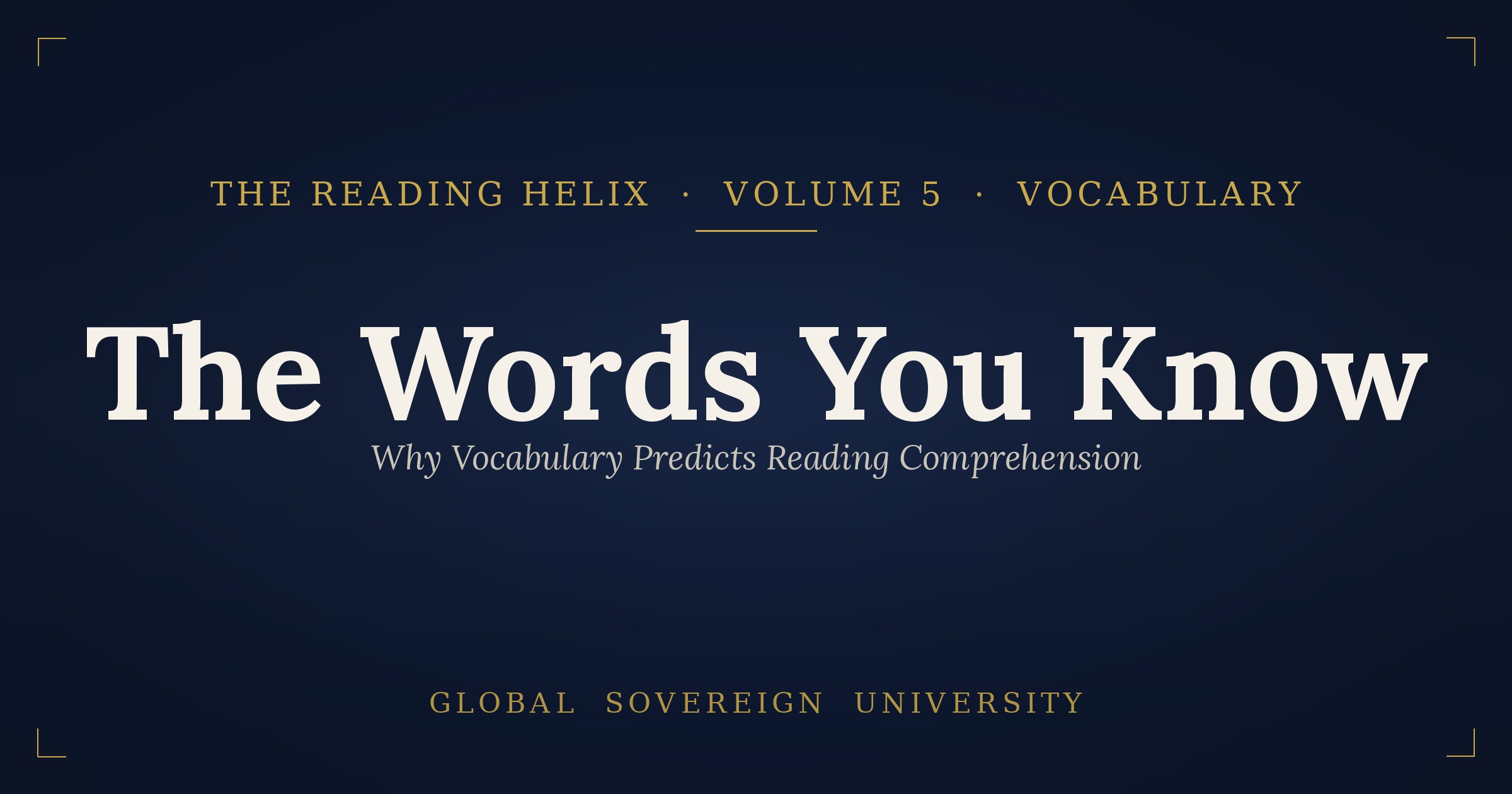
The Reading Helix vocabulary book. The Words You Know is the fifth volume in The Reading Helix series — free education from Global Sovereign University Press, mailed at no charge to anyone who requests a copy. It teaches vocabulary the way research says vocabulary is actually learned: through reading volume, through morphology, through deliberate practice with high-utility Tier 2 words, and through the discipline of word consciousness — the habit of noticing and pursuing unfamiliar words rather than skipping them.
Request your free copy at globalsovereignuniversity.org. We will mail it to you anywhere in the United States at no charge. The book is not for sale. It is free. That is what the foundation does.





.jpeg)
.jpg)