Lesson 10 · from Chapters 11 and 15
Attention and the Psychology of the Loop
An agent can work at any hour, never carries residue from the last task, and does not become less discerning after the fiftieth similar case. The person asked to oversee it can do none of those things. This lesson is about designing for the second one.
Step one
Five ideas
Read each one. Mark it read, or have it read to you. The test at the bottom draws from these five and nowhere else.
Idea one
Time saved is not capacity recovered
The promise is straightforward: the agent will draft the report, retrieve the policy, organise the case, prepare the recommendation. In narrow task terms that is frequently true. But time saved on visible task execution does not automatically become cognitive capacity recovered.
Cognitive load comes in three kinds. Intrinsic load is the inherent complexity of the work — interpreting a complicated contract, diagnosing a failure. Some of it is inseparable from meaningful professional judgement. Germane load is the productive effort of building understanding: how policy conditions relate, what failure modes look like, what pattern sits behind a metric. It is demanding and it contributes to capability. Extraneous load is the effort imposed by the design of the environment rather than the substance of the work — switching between disconnected tools, deciphering unclear system states, responding to unnecessary alerts, reconstructing an agent's hidden reasoning, working out again whether a recommendation has already been validated. It consumes attention without deepening expertise or improving the decision.
Here is the paradox. An agent reduces intrinsic load by doing the retrieval, synthesis and drafting. Then it introduces a stream of opaque recommendations, alerts, confidence indicators, exceptions and handoffs that all require interpretation — and creates a new and more draining form of extraneous load. The employee becomes a cognitive air-traffic controller for machine activity.
So the specialist no longer spends an hour preparing a case from scratch. They spend forty-five minutes deciding whether the agent's apparently complete package can be trusted. The work has changed. It has not necessarily become easier.
And the measurement misses it entirely. The system may report productivity because more cases are touched per hour. The worker may experience exhaustion because each touch requires defensive cognition.
Idea two
Trapped between overreliance and overchecking
A well-calibrated system makes clear what has been verified, what remains uncertain, why a recommendation is being made, and what action is permitted. A poorly calibrated one presents ambiguous confidence signals, inconsistent explanations, generic warnings, and a growing volume of output that appears too complete to ignore but too uncertain to accept without investigation.
That leaves the worker with two bad options. Overreliance produces automation bias — the exhausted specialist accepts because challenging feels too costly, and risk transfers silently to the customer or the public. Overchecking produces paralysis — every case reconstructed by hand because the system has not earned enough trust to permit selective reliance, converting an expensive agentic system into an extra layer of administration. Neither condition represents successful augmentation.
The way out starts by rejecting an assumption: that more information is always more helpful. An agent can generate extensive rationales, dozens of citations, alternatives, predicted outcomes and live alerts. The operator does not need all of it at every moment. They need what is required to make the next legitimate decision. The design problem is not simply to make agentic reasoning visible. It is to make the right aspect of that reasoning visible to the right person at the right time.
A fully verified low-risk case may need only a concise explanation and confirmation that the governing policy and account facts were validated. A case with a contract conflict needs the conflicting provisions, their effective dates, the validator's objection and the decision requiring interpretation. Presenting both with the same volume and structure forces the worker either to ignore important distinctions or to inspect unnecessary detail.
The same applies to urgency. A red-tolerance gate should command attention because it marks a condition exceeding autonomous authority; a routine validator confirmation should not compete for the same priority. If every event is presented as urgent, nothing is meaningfully urgent — and the specialist learns to scan, dismiss, and eventually ignore the signals meant to protect the process. This is not a personal failure of discipline. It is a design failure.
Idea three
Machine availability is not a demand for human availability
Attention is not a switch that can be turned off and restored intact. Working through an ambiguous contract or tracing a variance means building a temporary mental structure — holding facts in mind, identifying relationships, testing interpretations. That structure is fragile.
An agent has no comparable constraint. It can retrieve thousands of documents, monitor exceptions and issue alerts at any hour. It does not experience attentional residue after changing tasks. It does not lose sleep after a difficult customer interaction. It does not become less discerning because it has reviewed too many similar recommendations. It can create work continuously. The people asked to oversee it cannot.
Which creates a design obligation. The agentic enterprise must not allow machine availability to become an implicit demand for continuous human availability, and must not mistake rapid machine output for a reason to accelerate human judgement beyond safe cognitive limits. The purpose of human-centred design is not to make people work more like agents.
When signals arrive continuously the nervous system stays in partial readiness. This condition is not sustained focus. It is sustained interruption. The worker begins an analysis, takes an alert, answers a message about a blocked workflow, returns — and finds the context has weakened, with residue from the previous task still occupying the mind. They feel busy all day while completing little deep work and retaining less confidence in what was completed.
So the design question is not how quickly the system can notify someone. It is: does this notification require attention now, from this person, in this form? Real-time visibility does not require real-time interruption — many conditions can be logged, grouped, ranked and reviewed on a schedule. And a notification that arrives when the recipient cannot act is not always protective. It may merely transfer anxiety. An after-hours alert about something only the AI Mechanic can resolve creates burden without increasing control.
Idea four
Mode uncertainty
One of the most exhausting features of badly designed AI work is that the person cannot tell what is being asked of them.
Am I being asked to observe, approve, edit, investigate, authorise, or take over this case? Has the agent already sent the communication? Is the proposed action reversible? Is what I am looking at a suggestion, a validated conclusion, or a pending commitment?
Ambiguity of role increases cognitive load because the worker must first infer the nature of the task before they can perform it. That inference happens on every case, it is invisible in any handling-time measure, and it is pure extraneous load — it teaches nothing and improves no decision.
Designing for explicit modes is the remedy, and it pairs with the routing question from the previous idea. The system should reduce the number of decisions a person must make merely to understand what the system is doing: group related actions, preserve context across handoffs, suppress alerts that do not require action, and distinguish genuine abnormalities from ordinary workflow events. Signals should go to the role that can respond, at the time when response is required, with the information necessary to act.
And note what this rules out as a remedy. Organisations often answer AI fatigue with resilience training, time-management guidance or prompting instruction. Those may help at the margin, but no amount of personal productivity advice can compensate for an interface that requires workers to reorient across ten concurrent agentic threads and defend every decision against a volume of machine-generated plausibility.
Idea five
Automation bias is physiology, not professionalism
Most knowledge workers do not intend to defer blindly. Service specialists want to resolve cases fairly; engineers want reliable code. Good intentions do not eliminate the limits of attention, working memory, time and emotional endurance.
Cognitive fatigue is not tiredness at the end of a hard day. It is the depletion of the resources needed to sustain attention, compare alternatives, recognise ambiguity, hold several facts at once, inhibit an immediate response, and detect when something plausible is not actually justified. Those are precisely the capacities required for meaningful oversight.
Now add the queue. The agent produces twenty recommendations while the specialist evaluates the first. Response-time targets stay visible. Rejecting an output requires reopening sources, writing an explanation, escalating — more effort than accepting it. Under these conditions, acceptance becomes psychologically easier than challenge.
A specialist may know perfectly well that the agent can misclassify an amendment or retrieve an outdated source. But having reviewed fifty case packages, absorbed alerts across several systems and faced a growing exception queue, their capacity to test the fifty-first is not what it was at the start of the day. The problem is not a lack of professionalism. It is the physiology of finite attention.
So mental fatigue has to be treated as an operational abnormality rather than a personal one. When acceptance rises without evidence of better grounding, when exception queues grow, when people report being simultaneously faster and less certain — investigate the workflow, not the worker. Otherwise the organisation optimises the visible system while the invisible one deteriorates: high throughput will conceal low confidence, low override rates will conceal exhaustion, and the absence of reported problems will conceal the absence of available attention.
A cognitively mature organisation makes it legitimate to say this workflow is asking for more judgement than the role can safely provide, and treats that as a signal for investigation rather than evidence of weakness. No gain in speed justifies the routine depletion of the people responsible for meaning, judgement, accountability and care.
Step two
The attention budget
Every alert costs twice: the time to deal with it, and the time to rebuild the thinking it interrupted. The second cost is larger and almost never counted. Set the day and watch what is left.
Try this. Count the notifications you received yesterday from any system, agentic or not. Then sort them by the three-part question: did it need you, did it need you then, and was it in a form you could act on? Most people find the justified share is under a third.
The rest were not free. Each one cost a handful of minutes to read and a much larger number to recover from — and that second cost never appeared in any measure of your day.
Step three
Show that it holds
Ten situations, two per idea, drawn at random. Two right in a row on an idea marks it solid. A wrong answer tells you why that particular choice fails, and sends you back to the one idea it was testing.
All five hold.
You can separate the three loads and say which one an agent adds, name the trap between overreliance and overchecking, route a signal by whether it needs this person now, spot mode uncertainty, and treat fatigue as an operational abnormality rather than a personal one. Lesson eleven turns to the register — keeping an asset inventory for things that are not objects.
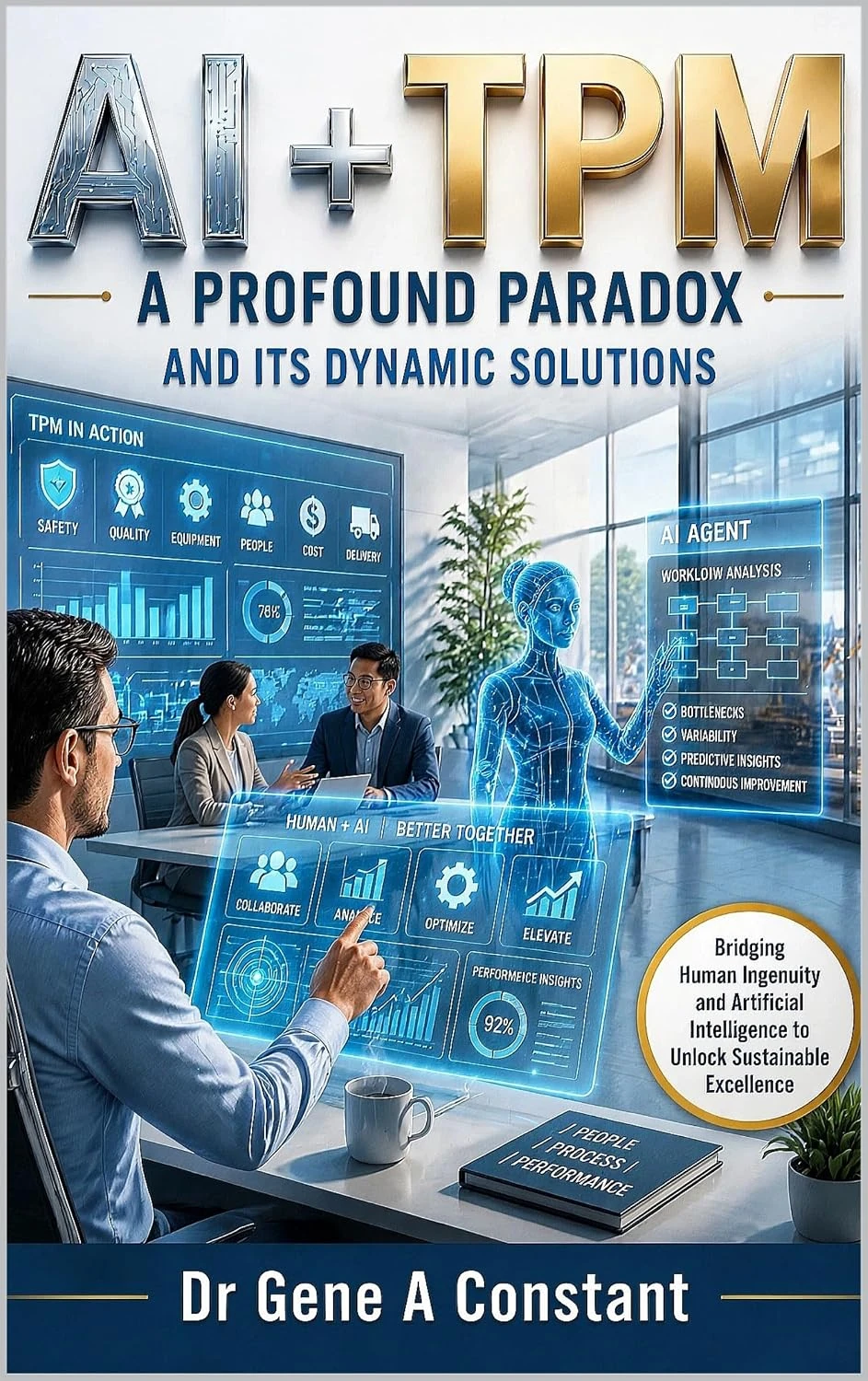
AI + TPM: A Profound Paradox and Its Dynamic Solutions
This lesson teaches chapters 11 and 15 together. The book runs to twenty chapters and sets out Cognitive Capability Maintenance in full — the framework this class is built on. Written and donated to the Foundation by GSU's founder, Dr. Gene A Constant.
Read on Kindle The whole class
The class is free and always will be. As an Amazon Associate, Global Sovereign University earns from qualifying purchases; every cent funds tuition-free education.
Global Sovereign University: Different by Design. Better by Mission.