Lesson 16 · from Chapters 19 and 20
Future-Proofing, and the Profound Paradox
The last lesson, and the one the book is named for. No agentic system remains trustworthy merely because it was trustworthy at the moment of deployment — and the paradox at the centre of all this was never a contradiction to be solved once.
Step one
Five ideas
Read each one. Mark it read, or have it read to you. The test at the bottom draws from these five and nowhere else.
Idea one
Trustworthy at deployment is not trustworthy
Future-proofing begins with the recognition that no agentic system remains trustworthy merely because it was trustworthy at the moment of deployment. Capability has to be renewed continuously — before drift becomes visible harm, before employee habits harden into automation bias, and before a once-sound workflow becomes disconnected from the changing reality it was designed to serve.
Which makes learning something other than a training event, a post-incident report or an annual retreat. In CCM, learning is a maintained operating capability. The ontological architect, the AI Mechanic, the security steward, the process owner, the specialist and the accountable leader each meet a different signal of change; the organisation stays adaptive only when those signals are interpreted together.
And the need is acute because agentic environments change on several timescales at once. A model provider may alter behaviour overnight. A prompt library may degrade gradually as new business language enters the enterprise. A policy repository may be updated formally while old documents remain embedded in the retrieval corpus. A specialist may develop an informal workaround that improves a hard handoff and never becomes standard work. None of these changes is isolated.
So the question changes. The future-proof organisation does not ask "has our AI been implemented?" It asks: what are we learning about the conditions under which this capability remains legitimate, reliable and sustainable?
That reframes the data. In a weak organisation, data is collected to prove a deployment succeeded — rising autonomous completion, lower handling time, reduced cost per case. These measures can conceal the very forms of decay CCM exists to detect. A rising completion rate may coincide with lower source freshness. Faster responses may conceal rising reopenings. Reduced handling time may be achieved by shifting cognitive burden onto specialists correcting flawed recommendations after hours. Fewer reported errors may reflect an environment in which people no longer feel able to challenge the system.
A learning organisation treats those tensions as information. The point is not to assume every deviation is failure. It is to prevent isolated metrics from becoming substitutes for understanding.
Idea two
Cumulative rather than anecdotal
Continuous learning needs a cadence. Calibration sessions belong in the operational rhythm of consequential workflows, not convened only after a serious incident. Participants examine completed cases, emerging exceptions, agent overrides, source conflicts, near misses and unfamiliar patterns — comparing what the agent recommended, what evidence it used, what the validator checked, what the specialist decided, and what later outcomes revealed.
And here is the part most reviews miss. The most valuable cases are often not obvious failures. They are the cases in which the system technically performed as designed but exposed a weakness in the design itself. Several customers receive individually correct remedies that are collectively inadequate because no repeated-contact pattern was recognised. Retrieval still returns authoritative documents — after a growing number of irrelevant ones. No data was exposed during a suspicious attachment event, and the contract agent made several attempts to widen its retrieval scope before policy controls stopped it.
These are not merely operational details. They are learning material — and they should be converted into maintained assets. A newly recognised source conflict becomes a regression case. A repeated override becomes an ontology review. A suspicious tool-use pattern becomes a behavioural-detection rule. A difficult ethical decision becomes a calibration scenario. In this way, learning becomes cumulative rather than anecdotal.
Without that, lessons scatter across meeting notes, ticket systems, private messages and the memories of experienced employees — a familiar form of knowledge-work entropy: the same problem is rediscovered repeatedly because no shared mechanism exists for preserving the insight.
But accumulation has to be governed. Adaptation without semantic discipline creates its own instability. If every local exception becomes a permanent category, the ontology bloats. If every informal workaround is encoded as policy, the workflow accumulates contradictions. If every metric fluctuation triggers a new control, you get alarm fatigue.
So learning must be selective. The question is not whether an event is novel. It is whether the event reveals a pattern that changes what the organisation needs to know, control or sustain. A single unusual request may need careful handling without a redesign. A recurring pattern exposing a missing relationship-level category may need an ontological revision. Adaptation is disciplined when it distinguishes signal from noise.
Idea three
Staged autonomy, and change as a portfolio
Future-proofing does not mean freezing systems until every uncertainty disappears. Organisations need controlled opportunities to test new models, agent roles, revised prompts and retrieval strategies — through sandboxes, digital twins, limited pilots and staged autonomy rather than unrestricted production exposure.
A promising new retrieval model first runs in shadow mode: it reviews the same cases but influences nothing, and its retrieval choices, source ranking, confidence patterns and errors are compared against verified outcomes and specialist judgement. If it improves performance without reducing provenance, increasing security risk, or adding unsustainable review complexity, it may progress to recommendation mode. Only later, and only within clearly bounded conditions, should it influence execution. This progression protects the organisation from treating novelty as evidence.
It also protects people. Hybrid workforces cannot absorb an endless sequence of new interfaces, revised escalation rules, model updates and performance expectations without cost. Every change imposes cognitive demand. If people must constantly relearn how to supervise agents while still meeting existing targets, they will eventually retreat into workarounds, passive acceptance, or resistance that appears personal but is actually a response to unmanaged complexity.
Which is why leaders must manage adaptation as a portfolio, not as a stream of disconnected technical releases. Decide which changes are essential, which can be sequenced, which need additional training, and which should wait until there is review capacity. Communicate why a change is happening, what evidence supports it, what authority has changed, and how people can report unexpected effects.
That is adaptive leadership in its clearest form. People are more likely to engage with evolving systems when they can see that learning changes decisions, rather than merely generating more demands.
Idea four
A condition to be maintained
Now the paradox itself. AI lets organisations reduce friction, accelerate analysis, preserve context, automate routine coordination and extend the reach of scarce expertise. Yet the same capability can multiply fragility.
The faster an agent can retrieve, reason, communicate and act, the faster an incomplete source, a weak ontology, a compromised instruction, an excessive permission or an unexamined assumption can acquire organisational force. The more polished the output, the easier it becomes for an exhausted reviewer to mistake fluency for truth. The more work delegated, the greater the danger that human expertise atrophies precisely when it is most needed to challenge the system.
This is not a contradiction to be solved once. It is a condition to be maintained.
Earlier automation assumed a linear relationship: better tools, faster work, higher productivity, advantage — and the management challenge was adoption. The agentic era makes that model inadequate, because an agent does not merely speed up a fixed process. Its impact is recursive. It changes not only what work is done, but how people define work, where they place trust, what they notice, what they stop practising, and how quickly a local defect can become a system-wide pattern.
So the technology that appears to reduce organisational entropy can also generate it at a new scale. A janitorial agent can preserve context across years of activity — and if its ontology is poorly governed, it can organise ambiguity into a more durable form of confusion. An agentic Kaizen system can find micro-frictions invisible to conventional mapping — and if allowed to optimise only for throughput, it may remove the pauses in which people recognise ethical concerns or relationship-level harm. A retrieval system can make authoritative knowledge instantly available — and without provenance and hierarchy, distribute obsolete guidance with extraordinary efficiency.
Which is the honest claim to make about all of it. CCM does not eliminate the profound paradox of AI. It makes the paradox governable. The more capable the system becomes, the more consequential the organisation's responsibility becomes to maintain the evidence, boundaries, human judgement and attention around it.
Idea five
Contestability, and the ultimate measure
Agents are moving beyond discrete tasks into the ordinary fabric of work. Increasingly people will not experience AI as a tool they deliberately open. They will experience it as an ambient layer of the workplace: present in the systems that prioritise work, summarise information, suggest decisions, route exceptions and shape the sequence in which attention is applied.
That creates real opportunity — and a new obligation. When AI becomes less visible, its influence can become harder to question. A recommendation may shape a decision before anyone consciously examines its evidence. A routing system may decide which cases get urgency without anyone seeing the assumptions in its categories. A workflow optimiser may eliminate a pause that appeared inefficient in telemetry but was the moment an employee noticed a human concern the system could not represent.
So the future of human-AI synergy depends on keeping consequential influence intelligible. Not inspecting every token — that would replace automation with impossible surveillance — but understanding, at the point where judgement matters, what is being proposed, what evidence supports it, what uncertainty remains, what authority the system has exercised, and what options remain.
This is the practical meaning of contestability. Anyone affected must not face an opaque conclusion presented as inevitable. They must be able to ask: why was this classified this way? Which sources controlled the recommendation? What information was missing? Who may change the outcome? What happens if I disagree? These questions are not obstacles to intelligent work. They are evidence that intelligence remains connected to legitimacy.
The service workflow modelled it. Its value was never that it issued adjustments faster than a specialist. The system became useful when it helped the specialist see more clearly, not when it made the specialist unnecessary. Human-AI synergy is not achieved when agents imitate people convincingly. It is achieved when humans and agents contribute different strengths within a system designed to preserve accountability.
Which leaves the promise a mature organisation can actually make. It does not claim that its agents are infallible. It claims something more credible: its agents are maintained. Their authority is conditional, their evidence traceable, their failures containable, their permissions reducible — and the people who work with them retain the time, knowledge and authority required to exercise judgement. A more demanding promise than technological perfection, and a more durable one.
So the book ends where the class does. The ultimate measure of human-AI synergy will not be how much work an enterprise can cause agents to perform without people. It will be whether the enterprise can use agentic capability to make people more capable of seeing, deciding, learning, creating and caring.
Step two
The adaptation portfolio
Every change imposes cognitive demand, so a workforce has a ceiling on how much it can absorb. This bench ships changes into that ceiling and reports what actually lands — and what happens to the ones that don't.
Try this. Push the number of changes to twenty and watch adopted capability fall. Then hold it there and raise protected time and headroom — the same twenty changes, and now more of them land. Capacity is the thing you can build; the shipping rate is only what you spend it on.
Then move the essential-share slider on its own. It changes which changes are worth landing, and never how many can. Sequencing is real leadership and it is not extra capacity.
Step three
Show that it holds
Ten situations, two per idea, drawn at random. Two right in a row on an idea marks it solid. A wrong answer tells you why that particular choice fails, and sends you back to the one idea it was testing.
That is the whole class.
Sixteen lessons, twenty chapters, one discipline. You can say why a capability decays, what entropy looks like in knowledge work, why productivity and reliability pull apart, and what Cognitive Capability Maintenance actually asks of an organisation — housekeeping, Kaizen, algorithmic upkeep, epistemic guardrails, teaming, attention, asset governance, measurement, compliance, failure, security, and now renewal.
The paradox does not resolve. It becomes governable, and it stays that way only while someone is maintaining it. That someone is now better equipped to be you.
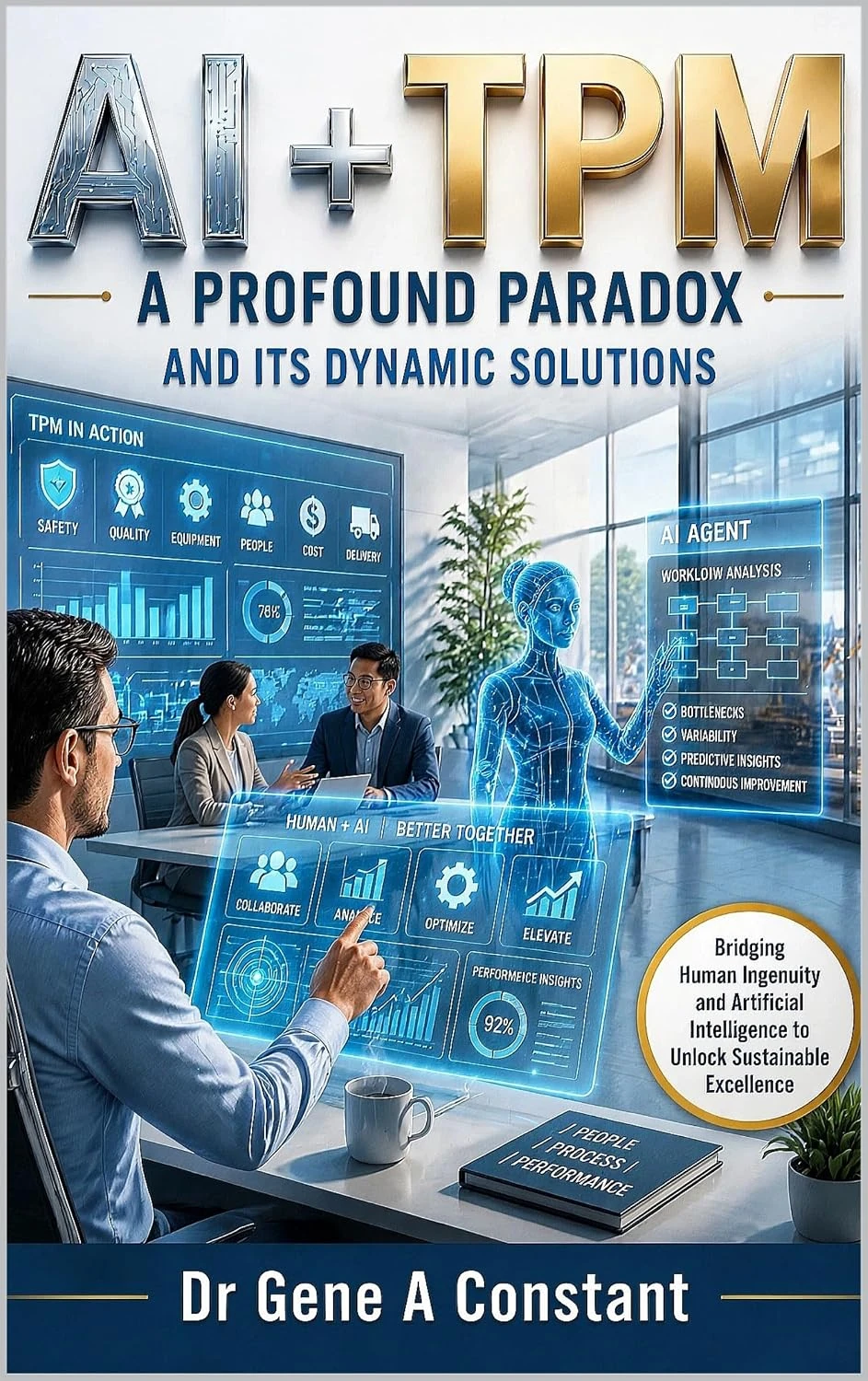
AI + TPM: A Profound Paradox and Its Dynamic Solutions
This lesson teaches chapters 19 and 20 — the last of the twenty. If the class was useful, the book is where the whole framework sits together, in the author's own words rather than a summary of them. Written and donated to the Foundation by GSU's founder, Dr. Gene A Constant.
Read on Kindle The whole class
The class is free and always will be. As an Amazon Associate, Global Sovereign University earns from qualifying purchases; every cent funds tuition-free education.
Global Sovereign University: Different by Design. Better by Mission.