Lesson 2 · from Chapter 2
The Entropy Crisis in Knowledge Work
A broken machine stops producing, which is why nobody has to be persuaded to fix it. A fractured knowledge system keeps producing — reports, forecasts, decisions, all of them fluent. This lesson is about disorder that can still move, and why speed is what turns it from a nuisance into a risk.
Step one
Five ideas
Read each one. Mark it read, or have it read to you. The test at the bottom draws from these five and nowhere else.
Idea one
Disorder that can still move
Knowledge work entropy is not a metaphor. It is a practical operational condition: the tendency of a knowledge system to become less coherent, less trustworthy and more costly to operate over time.
Every organisation creates information faster than it can organise, validate, contextualise and retire it. Every workflow produces exceptions. Every team develops local shortcuts. Every handoff — between people, departments, applications or agents — is an opportunity for meaning to be lost or altered.
What makes it dangerous is that it is masked by fluency. A broken machine is difficult to romanticise; it stops. A fractured knowledge system carries on generating reports, summaries, forecasts and policies, and can even look highly productive, while resting on data that has no clear owner, assumptions that are no longer valid, and chains of reasoning nobody can reconstruct.
So the result is not simply error. It is erosion of trust — and trust is the invisible infrastructure of knowledge work. When it declines, people build shadow systems: private spreadsheets, local copies, manual re-checks of figures that were supposed to be authoritative, extra meetings and extra approvals. Every one of those is a reasonable response to uncertainty, and every one produces more entropy.
Entropy is not merely disorder. It is disorder that can still move.
Idea two
Hidden maintenance debt
In a human-paced organisation this deterioration stays manageable for a long time, because experienced people compensate for it. They know which report has the real numbers, which spreadsheet not to trust, which approval can be accelerated, and which policy has been overtaken by practice.
Those workarounds are usually signs of care and practical intelligence. They are also hidden maintenance debt. The organisation appears to function because its most capable people continually repair its informational weaknesses in their heads. When those people leave, become overloaded, or are simply unavailable, the apparent order can collapse with surprising speed. What looked like organisational capability was, in part, unrecorded human compensation.
An autonomous system cannot draw on any of it. It cannot rely on a veteran's unspoken understanding of which customer category is exceptional or which data field is unreliable. It operates through what it can access, retrieve, interpret and execute.
Which produces the central claim of the chapter: AI does not create knowledge work entropy from nothing. More often it reveals, accelerates and distributes entropy that was already there. Where the environment is fragmented, agents inherit the fragmentation. Where standards conflict, agents meet the conflict. Where information has lost its provenance, agents convert uncertainty into fluent but unsupported output.
Idea three
Aligned failure
A flawed human decision is usually constrained by the pace of one person's work and by the natural pauses inside a process. A flawed agentic output becomes the input to the next agent.
A summary becomes a planning document. A planning document becomes an instruction. An instruction triggers a workflow. The workflow updates records, sends communications, writes code, changes priorities or recommends a financial action. If every downstream component accepts the previous output as valid context, the organisation experiences an aligned failure: a chain of actions that are mutually consistent and collectively wrong.
The danger is sharpest when every component performs correctly against its own narrow objective. The retrieval agent finds relevant-looking documents. The generator produces a coherent synthesis. The validator confirms the synthesis follows the expected structure. The execution agent completes an approved action. A dashboard registers successful completion. And the source material was stale, the interpretation wrong, and the outcome a violation of the purpose the process existed for.
This is the difference between isolated error and propagated entropy. A modest defect rate, multiplied by autonomous speed and repeated across interconnected workflows, is no longer a defect rate. It is a systemic problem.
Idea four
The verification tax
Agentic AI looks like relief from cognitive pressure. It drafts, summarises, searches, analyses and coordinates, and it genuinely reduces the effort of producing a first version. But reduced production effort is not reduced cognitive load. The burden is transferred from creation to verification.
Someone writing a report from source material makes judgements throughout: what evidence matters, where the uncertainty lies, when an argument does not hold. Those judgements are demanding but they are integrated into the work. When an agent produces the report in seconds, the person is handed a finished artifact that may contain accurate facts, subtle omissions, unsupported interpretations and fluent fabrications — and to review it responsibly they must retrace the evidence, compare claims against sources, and test the logic. The apparent time saving conceals a verification tax.
Cognitive Load Theory names the three kinds. Intrinsic load is the real complexity of the work and cannot be removed without removing the substance. Germane load is the productive effort of building understanding and expertise — difficult, but not wasteful, and a good environment makes room for it. Extraneous load is effort imposed by how work is organised rather than by its purpose: searching five systems for one answer, translating between inconsistent labels, reconstructing a decision from fragmented messages. It does not deepen expertise; it consumes the attention expertise requires.
Knowledge work entropy is, in large part, the accumulation of extraneous load. And because agentic output arrives continuously rather than waiting its turn, each item demands a fresh reconstruction of context. Attention does not move cleanly between contexts — part of the mind stays attached to the previous problem, which is attentional residue. That is why high-volume AI assistance can leave people feeling simultaneously faster and more exhausted.
Idea five
Why the old methods stop working
Shared drives, status meetings, process maps, Kanban boards, approval chains, periodic audits — none of these were irrational. They created order at a scale human teams could observe. The problem is that they were designed for a human-paced system and are now applied to an increasingly autonomous one. Three break in particular.
They depend on retrospective visibility where the work needs real-time observability. A manager can inspect a Kanban board. They cannot reliably inspect ten thousand asynchronous agent actions by refreshing a dashboard at the end of the day. A retrieval failure can repeat across thousands of outputs before the next weekly report appears. The old question — was the system compliant when we reviewed it? — has to become: is the system behaving within its authorised boundaries now?
Documentation alone does not create operational memory. Years of responsible documenting produce not clarity but sediment: several versions of a policy coexisting, a retired procedure still searchable, a crucial exception explained in an email thread rather than the formal process. A person navigates it by experience. An agent asked to find the policy may find several, and if it cannot distinguish the current source of truth it will produce a fluent answer less trustworthy than an experienced employee's hesitant one — which then becomes new content, cited by another agent. Infinite retention is not maintained knowledge. It may be noise with the authority of an archive.
"Keep a person in the loop" can conceal a design failure. A person placed at the end of an automated process is not necessarily exercising oversight. They may be receiving the accumulated burden of every ambiguity the system could not resolve, approving recommendations without seeing the source material, clearing queues that grow faster than careful review permits. That is not human judgement. It is human buffering.
Step two
The review queue
The chapter puts it plainly: an organisation that requires a manager to review two hundred agent decisions a day, gives limited evidence for each, and measures them on queue clearance has designed for superficial approval. Here is that sentence as arithmetic. Set the queue and see which regime you have built.
Try this. Take a queue somebody on your team clears daily. Count the items, then time yourself reviewing three of them properly — retracing the evidence, not skimming the output. Use that as the minutes figure, and be honest about the hours actually available after everything else in the day.
If the share that can be properly reviewed comes out below half, the control on that process is not review. It is hope. And the person at the end of it is not exercising oversight; they are buffering.
Step three
Show that it holds
Ten situations, two per idea, drawn at random. Two right in a row on an idea marks it solid. A wrong answer tells you why that particular choice fails, and sends you back to the one idea it was testing.
All five hold.
You can name what entropy is and why fluency hides it, recognise the human compensation an organisation has been living on, spot an aligned failure where every component passed its own test, put numbers on the verification tax, and say which of the old methods breaks and why. That is chapter 2.
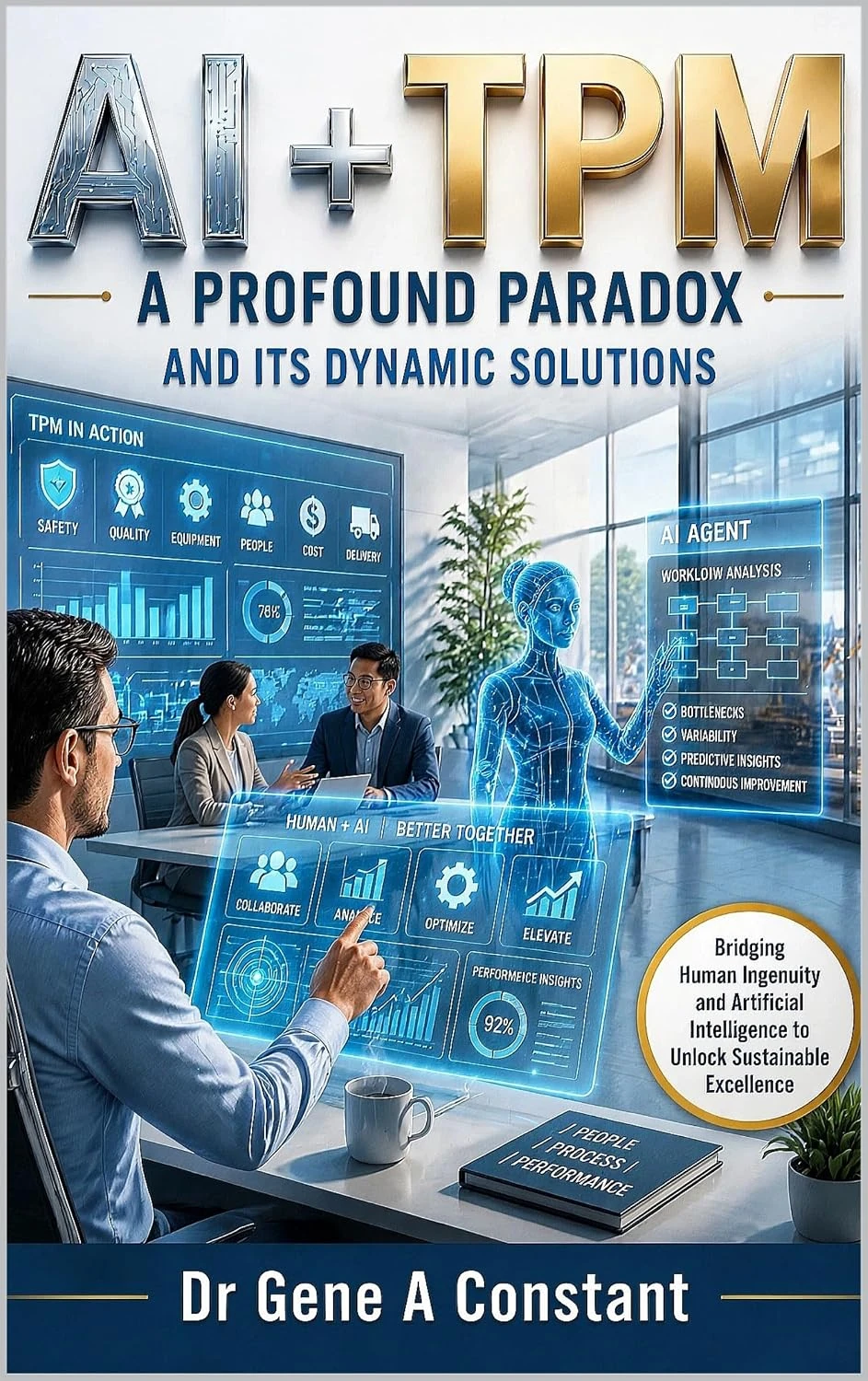
AI + TPM: A Profound Paradox and Its Dynamic Solutions
This lesson teaches chapter 2. The book runs to twenty chapters and sets out Cognitive Capability Maintenance in full — the framework this class is built on. Written and donated to the Foundation by GSU's founder, Dr. Gene A Constant.
Read on Kindle The whole class
The class is free and always will be. As an Amazon Associate, Global Sovereign University earns from qualifying purchases; every cent funds tuition-free education.
Global Sovereign University: Different by Design. Better by Mission.