Lesson 4 · from Chapter 4
Cognitive Capability Maintenance
Three lessons of diagnosis, and here is the discipline itself. CCM is the operational practice of sustaining the epistemic integrity, behavioural reliability and cognitive health of a hybrid human–AI system — because when intelligence becomes part of the production machinery, the maintenance of intelligence becomes the central work of management.
Step one
Five ideas
Read each one. Mark it read, or have it read to you. The test at the bottom draws from these five and nowhere else.
Idea one
A capability is not a possession
Organisations say they are building capabilities when they buy software, hire talent, create a centre of excellence or launch a transformation. But a capability is not a possession. It is a living capacity to produce reliable outcomes under changing conditions.
A company can own advanced models, orchestration platforms, vast repositories and thousands of licences while lacking the capability to use any of it safely. It can generate more work than ever while becoming less able to tell high-quality output from plausible noise. It can automate decisions while losing clarity about who is responsible for them. In that condition it has acquired AI assets but not AI capability.
CCM starts from the opposite premise: capability is perishable. It decays when knowledge goes stale, when data loses provenance, when prompts and retrieval systems drift, when agent permissions expand without discipline, when processes accumulate exceptions, and when people become too fatigued to question what they are shown. It also decays when expertise is offloaded so completely that employees can no longer understand the work they are formally responsible for governing.
Which is the paradox stated at its sharpest: the more intelligence is embedded in the production system, the more deliberately the organisation must maintain intelligence itself.
Idea two
The productive unit is the relationship
TPM treated productive capacity as a system rather than the job of a repair function. CCM keeps that philosophy and changes what is being maintained.
The maintained machine is now a hybrid intelligence system: human attention, domain expertise, data sources, knowledge graphs, prompt libraries, models, retrieval pipelines, agents, tools, policies, permissions, interfaces, feedback loops and decision records. None of it can be understood in isolation. A highly capable model produces weak output when it retrieves stale information. A well-maintained knowledge base still creates risk when an agent has excessive authority. A carefully governed agent remains operationally unsafe if the human reviewer is buried under exceptions.
The productive unit is not the model. It is the relationship among these components.
This is why CCM is neither a renamed governance programme nor an extension of IT maintenance. Governance alone becomes static and distant from the work — it can produce approved-use policies and review committees without noticing that employees are drowning in verification, or that retrieval is quietly returning worse sources. Technical maintenance alone watches uptime, API health and token spend, none of which reveal whether an agent's recommendations still make sense. A system may be technically healthy while cognitively degraded: online, responsive and cost-efficient while becoming less grounded and harder to supervise.
Idea three
Three disciplines, fused rather than assembled
CCM rests on three practices usually managed as separate concerns, each with its own history, vocabulary and professional constituency.
Lean Office Management brings flow, waste, visible abnormalities and standard work. It asks where work waits, where information is duplicated, where handoffs fail and where exceptions accumulate. In an agentic setting it makes one thing plain: an overflowing queue of AI-generated recommendations is not progress, it is work-in-process awaiting cognitive validation.
AI governance brings boundaries, accountability, provenance, access control and auditability. What may the agent know, what may it do, which actions need authorisation, what evidence must be kept, how will failure be contained. It makes autonomy deliberate rather than assumed.
Cognitive ergonomics brings human limits. Does the system preserve attention, support comprehension, reveal uncertainty and enable meaningful intervention? Here it is a quality and risk-control function, not an employee-wellness initiative.
And the reason they must fuse rather than sit side by side in a committee: Lean without governance can make the wrong process faster. Governance without Lean can create a dense layer of approvals that slows work without improving it. Cognitive ergonomics without operational redesign becomes a wellness programme asked to compensate for an unhealthy production system.
Which produces a new standard for what "well maintained" means. A workflow is not well maintained because it is fast. It is well maintained when it is fast enough, reliable enough, understandable enough, and humane enough to remain sustainable.
Idea four
Calibrated delegation, and two false choices
The goal is not maximum autonomous activity, and it is not keeping a human attached to every task out of habit or fear. It is calibrated delegation: assigning work to the form of intelligence best able to perform it, while preserving the evidence, boundaries and human capacity that accountable outcomes require.
An agent may be better suited to monitoring thousands of transactions, searching large collections, reconciling routine discrepancies, preparing first drafts and performing repetitive tool-based actions. A person remains essential where goals are ambiguous, values conflict, relationships matter, evidence is incomplete, or the consequences of error exceed the system's demonstrated reliability. The human role is not reduced to clicking approval; it becomes more demanding — defining purpose, designing constraints, interpreting context, resolving exceptions, challenging assumptions, and deciding when the system must stop.
So CCM rejects two false choices. The first is automation versus human work — most consequential organisations will operate through hybrid work, and the real question is how responsibility travels across the boundary. The second is innovation versus control. Well-designed maintenance does not oppose innovation; it makes innovation durable. A factory that ignores lubrication and inspection looks fast until breakdown halts production.
Maintenance is not friction added after value creation. It is the condition that allows value creation to continue.
Governance carries a matching rule for evidence: proportional lineage. The greater the consequence of an output, the stronger the trail it must preserve. A low-risk internal draft needs little. Anything affecting a customer, a financial decision, an employee outcome, a legal commitment or a production environment needs to show which information informed the agent, which policy rules applied, which tools were used, what uncertainty was identified, and who authorised the action.
Idea five
An abnormality is a question, not a verdict
CCM changes how a leader reads a number. Under older models, a rise in human overrides looks like staff resisting the tool. Under CCM it prompts an investigation: are agents meeting contexts they were not designed for? Has the underlying knowledge changed? Are confidence thresholds badly calibrated? Is the interface hiding critical evidence? Are reviewers finding genuine defects, or compensating for unclear policy?
And the inverse matters just as much. A decline in overrides is not automatically a success. It may mean the agent got better. It may also mean automation bias, weak review design, or a workforce too overloaded to challenge anything. CCM requires organisations to look beneath surface measures.
Continuous improvement changes too. Agents can observe execution traces at a scale no human can, revealing invisible queues, repeated retrieval failures, delayed tool calls and patterns of reviewer disagreement. But they must not optimise autonomously without regard to purpose — proposed improvements get tested against quality, security, compliance, customer impact and human workload before becoming operational reality. The system learns, but it learns under stewardship.
Underneath all of it sits the commitment the discipline exists to protect. Accountability cannot survive as a ceremonial signature at the end of an opaque process. It requires intelligibility — people must understand enough about what the system did, why it acted, what evidence it used and where uncertainty remains, and be able to challenge it without becoming full-time engineers or auditors.
Step two
Where does this work belong?
Calibrated delegation, made movable. Describe one task and the bench places it on the human–AI boundary and says how much lineage it has to keep. Notice that reliability alone never buys autonomy — it is always weighed against what an error costs.
Try this. Take one task already delegated to an AI system where you work and set it honestly — especially the reliability, which should be a measured figure on that task rather than a general impression of the tool.
Then compare where the bench puts it with where it actually sits today. If it is running with more autonomy than the numbers support, the gap is not a technology problem. It is a maintenance decision nobody made deliberately.
Step three
Show that it holds
Ten situations, two per idea, drawn at random. Two right in a row on an idea marks it solid. A wrong answer tells you why that particular choice fails, and sends you back to the one idea it was testing.
All five hold.
You can tell an AI asset from an AI capability, say why the productive unit is the relationship rather than the model, name the three disciplines and what each fails at alone, place work on the human–AI boundary deliberately, and read an abnormality as a question rather than a verdict. That is the framework this whole class is named for.
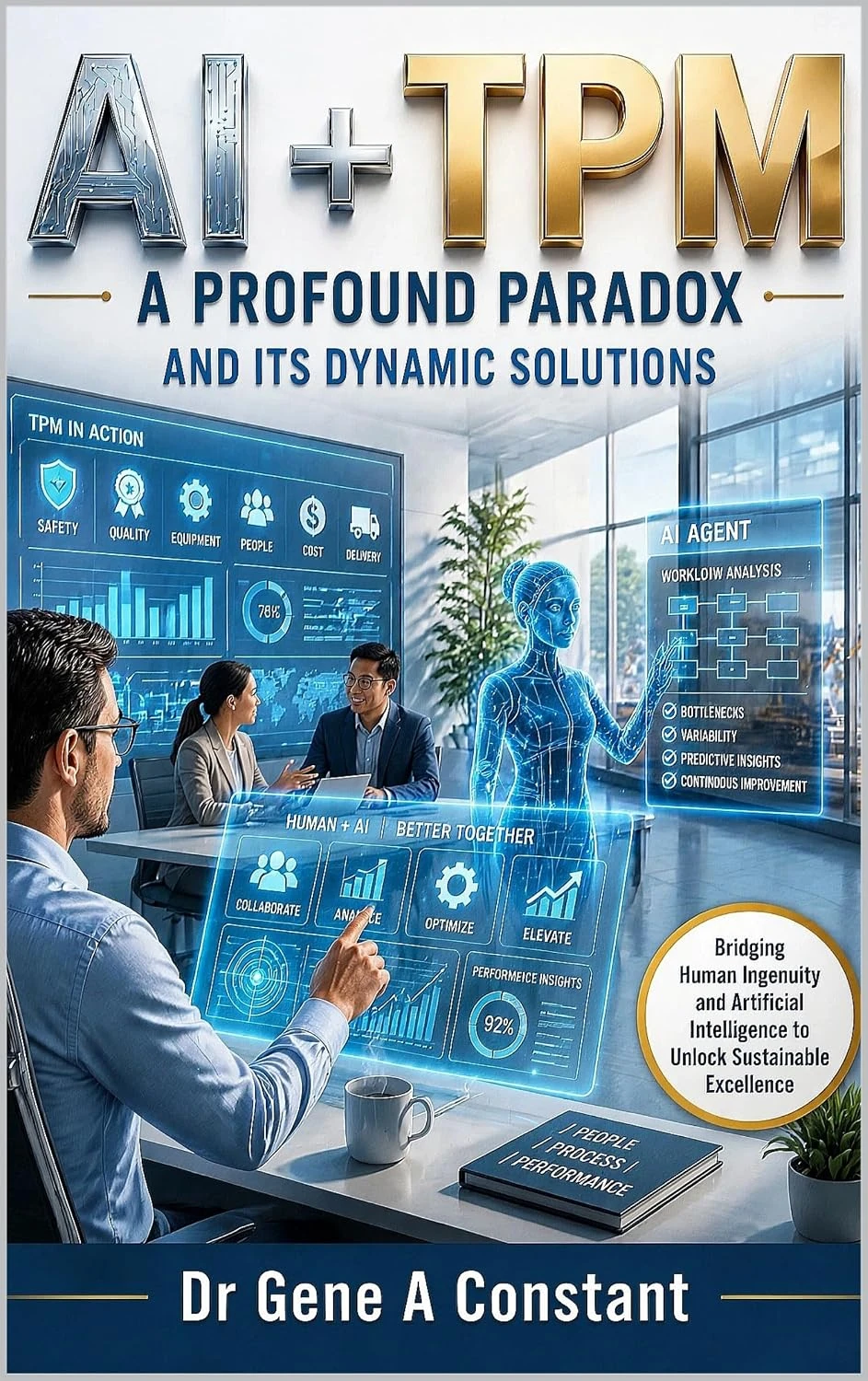
AI + TPM: A Profound Paradox and Its Dynamic Solutions
This lesson teaches chapter 4, where Cognitive Capability Maintenance is introduced. The book runs to twenty chapters and develops the framework in full. Written and donated to the Foundation by GSU's founder, Dr. Gene A Constant.
Read on Kindle The whole class
The class is free and always will be. As an Amazon Associate, Global Sovereign University earns from qualifying purchases; every cent funds tuition-free education.
Global Sovereign University: Different by Design. Better by Mission.