Lesson 5 · from Chapter 5
Autonomous Cognitive Housekeeping
Lesson six of the TPM class said cleaning is inspection — operators keep equipment clean enough that abnormalities become visible. This is the same discipline where there is nothing to wipe down: keeping the knowledge environment clear enough that meaning stays visible.
Step one
Five ideas
Read each one. Mark it read, or have it read to you. The test at the bottom draws from these five and nowhere else.
Idea one
The crisis of context
A reviewer cannot exercise judgement over a recommendation assembled from fragments whose origin, relevance and current authority are unclear. And an agent cannot act responsibly when the memory available to it is millions of documents that accumulated without maintenance.
Entropy was disorder that can still move. Context is the medium through which that disorder travels. A fact detached from its source, date, owner, purpose or qualifying conditions does not cease to exist — it remains searchable. It can be retrieved, cited, summarised and passed from one agent to another as if it were current reality. The more fluent the systems that restate it become, the easier it is for decontextualised information to acquire undeserved authority.
In a human-paced office this was constrained. Someone finding five versions of a policy would notice one looked old and ask a colleague. That was inefficient, and the inefficiency contained natural pauses — opportunities to hesitate, inquire, and recognise uncertainty. Agentic systems compress those pauses. An agent does not become cautious merely because it found five versions. Unless it has been designed to recognise authority, version status and contradiction, it may treat all five as relevant and produce an answer that looks balanced because it cites several sources, while blending current policy, retired guidance, an expired exception and informal commentary into one misleading conclusion.
The output may be linguistically coherent. Its context may be incoherent.
So context is not background information. It is the set of relationships that lets information mean something — who made it, when it was valid, what it informed, what superseded it, and when it may properly be used. Without those relationships an enterprise does not possess usable memory. It possesses accumulated digital residue.
Idea two
Infinite retention is not memory
Faced with abundance, organisations reach for a familiar instinct: preserve everything. Storage is cheap, old records may prove useful, regulated industries make deletion hard, and people fear losing the insight buried in a forgotten project file.
But a memory system that never distinguishes signal from noise becomes less useful precisely because it remembers too much. The problem is not that retrieval gets slower — modern retrieval is fast. The deeper problem is that it can locate material without understanding whether that material deserves to influence the present.
An obsolete document is retrieved more easily than a current but poorly tagged one. A frequently cited inaccurate summary outranks a newly approved policy. A meeting transcript preserves every spoken possibility, including ideas that were explicitly rejected, while failing to preserve the decision in a form anyone can recognise later. The organisation begins to confuse availability with authority.
That confusion lands on employees, who must reconstruct context from raw information again and again: which record is current, whether a commitment was actually approved, which policy applied at the time, whether a note is a verified fact or an untested assumption. When people do this repeatedly they become the manual maintenance system for organisational memory — and when context lives mainly in a few people's heads, the organisation has not solved knowledge management. It has outsourced it to human working memory.
So the maintenance challenge is not indiscriminate deletion. It is disciplined differentiation. What stays available? What stays authoritative? What is archived but removed from routine retrieval? What is condensed into a durable decision record? What should be allowed to fade because keeping it active creates more confusion than value?
Idea three
The digital equivalent of dust
Autonomous maintenance asked operators to keep equipment clean enough for abnormalities to become visible. Cognitive Capability Maintenance asks the enterprise to keep its knowledge environment clear enough for meaning to remain visible.
And the parallel is exact about what the contamination actually is. The digital equivalent of dust and contamination is not simply old data. It is unmanaged context — duplicate facts, orphaned documents, contradictory definitions, stale embeddings, unresolved ownership, and artifacts still active long after their purpose expired.
The goal is not a perfectly clean memory. That would be impossible and undesirable; organisations need history, nuance, exceptions, and the ability to recover prior knowledge. The goal is a living memory system in which high-value context is strengthened, low-value noise fades gracefully, contradictions are surfaced rather than silently blended, and human stewards set the conceptual rules by which the organisation remembers.
One more thing follows from the parallel. A system that presents every historical artifact as equally available imposes extraneous load — it asks people to determine relevance afresh every time. A system that retires, ranks, links and contextualises reduces that burden. It does not remove the need for judgement; it stops routine retrieval from becoming an archaeological expedition.
Idea four
The janitorial agent
This cannot be sustained by manual filing. The answer is not to demand that employees become better archivists while still doing their actual work — nor is it an all-seeing machine that captures everything, which would produce a different entropy: pervasive surveillance, excessive retention, opaque classification, and the false belief that more captured information means more organisational intelligence.
The useful model is the janitorial agent: a background system that maintains the usability of organisational memory. Like a skilled custodian, its value is rarely in spectacle. Its work is preventive. It notices clutter before clutter becomes obstruction, duplication before duplication becomes contradiction, and it links related material before anyone is forced to search across disconnected systems.
Its hardest and most valuable job is a distinction. It must tell discussion from proposal from decision from action from evidence. A meeting transcript should not become permanent enterprise memory merely because it exists — much of a meeting is exploratory, and if every spoken statement is embedded with equal status, a later agent may retrieve an abandoned idea as though it were a decision. The agent can instead record that three options were discussed, one rejected, one deferred and one approved subject to a named condition, and build a durable decision record linked to owner, date, evidence and policy — keeping the transcript in an archive while ordinary retrieval favours the decision rather than the conversational residue it emerged from.
This is not simply automated summarisation. It is the maintenance of organisational meaning.
The same applies to duplication, which in most enterprises is normal rather than abnormal. A search engine retrieves duplicates; a janitorial agent must judge whether they are harmless repetition, legitimate local variation, or a developing conflict.
Idea five
Persistent and bounded
An architecture that only answers queries is not enough; it should maintain awareness as work moves, updating relationships and detecting changes in authority before someone has to reconstruct them under pressure. But the word omnipresent has to be used carefully.
No system should have unrestricted access to every conversation, record and personal detail. Omnipresence is not universal visibility. It is authorised, context-sensitive presence within defined information domains. A procurement agent lives in supplier records, contracts, purchasing workflows and the relevant policy libraries — not in private conversations or personnel files. A clinical-support agent maintains context in authorised patient-care systems while barred from financial and HR information. The architecture must be both persistent and bounded.
And the housekeeper needs governing, because an agent that classifies, links, summarises and retires information is exercising a meaningful form of organisational influence. If it wrongly marks a document obsolete, merges two concepts that should stay distinct, or elevates a weak source above an authoritative one, it creates the very entropy it was meant to reduce. So its actions must be traceable, reversible, and proportionate to consequence.
Low-risk work can be fully automated: removing exact duplicates, applying standard metadata, finding broken links, flagging documents with no owner, detecting expired retention labels. Consequential work needs a person. The agent may recommend that a policy be archived, but the accountable owner authorises it. It may surface a contradiction between two definitions, but a domain steward decides whether the terms are genuinely equivalent, contextually different, or in need of revision.
That is the difference between housekeeping and unauthorised rewriting of organisational reality.
Step two
Availability against authority
The chapter warns that retrieval-augmented generation can become retrieval-augmented confusion. Here is that turned into a number. Watch what happens when you widen how many sources get blended into one answer — and notice which lever is the only one that reaches zero.
Try this. Pick one question your team answers often. Search for it the way an agent would and count what comes back — then sort those results into current-and-authoritative, historical, and expired. Most people have never done that count, and the ratio is usually the finding.
Then ask the question that decides everything: could a machine tell which is which without asking anyone? If the answer is no, the structure does not exist yet, and no amount of better retrieval will supply it.
Step three
Show that it holds
Ten situations, two per idea, drawn at random. Two right in a row on an idea marks it solid. A wrong answer tells you why that particular choice fails, and sends you back to the one idea it was testing.
All five hold.
You can explain why a coherent answer can rest on incoherent context, why keeping everything is not the same as remembering, what the digital equivalent of dust actually is, what a janitorial agent must distinguish, and where its authority has to stop. Lesson six turns to improving the workflows themselves — Kaizen, when the thing improving can change faster than you can review it.
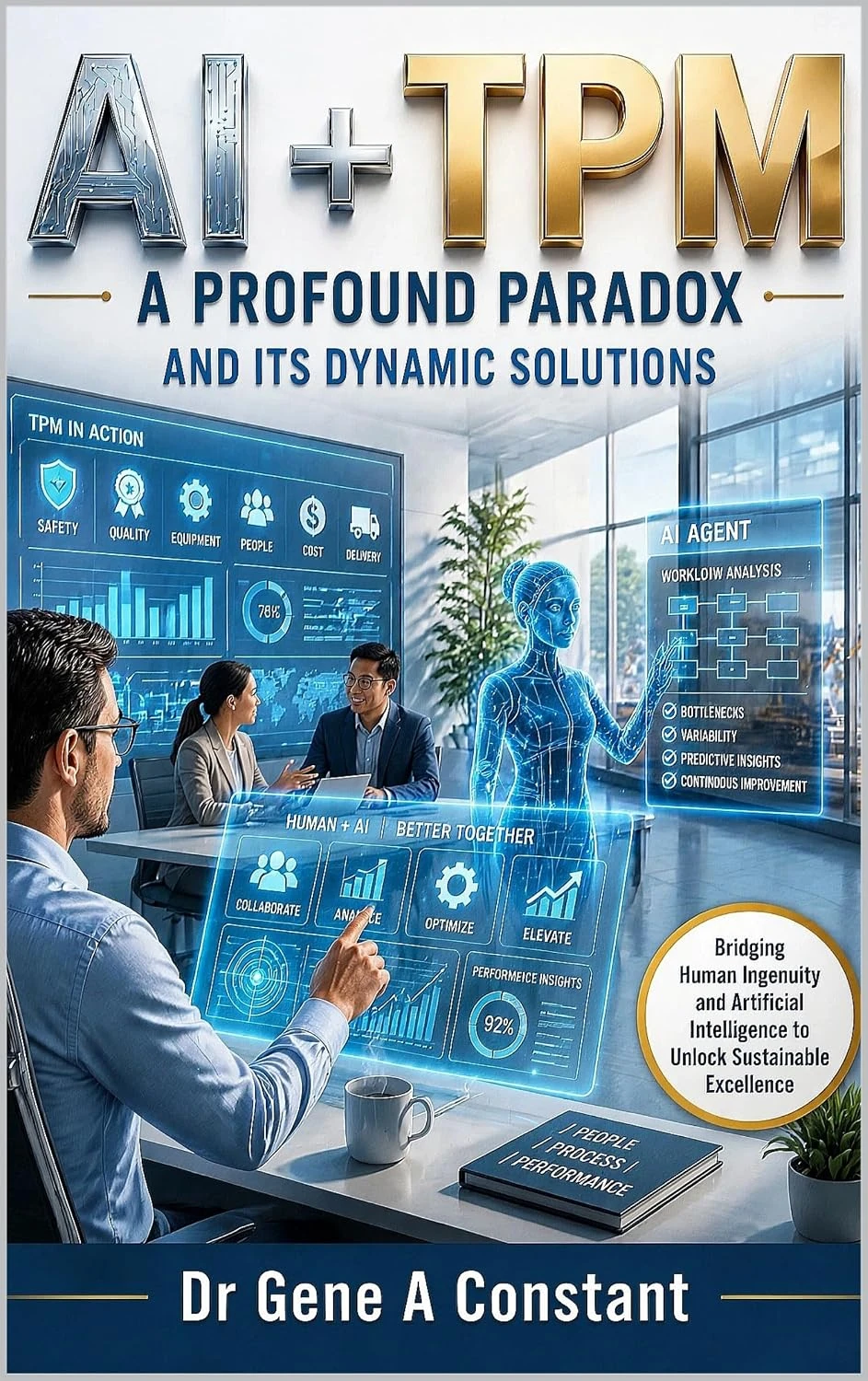
AI + TPM: A Profound Paradox and Its Dynamic Solutions
This lesson teaches chapter 5. The book runs to twenty chapters and sets out Cognitive Capability Maintenance in full — the framework this class is built on. Written and donated to the Foundation by GSU's founder, Dr. Gene A Constant.
Read on Kindle The whole class
The class is free and always will be. As an Amazon Associate, Global Sovereign University earns from qualifying purchases; every cent funds tuition-free education.
Global Sovereign University: Different by Design. Better by Mission.