Lesson 6 · from Chapter 6
Agentic Kaizen
Kaizen began with people standing around a process and watching it. Most of the work no longer happens where anyone can stand. This lesson is about improving what you cannot see — and about the one decision that must never be handed to the thing doing the improving.
Step one
Five ideas
Read each one. Mark it read, or have it read to you. The test at the bottom draws from these five and nowhere else.
Idea one
The work is invisible at the scale of ordinary experience
Traditional office Kaizen began with observation. A team gathered round a process, followed a request from intake to completion, and saw the waste: someone waiting for an approval, re-entering data, searching email, carrying paperwork between departments, sitting in a meeting that ended without a decision. That made inefficiency concrete, and it gave everyone a shared language for improvement. The discipline is still valuable.
But the work has moved. It now runs across APIs, retrieval services, workflow engines, identity systems, model endpoints, queues and agents calling tools on behalf of other agents. To the customer, a request went in and a response came back. Between those two visible events, dozens or hundreds of micro-events may have occurred — some in milliseconds, some in parallel, some retried silently after failure, some delayed by rate limits or permission checks.
A manager can watch a service team and see that people spend too long looking for account information. What the manager cannot see is that the retrieval agent is making three redundant searches because it was given overlapping tools, that a policy database is slow at particular hours, or that an identity check fails intermittently and restarts the sequence. By the time the visible symptom emerges, the underlying friction may be distributed across systems no single person can see in full.
These are micro-frictions embedded inside the runtime of work, and no conventional workshop will reliably find them. Human observation has not become irrelevant — it has to be supplemented by continuous telemetry: execution traces, retrieval paths, tool calls, latency, confidence changes, policy checks, handoffs, retries, failures, overrides and outcomes. Properly designed, that shows you the digital equivalent of waiting, motion, overprocessing, defects and rework.
Idea two
Two value streams, mapped at once
The human-facing value stream is the experience of whoever receives the outcome. Did the request reach an appropriate resolution? Was the decision timely, accurate, understandable and proportionate? Did the workflow preserve trust?
The machine-facing value stream is the chain that produced it. Did the agent use authoritative sources? Did it wait unnecessarily, duplicate work, hit a permission barrier? Did one agent create ambiguity another had to resolve? Did a human override reveal a valid exception, or an underlying defect?
Neither is sufficient alone. A technically elegant workflow producing poor customer outcomes has failed. A customer-friendly outcome achieved through unsustainable manual reconstruction is also unstable.
And the trap that catches most organisations is elapsed time. A workflow looks fast because an agent responds within seconds — yet total cycle time may be poor if that response creates confusion, triggers follow-up, needs specialist correction, or sits in a review queue for hours. A process looks efficient because it runs without human intervention — yet it may make repeated tool calls and build a growing inventory of weakly validated outputs that someone will have to reconcile later.
Lesson three said output is not completed value merely because it was generated. The same rule applies here: an automated action is not a Lean improvement merely because it occurred without visible human effort.
Idea three
Data exhaust is not understanding
Machine-scale observation brings its own risk. A digital workflow generates an overwhelming quantity of logs, traces, metrics, alerts and events. Presented without hierarchy or purpose, the organisation simply replaces one form of invisibility with another: leaders surrounded by dashboards and still unable to say what requires action, technical teams optimising whatever is easiest to measure, managers watching response time because it is visible while overlooking whether that speed is creating downstream rework. This is local optimisation in a more sophisticated form.
The purpose of telemetry is not total surveillance and not turning every activity into a performance metric. It is to reveal abnormalities, and to prompt better questions. Why is this agent invoking more tools than before? Why are specialists overriding this category? Why has the queue of low-confidence cases grown? Why are employees creating workarounds outside the approved workflow?
Those questions need human interpretation, because telemetry can show that a pattern exists without determining what the pattern means. A rising override rate may mean the agent has drifted from business reality — or that reviewers got better after training, or that a policy became ambiguous, or that the system is correctly surfacing edge cases that should never have been automated. A falling rate may mean improved reliability — or automation bias, with people accepting outputs because the volume has made real challenge impossible.
The same metric can represent improvement or deterioration depending on context.
Idea four
Exploration, evaluation, reflection, internalisation
A self-evolving agent is not an agent free to rewrite its own purpose. It is one that can improve selected elements of its performance through structured feedback from real work, in four linked stages.
Exploration tries alternative pathways — a different retrieval order, one fewer tool call, a shorter evidence-ranked summary for the specialist. It must not be confused with unrestricted experimentation in production. An agent altering live customer communications, financial actions or access permissions to discover a faster route is acting outside any responsible reading of Kaizen. The purpose of exploration is learning under boundaries: sandboxes, digital twins, limited pilots, low-risk workflows where changes are reversible.
Evaluation compares outcomes — and must be broader than speed. A change that cuts handling time but increases customer corrections is not an improvement. One that lowers token consumption but weakens source grounding is not an improvement. Here the three pillars return as a single discipline: Lean asks whether waiting, duplication, rework and invisible queues fell across the whole stream; governance asks whether the new path stays inside authorised boundaries and preserves provenance; cognitive ergonomics asks whether human judgement became easier and more meaningful, or whether complexity was simply compressed into a more exhausting review.
Reflection asks why rather than recording that something succeeded. Why did this class of cases need repeated context reconstruction? Why did the agent retrieve an obsolete policy more often after a model update? It might conclude the problem is not the model's reasoning but an incomplete ontology, or an unresolved policy conflict, or a handoff that loses context and forces the next agent to infer it. This converts raw telemetry into candidate learning — and moves the organisation beyond symptom management, so a growing queue prompts investigation rather than more reviewers.
Internalisation is where self-evolution becomes organisational evolution, and it is the stage most often skipped. A locally successful technical adjustment is not a durable improvement: an agent may find a shortcut that works today but violates a policy principle, hides an exception, or becomes unsafe when a source system changes. So every significant improvement needs an owner, a rationale, a version history, a defined scope, measurable acceptance criteria, and a rollback path — and it may require changes outside the technical system entirely: clarifying a policy, assigning ownership to an orphaned source, redesigning a role.
Idea five
Plan, Do and Check can be shared. Act cannot.
Map the loop onto PDCA and the boundary becomes obvious. The agent can support Plan by detecting friction and developing hypotheses. It can assist Do through sandboxed tests and limited pilots. It can strengthen Check through continuous evaluation of real outcomes. But the transition into broad operational use — the Act phase — remains a matter of accountable authorisation.
That boundary is not squeamishness about machines. It follows from what the agent is good at. An agent can become remarkably effective at optimising what it has been asked to measure. But an organisation is more than its measurable throughput. It has legal obligations, ethical commitments, customer relationships, strategic priorities and human limits that cannot be safely reduced to a local objective function.
So evaluation remains incomplete without a theory of value. A system may find that a shorter phrasing cuts review time — while removing the nuance a sensitive decision needed. It may find that routing more cases automatically shortens the queue — while obscuring a pattern of vulnerability an experienced person would have recognised. It may find that a strict reading of a policy reduces variance — in an area where the organisation deliberately preserved discretion. The telemetry can reveal the pattern. It cannot determine the legitimate trade-off by itself.
The promise here is not autonomous perfection. It is a more observant, responsive, evidence-rich improvement system — one that notices micro-frictions before they become chronic waste, tests remedies before deploying them widely, and turns human corrections into reusable organisational learning. The same capability becomes a source of systemic risk the moment a system is allowed to learn without purpose, optimise without boundaries, or internalise changes without accountable review.
Step two
Is this proposal an improvement?
An agent proposes a workflow change and brings four measurements. Score it the way evaluation is supposed to be scored — across flow, quality and cognitive burden rather than speed alone. One of the four inputs the bench will not score at all, and that refusal is the point.
Try this. Take the last workflow change anyone made where you work and find the four numbers. Handling time will exist. The other three usually will not — and that absence is the finding, because it means the change was approved on the one dimension that is easiest to see.
Then ask who authorised it, what the acceptance criteria were, and what the rollback path is. If those three answers do not exist, the change was never internalised. It was just deployed.
Step three
Show that it holds
Ten situations, two per idea, drawn at random. Two right in a row on an idea marks it solid. A wrong answer tells you why that particular choice fails, and sends you back to the one idea it was testing.
All five hold.
You can say why a workshop no longer finds the waste, map both value streams, resist reading a single metric as a verdict, name the four stages of the loop, and place the one decision that stays with a person. Lesson seven turns to the model itself — drift you can measure, drift you cannot, and what a maintenance interval means for something with no moving parts.
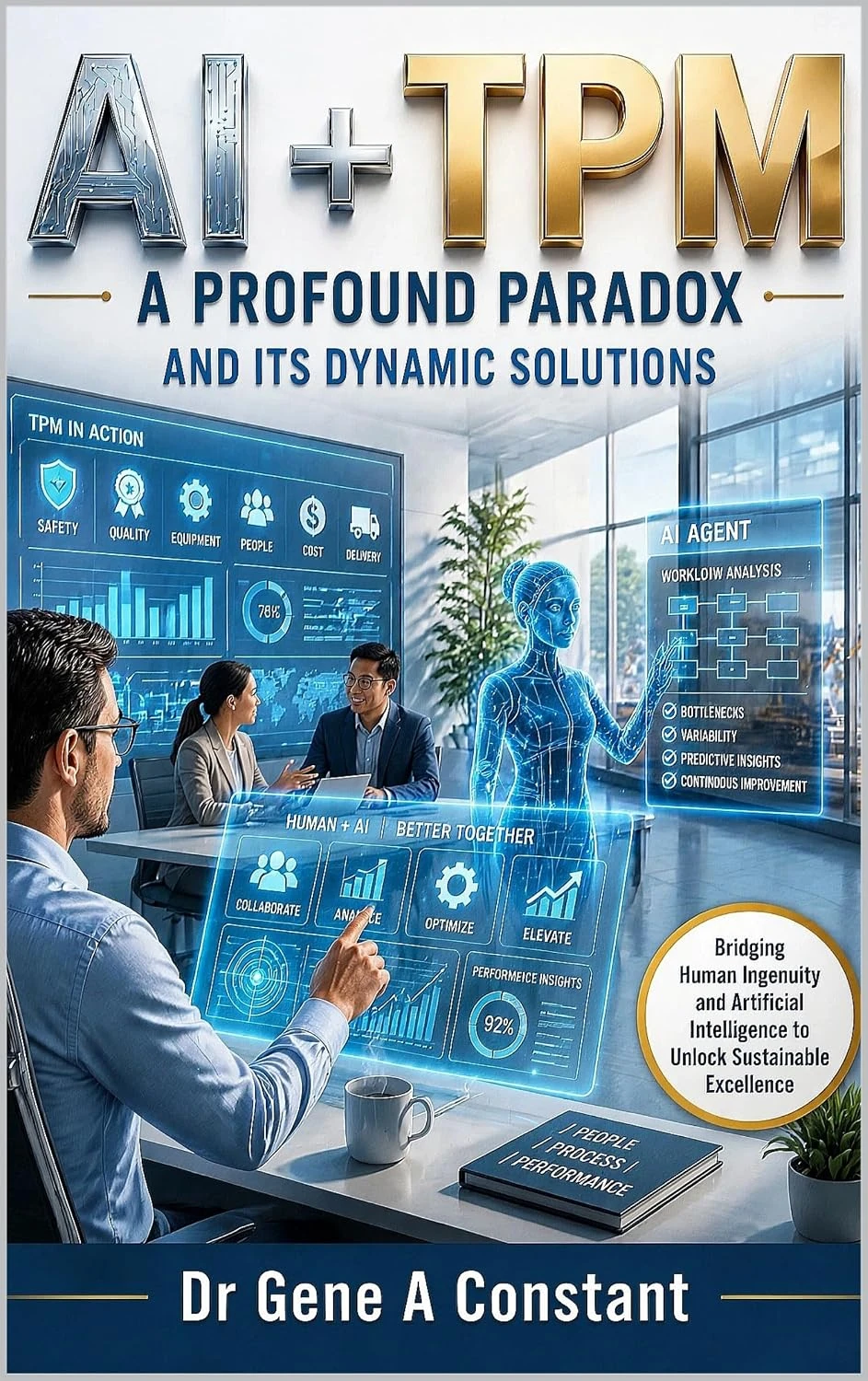
AI + TPM: A Profound Paradox and Its Dynamic Solutions
This lesson teaches chapter 6. The book runs to twenty chapters and sets out Cognitive Capability Maintenance in full — the framework this class is built on. Written and donated to the Foundation by GSU's founder, Dr. Gene A Constant.
Read on Kindle The whole class
The class is free and always will be. As an Amazon Associate, Global Sovereign University earns from qualifying purchases; every cent funds tuition-free education.
Global Sovereign University: Different by Design. Better by Mission.