Lesson 2 of 8 · Chapter 2
Getting to Know Ourselves
What are you made of? In this lesson you meet the cells that build you, compare plant and animal cells, see how organs work as a team, and find out how your body grows and heals.
Choose how you want to learn
You can change this any time. Press Listen on any part to hear it read aloud. Grown-ups: read along with younger children.
- 1 · You are built from cells
- 2 · Plant and animal cells
- 3 · Organs work as a team
- 4 · How you grow
- 5 · How you heal
- 6 · The whole chapter
- 7 · Try it at home
- 8 · Your card
- 9 · Check yourself
Part 1
You are built from cells
Your body is made of tiny living parts called cells. They are too small to see, but they are everywhere in you.
Think of your body as a big city. Cells are the little buildings, and each one has a job.
Cells keep your inside balanced. When you get hot, you sweat. When you get cold, you shiver.
A cell is the smallest living unit that can do all the jobs of life: use energy, grow, respond, and keep its inside balanced. Keeping the inside balanced has a big name, homeostasis.
Most cells have a soft outside called the cell membrane. It is not a hard wall. It is a smart gate that lets in water, oxygen and food, and lets out waste.
Many cells have a control center called the nucleus. It holds DNA, a set of instructions for building and running the cell. Cells are not all the same: muscle cells pull, nerve cells send fast messages, and red blood cells are shaped to carry oxygen through narrow spaces.
“They are called cells.”
“Your body is not a statue. It is a living place under constant construction.”
“It is more like a smart gate.”
Which part of a cell does this job? Tap one for each. Get all six to finish.
Part 2
Plant cells and animal cells
Plant cells and animal cells share many parts.
Plant cells have a stiff cell wall, like a fence. That helps plants stand up without bones.
Plant cells have tiny green parts that catch sunlight and make food. Animal cells do not. Animals eat food instead.
Both kinds of cells have a membrane, a jelly-like inside, and usually a nucleus with DNA.
Plant cells add a sturdy cell wall. They also have chloroplasts, which capture sunlight for photosynthesis: turning sunlight, water and carbon dioxide into sugar. And they have a big storage space for water. A droopy houseplant perks up after watering because thousands of cells fill with water and get firm again.
Animal cells have no cell wall, so they can bend into many shapes, like muscle cells that squeeze or defender cells that slip through tiny gaps. Animals get energy by eating. Your food is broken down, carried in your blood to your cells, and turned into energy with help from the oxygen you breathe.
“That is one reason plants can stand up tall without bones.”
“Animal cells do not have chloroplasts, because animals do not make their own food from sunlight.”
“Your breath and your breakfast are connected down at the cell level.”
Plant cells only, or both plant and animal cells? Tap one for each. Get all seven to finish.
Part 3
Organs work as a team
Cells join into groups called tissues. Tissues build organs, like your heart and lungs.
Organs work together in teams called organ systems.
When you run, your heart, lungs, muscles and brain all help at once.
One muscle cell cannot run across the yard. But cells form tissues, tissues build organs, and organs cooperate in organ systems.
The circulatory system delivers, with the heart as the pump and blood vessels as roads. The respiratory system swaps oxygen in and carbon dioxide out. The digestive system is the kitchen. The nervous system sends messages. Muscles and bones move and hold you up. The immune system is the security team.
Organs are shaped for their jobs. Lungs branch like an upside-down tree, and your intestines are long and folded to make room to soak up food. Your body talks to itself with fast nerve messages, like texts, and slower chemical messages in the blood, like letters. That is why your heart pounds and your tummy flutters when you are nervous.
“Organs are not separate little machines. They are a network.”
“So organs are not just body parts. They are clever solutions.”
“Your body is a conversation.”
Which organ system is doing this job? Tap one for each. Get all six to finish.
Part 4
How you grow
Your body grows by making more cells.
To build, it needs food, water, sleep and movement.
Your bones are alive. They grow longer while you are a kid.
Growing is building, not blowing up like a balloon. Building takes raw materials from food and water, energy, instructions from DNA, and teamwork.
Your body does not just make more cells. New cells specialize: some become muscle, some bone, some skin, some nerve. That is why you grow stronger and more skillful, not only taller.
Kids are in a big building stage. Adults mostly stop getting taller because their bones stop lengthening, but grown-up bones still rebuild when they are used. A lot of building and repair happens while you sleep, and safe movement tells bones and muscles to get stronger.
“Sleep is not wasted time.”
“They do not only multiply; they specialize.”
“Your bones are living tissue, not dead sticks.”
What does each helper give your growing body? Tap one for each. Get all six to finish.
Part 5
How you heal
When you scrape your knee, your body gets to work right away.
First a scab covers the hurt spot like a roof. Underneath, new skin grows.
Do not pick a scab. It is protecting the work underneath.
A bruise happens when tiny blood vessels break and blood leaks under the skin. Cleanup cells break the old blood down and recycle it. That is why a bruise goes from purple to green to yellow.
A scrape heals in steps. Blood clots to plug the leak. A scab forms as a temporary roof. Under it, new skin cells move in from the edges while immune cells guard against germs. Then the scab falls off. A deep cut can leave a scar, a strong patch your body makes to close the gap safely.
Your body is always rebuilding, even when you cannot see it: skin sheds, hair and nails grow, blood is renewed. If a hurt spot gets redder, hotter, more swollen or more painful, tell a grown-up. Science includes wise caution.
“It is not paint spreading under your skin. It is living repair.”
“It is a cover that protects the construction site underneath.”
“Picking is like ripping off the roof while the builders are still working.”
Put the healing of a scrape in order. Tap the step that comes next.
Part 6
Read the whole chapter
Here is all of Chapter 2, “Getting to Know Ourselves: The Building Blocks of Life”, exactly as the book tells it. Press Listen to hear it read aloud, or open it and read along.
Open Chapter 2 (about 25 minutes to read)
Part 7
Try it at home
Do these with your family. Tick each one when it is done.
Part 8
Your “My Body Builder” card
Fill it in, then print it for the fridge. Nothing you type here leaves this device.
My Body Builder
Global Sovereign University · Biology: How Life Works, lesson 2
Six body teams
- Circulatory: delivers
- Respiratory: breathes
- Digestive: breaks down food
- Nervous: sends messages
- Muscles and bones: move and hold you up
- Immune: guards and heals
Part 9
Check yourself
7 questions. Pick an answer. If it is not right, read the hint and try again.
Lesson 2 complete.
You can explain what a cell is, compare plant and animal cells, name six organ systems and their jobs, and tell how your body grows and heals. Next: Lesson 3, Exploring Habitats, is being built.
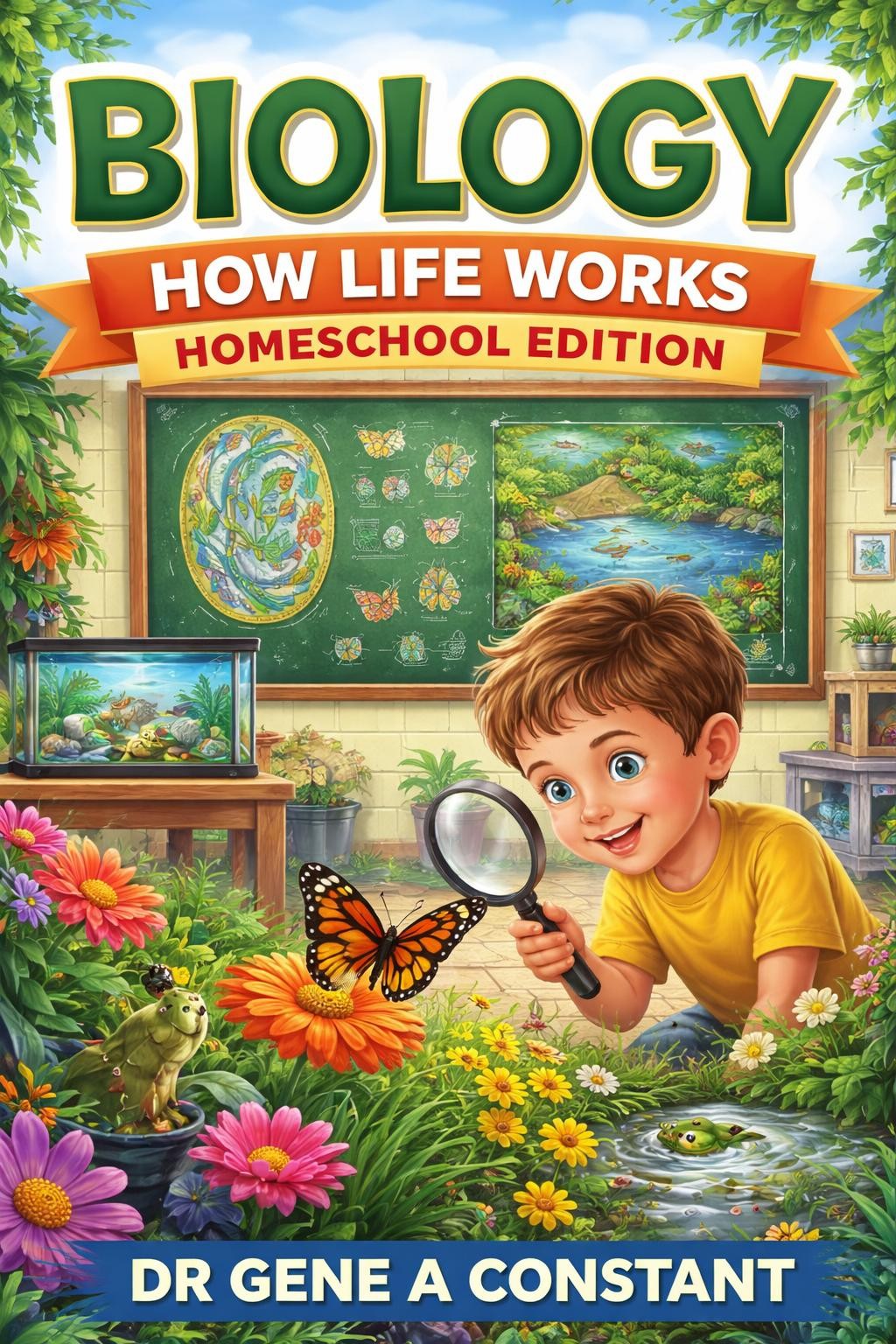
Biology: How Life Works, Homeschool Edition by Dr. Gene A Constant. This lesson is chapter 2, and the whole chapter is on this page.
GSU is a 501(c)(3) nonprofit and book sales are its only income. A purchase is not a tax-deductible donation. This lesson is free and always will be.