Lesson 3 of 8 · Chapter 3
Exploring Habitats
Where does life live? In this lesson you find habitats in surprising places, learn the five things every home must give, see how plants and animals fit their homes, and discover how people shape the neighborhoods of life around them.
Choose how you want to learn
You can change this any time. Press Listen on any part to hear it read aloud. Grown-ups: read along with younger children.
- 1 · Life in surprising places
- 2 · What makes a home a home
- 3 · Homes for plants and animals
- 4 · How people shape habitats
- 5 · Being a good neighbor
- 6 · The whole chapter
- 7 · Try it at home
- 8 · Your card
- 9 · Check yourself
Part 1
Life in surprising places
A habitat is the place a living thing calls home.
Habitats can be tiny: a crack in the sidewalk, the underside of a rock, or the edge of a puddle.
Your body is a habitat too. Tiny helpful microbes live on your skin and inside you.
A habitat gives a living thing what it needs: food, water, shelter, space, and the right conditions. Habitats do not have to be big. A weed in a sidewalk crack survives tight space, fast-drying soil, and hot and cold concrete, and it can become a tiny neighborhood for ants and spiders.
Lift a rock gently and you may find pill bugs, earthworms and beetles. The underside of a rock holds moisture, blocks bright sun and hides small animals from wind and predators. Dry ground is not empty either: soil holds rock bits, rotting leaves, air, water and microbes that can rest through dry times and wake up when it rains.
Water edges are habitats too: a puddle, a ditch, a birdbath. The edge, the middle, the sunny side and the shady side can each be a different micro-habitat. And when you put a rock back the way you found it, you are being a careful guest: for the creatures under it, that rock is a roof.
“This is one of the best surprises in biology: life is brave.”
“A habitat is the place a living thing calls home.”
“To many microbes, you are a whole planet.”
Why do small animals live under a rock? Tap the habitat need each clue meets. Get all six to finish.
Part 2
What makes a home a home
Every living thing needs five things from its home.
Food, water, shelter, space, and the right conditions, like the right amount of warmth and light.
Plants cannot walk to find a better home. They grow in ways that fit the place where they are.
A birdhouse on a tree is not automatically a habitat. It becomes one only if it has the right shelter in the right spot, with food and water nearby and enough safety to raise babies. A habitat is a place plus what a living thing needs.
Suitable conditions means things like temperature, light, moisture and how salty the water is. Conditions are like the rules of a habitat. Picture a damp spot under a log, then the same spot after a week of hot sun and no rain. Same place, different conditions, and the animals that need moisture may move away.
Plants solve their habitat problems in place, with structure and strategy. Plants in sun often have smaller, tougher or waxy leaves that hold water. Plants in shade often have broad leaves to catch more light. Plants in dry places may have deep roots or thick stems that store water, and some plants have roots that can handle soggy soil.
“Food, water, shelter, space, and suitable conditions.”
“If the rules change, the neighbors change too.”
“The habitat changed without the log moving an inch.”
Which home does each plant feature fit best? Tap one for each. Get all six to finish.
Part 3
Homes for plants and animals
A plant can be a home for many other living things.
One leaf can feed a caterpillar, hide a spider, and give a ladybug a place to land.
An animal’s home is more than a nest. It is all the places it goes to eat, drink, rest and hide.
Once plants move in, other living things follow. A plant is a food source, a shade maker, a water holder and a shelter builder. When a leaf falls and rots, it becomes food for decomposers in the soil.
For many animals, home is a territory or a route. A squirrel’s home includes its nest, the trees where it finds food, the fence it uses as a highway, and its hiding spots. Shelter can be a burrow, a crack in a rock, or a strategy: a moth that blends into bark, or a rabbit that freezes in tall grass.
Food chains usually start with plants: seeds feed birds, leaves feed insects, and rabbits that eat plants feed foxes. That is why a yard with many kinds of plants usually has more kinds of insects and birds than plain mowed grass. Animals also share space by keeping different schedules: one feeds in the morning, another at night.
“So when you see a plant, you are often seeing the foundation of a habitat.”
“Home is not always one spot. It can be a map.”
“Same space, different schedule.”
Which habitat need is the animal meeting? Tap one for each. Get all six to finish.
Part 4
How people shape habitats
Habitats change living things, and living things change habitats. People do too.
Cutting tall grass, leaving trash, or turning on a bright light all change what can live there.
Rain carries things from the ground into streams and lakes.
Every habitat has rules, and every action can nudge the rules. Cut a patch of tall grass and the ground gets hotter, cover disappears, and some animals leave while others move in.
Water connects habitats. Rain runs off roofs and roads into storm drains and then into creeks and lakes, so paint or trash on the ground can end up harming water life. Waste matters too: leaves rot into soil, but plastic does not, so it does not fit nature’s recycling.
Light and sound are habitat conditions. A bright porch light pulls moths together and changes where spiders and bats hunt, and constant noise can make some animals avoid an area. The plants we choose decide what food and shelter there will be: more kinds of plants usually means more kinds of animals.
“So here is one way to think like a biologist: every habitat has rules, and every action can nudge the rules.”
“The flow connects habitats.”
“Plastic wrappers do not turn into soil like leaves do.”
How is each choice changing a habitat? Tap one for each. Get all six to finish.
Part 5
Being a good neighbor
A habitat is someone’s home, so be a careful guest.
Look more than you touch. Put rocks and logs back the way you found them.
Small acts help: pick up litter, fill a birdbath, or plant a flower for bees.
When animals come into our space, like ants in the kitchen, they are not being rude. They are meeting their habitat needs. Cleaning up crumbs and sealing food changes the kitchen’s habitat so the ants have no easy food. That is habitat management, not a battle against bad animals.
Stewardship means caring for something that matters and taking responsibility for your part. You do not control everything, but you can pick up litter, refill a birdbath in hot weather, leave a small pile of sticks and leaves for shelter, and plant something that feeds pollinators.
Noticing is a kind of care. Writing “Today I noticed where rainwater flows” or “Today I put the rock back like a roof” builds a habit that can last your whole life: seeing how living things are connected, and choosing wisely.
“A habitat is not just a science sample. It is someone’s home.”
“Noticing is a kind of care.”
“You shape it, you share it, and you get to decide, day by day, what kind of neighbor you will be.”
My habitat footprint: does each choice make habitats harder or healthier? Tap one for each. Get all eight to finish.
Part 6
Read the whole chapter
Here is all of Chapter 3, “Exploring Habitats: Where Life Thrives”, exactly as the book tells it. Press Listen to hear it read aloud, or open it and read along.
Open Chapter 3 (about 25 minutes to read)
Part 7
Try it at home
Do these with your family. Tick each one when it is done.
Part 8
Your “My Habitat Explorer” card
Fill it in, then print it for the fridge. Nothing you type here leaves this device.
My Habitat Explorer
Global Sovereign University · Biology: How Life Works, lesson 3
Five habitat needs
- Food: something to eat
- Water: to drink or soak up
- Shelter: safety from weather and enemies
- Space: room to live and raise young
- Conditions: the right warmth, light and moisture
Part 9
Check yourself
7 questions. Pick an answer. If it is not right, read the hint and try again.
Lesson 3 complete.
You can explain what a habitat is, name the five habitat needs, tell how plants and animals fit their homes, and give ways people make habitats harder or healthier. Next: Lesson 4, Marvelous Micro-Worlds, is being built.
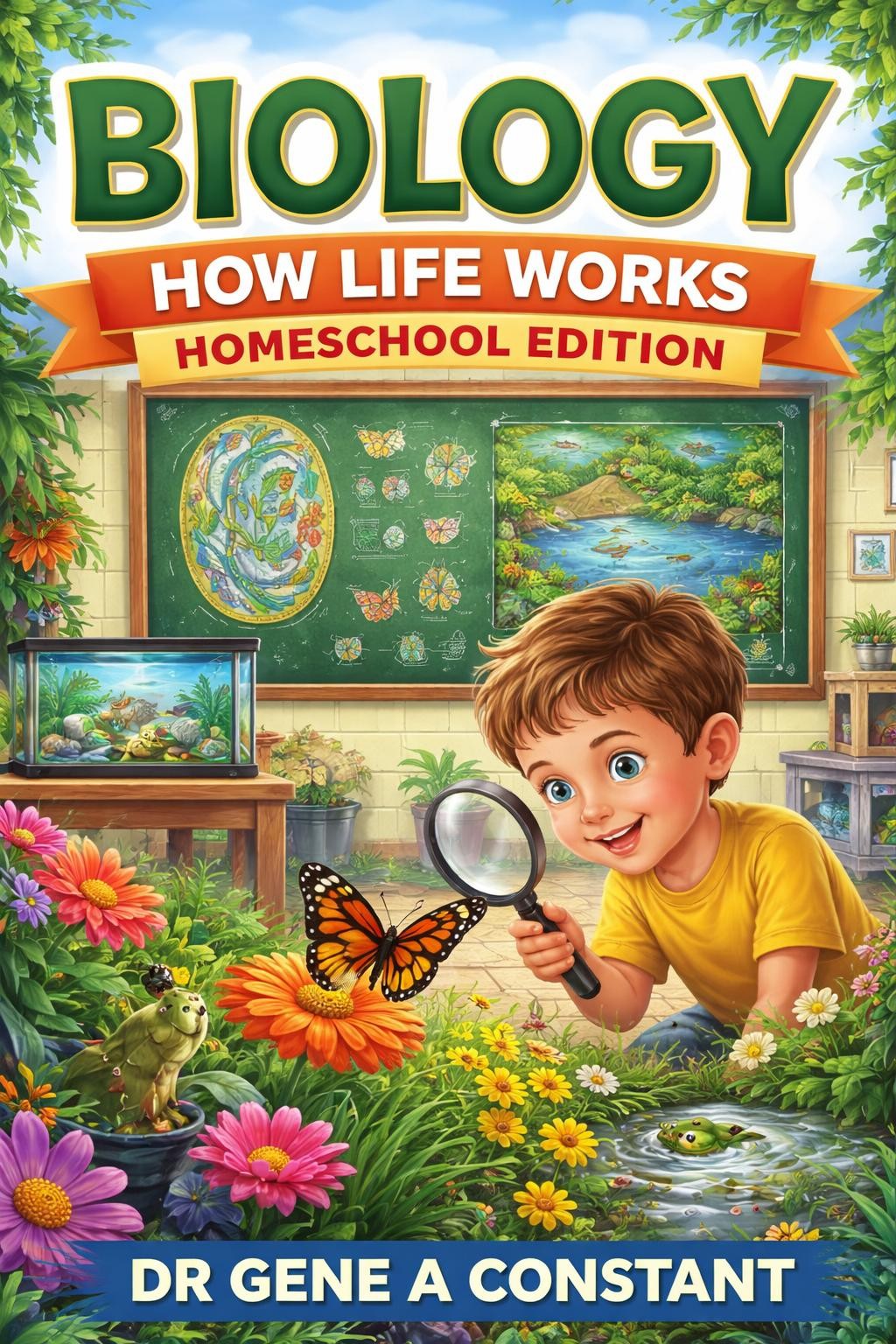
Biology: How Life Works, Homeschool Edition by Dr. Gene A Constant. This lesson is chapter 3, and the whole chapter is on this page.
GSU is a 501(c)(3) nonprofit and book sales are its only income. A purchase is not a tax-deductible donation. This lesson is free and always will be.