Lesson 8 of 8 · Chapter 8
Hands-On Science
Time to do science yourself! In this lesson you set up a science journal, learn the difference between noticing and guessing, try experiments at home, and design an investigation of your very own.
Choose how you want to learn
You can change this any time. Press Listen on any part to hear it read aloud. Grown-ups: read along with younger children.
- 1 · Your science journal
- 2 · Noticing or guessing?
- 3 · Four lenses, sketches and patterns
- 4 · Experiments at home
- 5 · Design your own investigation
- 6 · The whole chapter
- 7 · Try it at home
- 8 · Your card
- 9 · Check yourself
Part 1
Your science journal
A scientist starts by noticing on purpose.
A science journal is a notebook where you write and draw what you notice.
It helps you remember details your brain might forget.
You do not need a lab coat or fancy tools. A young scientist practices three things: attention (what do I notice?), honesty (what do I actually see, not what I assume?) and curiosity with care (how can I explore without harm?). Observing gently also gets better data, because poking and stomping changes the very thing you are studying.
A journal is a second set of eyes. Without notes you might think “that plant always looks the same.” With notes you might find “new leaves appeared after the rainy week.” Any notebook works. Put your Question Parking Lot on the first page and Biology I Used Today with a Wonder I Noticed Today line on the next.
Then use the same observation template every time: date and time, location, weather and conditions, what you noticed with your senses, a simple sketch, what you think might be happening, one question, and an optional care action.
“It begins with noticing on purpose.”
“A young scientist is not a kid who knows everything.”
“A journal turns ‘I feel like’ into ‘I noticed that.’”
Fill in the journal template in order. Tap the line that comes next.
Part 2
Noticing or guessing?
An observation is what you really see, hear, smell, feel or measure.
An inference is your best guess about what it means.
“The leaf has holes” is an observation. “A caterpillar ate it” is an inference.
Scientists keep two kinds of statements apart. An observation is what you directly sense or measure. An inference is what you think it means, based on clues. Both are important, but they are not the same.
Example: “The leaf on the ground crumbles easily and has threadlike fuzz” is an observation. “Decomposers like fungi are breaking it down” is an inference.
When you write an inference, label it with words like “I think this might mean…” or “One possible explanation is…” Then if you learn something new, you can update your idea without feeling wrong. You were learning.
“Both are important, but they are not the same.”
“That keeps you honest and flexible.”
“You were learning.”
Observation or inference? Tap one for each. Get all eight to finish.
Part 3
Four lenses, sketches and patterns
Look at one spot in different ways, like changing settings on a camera.
A science sketch does not need to be pretty. Simple shapes and labels are perfect.
Visit the same spot again and again to see what changes.
Try one lens per observation. The habitat lens: light or shade, damp or dry, warm or cold? The energy lens: where are the producers, consumers and decomposers? The relationship lens: pollinators, competition, cooperation? The body lens: how is a body solving a problem right now, like a bird fluffing its feathers?
Sketching is a thinking tool, not art class. Start with simple shapes, add labels like “leaf” or “holes,” and add one detail you almost missed.
The same spot, new day page: pick a small spot, give it a name like “Mailbox Tree,” and visit for five minutes twice a week for a month. Each time, write one thing that stayed the same, one that changed, one relationship and one question. That builds a record of change over time.
“A science sketch is a way to slow down and notice details.”
“It is closer to a map than a masterpiece.”
“Over time, you will start seeing patterns, and patterns are the beginning of real explanations.”
Which lens is this question using? Tap one for each. Get all eight to finish.
Part 4
Experiments at home
An experiment is a careful way to test a question.
Change just one thing, and keep everything else the same. That makes it a fair test.
Write down what really happens, even if it surprises you.
The book offers five gentle home experiments. Salt and cells: vegetable slices in salty and fresh water, a model of how water moves in cells. Yeast balloon: yeast eating sugar in warm or cool water and blowing up a balloon with gas. Leaf break-down race: leaves in damp shade or dry sun. Window lean: does a plant bend toward light? Your pulse: resting, after activity, and while recovering.
Each one changes one thing and keeps the rest the same. Cutting slices the same thickness is controlling variables: if one slice is thicker, you won’t know what caused the difference.
Do them with an adult, never taste experiment materials, don’t cap the yeast bottle tightly, and stop the pulse test if you feel dizzy. Then write results: your question, prediction, what you did, what happened, what you think it means, and one new question. A balloon that barely inflates is not failure. It is data.
“A real experiment is simply a careful way to test a question.”
“Write what actually happens, not what you hoped would happen.”
“That is not failure. That is data.”
In a fair test, is this the one thing you change, or something you keep the same? Tap one for each. Get all eight to finish.
Part 5
Design your own investigation
Pick a question you really care about.
Turn “Why…?” into a question you can test, like “Do I see more… when…?”
Make a plan, count carefully, and end with a kind action.
Start with a real question from your Question Parking Lot that is small enough to test. “Why are pill bugs under damp leaves?” is a great wondering question. To test it, turn it into a comparison: “Do I find more pill bugs under damp leaves than dry leaves?” A fair test is usually a fair comparison: damp versus dry, morning versus afternoon, warm versus cool.
Change one variable and keep the rest steady. Plan what you will compare, what stays the same, what you will count, how long you will watch, and how many times you will repeat it, because one day can be weird. Data can be simple: tally marks, a 0 to 5 score, pulse counts, a map.
If nothing happens, you still learned something true about your conditions or your question. Write a calm conclusion: what you found, your evidence, what it might mean, one limitation, and your next question. Then finish with a care action: “Because I learned this, I will…”
“A fair test is usually a fair comparison.”
“But data simply means information you collect on purpose.”
“Knowledge is not just something you store. It is something you live.”
Wondering question or testable question? Tap one for each. Get all eight to finish.
Part 6
Read the whole chapter
Here is all of Chapter 8, “Hands-On Science: Experiments, Projects, and Exploration”, exactly as the book tells it. Press Listen to hear it read aloud, or open it and read along.
Open Chapter 8 (about 22 minutes to read)
Part 7
Try it at home
Do these with your family. Tick each one when it is done.
Part 8
Your “My Investigation Plan” card
Fill it in, then print it for the fridge. Nothing you type here leaves this device.
My Investigation Plan
Global Sovereign University · Biology: How Life Works, lesson 8
How a young scientist works
- Notice on purpose and write it down
- Keep observation and inference apart
- Change one thing, keep the rest the same
- Write what happened, not what I hoped
- End with care: because I learned this, I will…
Part 9
Check yourself
7 questions. Pick an answer. If it is not right, read the hint and try again.
Lesson 8 complete.
You can keep a science journal, tell an observation from an inference, look through four lenses, run a fair test at home, and design your own investigation with a humble conclusion. You have finished all eight lessons! The final check for your Certificate of Comprehension will open on the Biology class page.
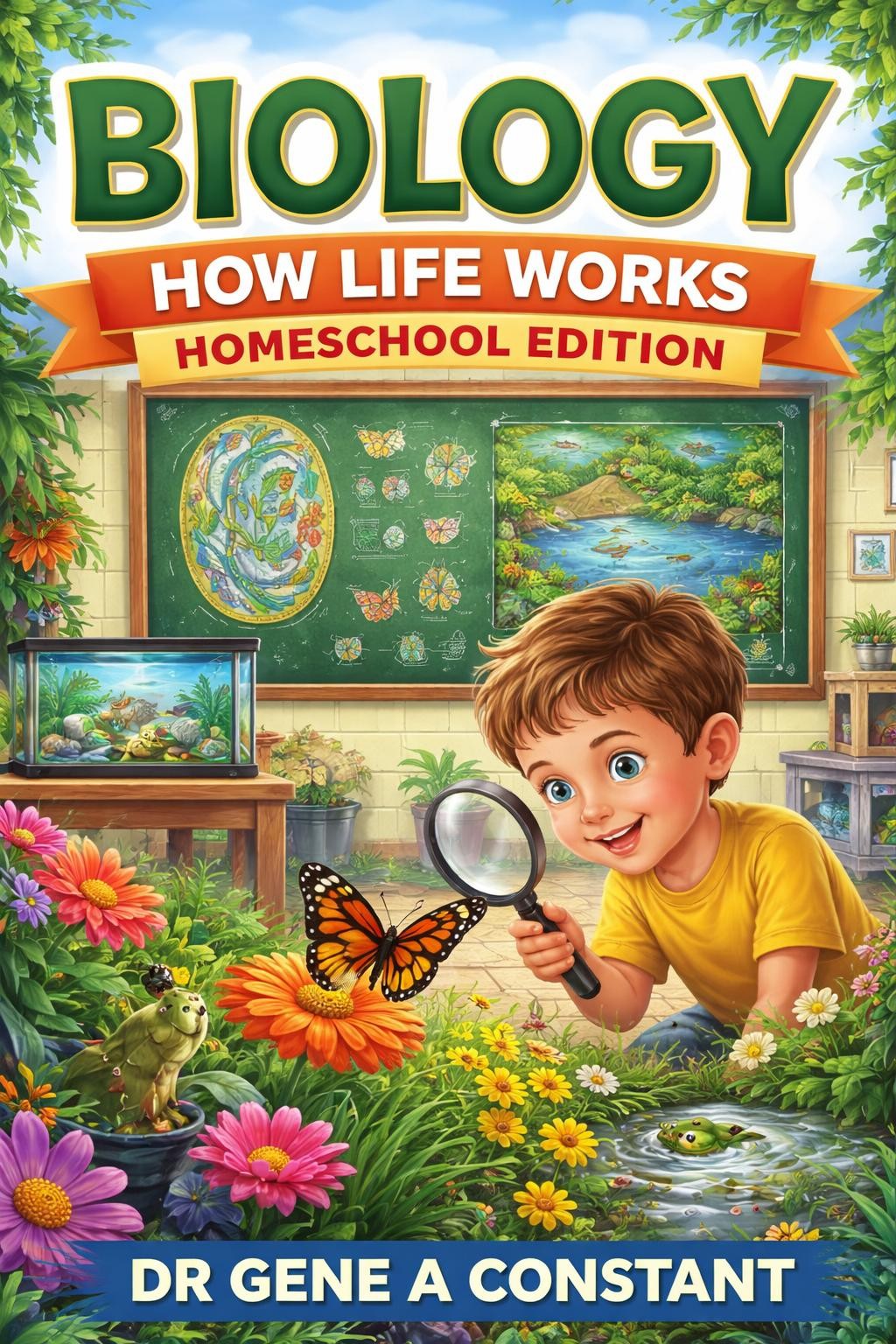
Biology: How Life Works, Homeschool Edition by Dr. Gene A Constant. This lesson is chapter 8, and the whole chapter is on this page.
GSU is a 501(c)(3) nonprofit and book sales are its only income. A purchase is not a tax-deductible donation. This lesson is free and always will be.