Math as a Language: How to Read, Speak, and Think in Numbers
Numbers have an alphabet, a grammar and dialects. Learn to read them, speak them and think in them.
Dr. Gene A Constant teaches mathematics the way we learn any language: its alphabet, grammar, translation, dialects and idioms, carried into money, the news and the family card table. Includes five free Thinking Games.
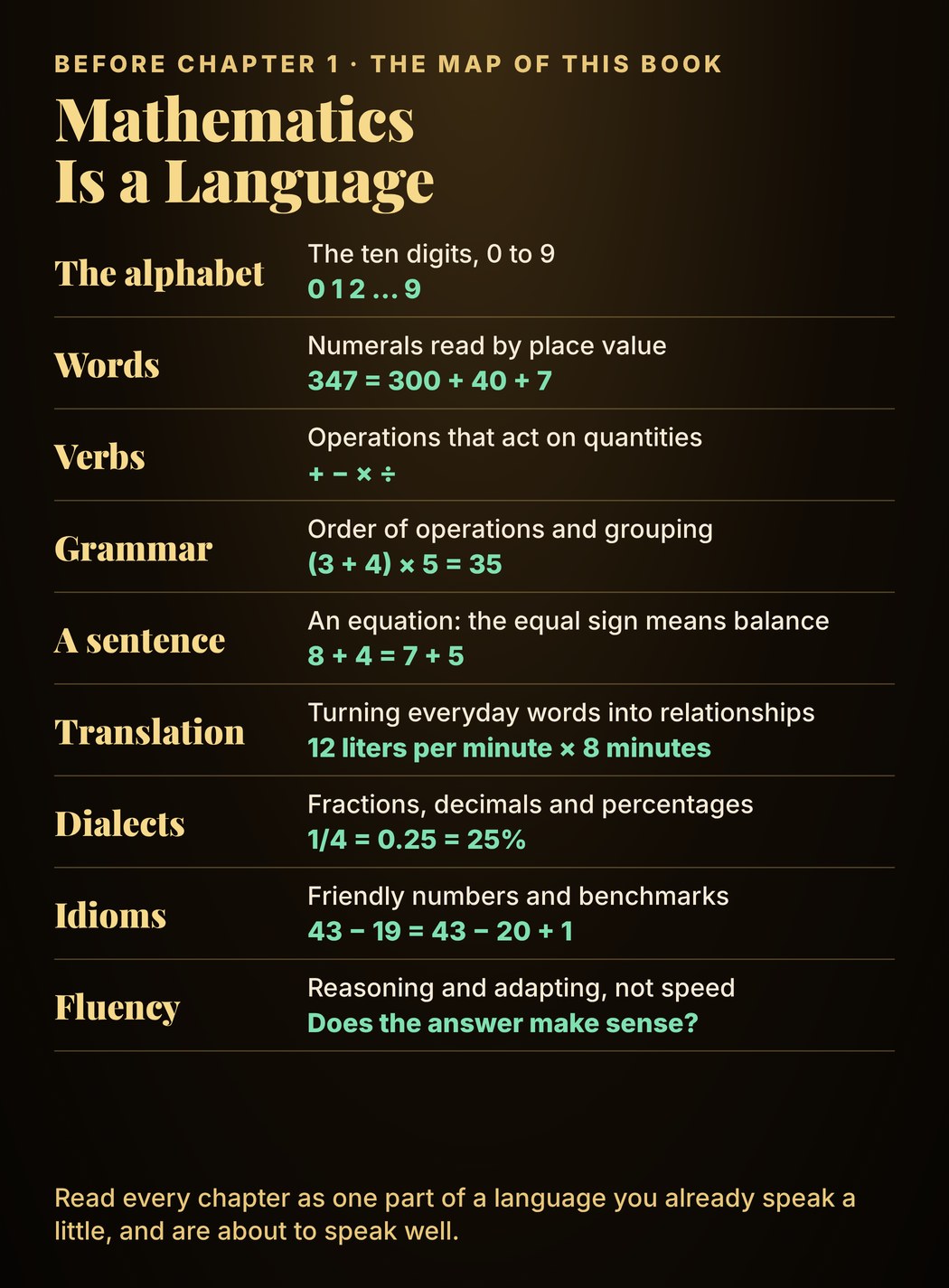
Contents
Paperback, 168 pages, 8.5 x 11 inches, in full color, with The Thinking Games: five free games built for this book.
Free With This Book · Mathematics Is a Language · The Six Rooms of This Book
Chapter 1: The Alphabet of Numbers and Foundational Syntax. Ten digits and the rule of place value form the alphabet of mathematics. Learn to read 347 as a sentence about quantity, and see why zero, renaming and the symbols themselves carry meaning.
Chapter 2: Grammar, Syntax, and the Rules of Discourse. The order of operations is the grammar that lets every reader find the same meaning in 3 + 4 × 5. Clear notation and an honest equal sign protect that meaning.
Chapter 3: The Art of Translation. Before any calculation, everyday words must be translated into relationships among quantities. Change stories, comparisons, rates and units show how to translate without falling for keyword tricks.
Chapter 4: Dialects and Context (Fractions, Decimals, Percentages). Fractions, decimals and percentages are three dialects for the same values. Learn when each one makes a quantity easiest to see, and how to move between them.
Chapter 5: Idioms and Mental Fluency. Fluent people use idioms such as friendly numbers, benchmarks and compensation, not only standard algorithms. Mental fluency grows from understanding, and speed is not its measure.
Chapter 6: The Language in Action: Civic and Financial Literacy. Headlines, polls, inflation, interest rates and budgets are mathematics spoken in public. Reading them well protects your vote, your wallet and your peace of mind.
Chapter 7: The Global Classroom and Overcoming Page Anxiety. Page anxiety is real, and it is learned. Models, conversation, many routes into an idea and adults who revise out loud can turn fear into curiosity.
Chapter 8: Math in the Living Room: Everyday Routines. The grocery aisle, the restaurant bill, the home project and the family card table are everyday classrooms. Unit prices, tips, discounts, area and games build fluency without a worksheet.
Chapter 9: Diagnostics: Spotting Literacy vs. Rote Memorization. Correct answers can hide memorized steps. Simple prompts, estimation and represent-it-another-way questions reveal whether a learner truly understands.
Chapter 10: Pivoting the Learning Paradigm. Teaching for fluency means asking what an idea means before asking which steps to follow. A set of lasting habits moves learners from procedure to reasoning that holds up in real life.
The Math as a Language Dictionary · The Thinking Games · Two Phones, One Sentence · 27 Free Ways to Learn to Read · Other Books by the Author · About the Author
Chapter 1: The Alphabet of Numbers and Foundational Syntax
Ten digits and the rule of place value form the alphabet of mathematics. Learn to read 347 as a sentence about quantity, and see why zero, renaming and the symbols themselves carry meaning.
Before a learner can read an equation, compare a sale price, or interpret a graph in the news, that learner must become familiar with the alphabet of mathematics. In everyday language, letters combine to form words, and words combine to form sentences. In mathematics, a small collection of symbols combines to express quantities, relationships, and ideas. The first and most frequently used of these symbols are the numerals of our base-10 system.
The word “numeral” is worth separating from the word “number.” A number is an idea: a quantity, position, amount, or relationship. A numeral is the written mark we use to represent that idea. The number five can be represented by the numeral 5, by the word “five,” by five dots arranged on a die, or by a hand with all five fingers extended. These are different representations of the same underlying concept.
This distinction may initially seem overly technical, but it matters. A child who sees 8 only as a shape to copy has not yet fully connected the numeral to the quantity it represents. Likewise, an adult who can type 0.07 into a calculator but cannot explain that it means seven hundredths may be operating symbols without reading their meaning. Mathematical literacy begins when symbols become meaningful rather than decorative.
Our standard numerical alphabet contains ten basic digits:
0, 1, 2, 3, 4, 5, 6, 7, 8, 9.
With only these ten characters, we can write every whole number imaginable, from the number of books on a shelf to the distance between planets. This efficiency is one of the great achievements of mathematical notation. English uses twenty-six letters, which can be arranged into an enormous number of words. Mathematics uses ten digits, which can be arranged into an infinite number of numerals.
The key is position.
Our system is called base 10 because it is organized around groups of ten. Most historians believe this structure became widespread in part because humans have ten fingers. Long before formal schools and printed textbooks, people counted livestock, harvests, debts, and days using their hands. Ten became a natural point at which to bundle, regroup, and begin again.
Imagine counting loose buttons. You begin with individual buttons: one, two, three, and so on. When you reach ten, you may place those ten buttons into a small bag. That bag now represents one group of ten. If you collect ten such bags, you may place them into a box. The box represents one hundred buttons. Ten boxes could be grouped again to represent one thousand.
This nesting structure is the foundation of base-10 notation:
10 ones make 1 ten.
10 tens make 1 hundred.
10 hundreds make 1 thousand.
The pattern continues indefinitely. Ten thousands make one ten-thousand, ten ten-thousands make one hundred-thousand, and so on. The quantities become larger, but the grammatical rule stays the same: every place to the left is worth ten times as much as the place before it.
Consider the numeral 347. It is not simply a row of three symbols. It is a compact sentence about quantity. The 3 tells us there are three hundreds. The 4 tells us there are four tens. The 7 tells us there are seven ones.
In expanded form:
347 = 300 + 40 + 7
Or, more explicitly:
347 = 3 × 100 + 4 × 10 + 7 × 1
This is what it means to read a numeral according to place value. The digit itself does not carry a fixed value independent of its location. The digit 4 can mean four ones in 4, four tens in 40, four hundreds in 400, or four thousands in 4,000. The character remains the same, but its role changes according to its position in the numeral.
Language offers a useful comparison. The letters “c,” “a,” and “t” can form the word “cat,” while the same letters arranged differently form “act.” The individual letters are familiar, but their arrangement changes the meaning. Similarly, the digits 2 and 5 represent very different quantities in 25 and 52. In 25, the 2 stands for two tens and the 5 for five ones. In 52, the 5 stands for five tens and the 2 for two ones. The digits have not changed; the syntax has.
This is why reversing digits is not a minor visual slip. When a learner writes 62 instead of 26, the issue may not be carelessness at all. It may reveal that the learner has not yet internalized that the position of a digit carries meaning. Responding with “Look more carefully” may correct the page in the moment, but it does not necessarily build understanding. A more productive question is, “What does the 2 mean in 26? What does it mean in 62?” The learner can then see that the two numerals describe different groupings.
Physical models make this structure visible. A single cube can represent one. A rod made of ten connected cubes can represent ten. A flat square made of one hundred cubes can represent one hundred. When learners build 243 using two hundred-flats, four ten-rods, and three single cubes, the numeral becomes a record of something they can see and touch.
Such models are not childish detours from “real math.” They are translations. They connect an abstract written code to quantities in the world. Even mature learners benefit from returning to this concrete meaning when place value has become shaky or procedural.
The base-10 structure also explains regrouping in addition and subtraction. Take 28 + 7. One can calculate this by starting with twenty-eight individual units and adding seven more. There are now fifteen ones. But base 10 does not leave fifteen as an unorganized pile. Ten ones are regrouped as one ten, leaving five ones. The result is three tens and five ones: 35.
The familiar written procedure of “carrying” is simply a compressed record of this regrouping. It should never be taught as a mysterious command to “put the 1 on top.” That small 1 does not magically appear. It represents one new group of ten. When its meaning is made explicit, the procedure becomes readable.
The same is true in subtraction. In 43 − 18, we may say that we cannot remove eight ones from three ones without exchanging one ten for ten ones. The numeral 43 can be re-expressed as three tens and thirteen ones. Now subtracting eight ones leaves five ones, and subtracting one ten from three tens leaves two tens. The answer is 25.
Often, students are taught to call this exchange “borrowing.” Although the word is common, it can obscure the actual idea. Nothing is borrowed from an outside source, and nothing must later be returned. One ten is simply renamed as ten ones. The value remains unchanged. This is an important grammatical principle in mathematics: a quantity may be represented in different but equivalent forms.
For example, 43, 4 tens and 3 ones, and 3 tens and 13 ones all name the same amount. Learning to move flexibly among these expressions is a foundation for later work with decimals, fractions, algebra, and mental computation.
Base 10 is powerful, but it is not inevitable. Computers commonly use base 2, or binary, which uses only 0 and 1. Time often uses base 60 for minutes and seconds. A dozen uses base 12. These systems remind us that the quantity itself is separate from the notation used to express it. Our decimal system is a convention, albeit an extraordinarily useful one.
That realization can be liberating. Mathematical symbols are not sacred marks that some people are naturally gifted at decoding. They are tools created by humans to communicate patterns clearly. Like any language, they can be learned through meaningful exposure, conversation, practice, and feedback.
When a learner sees 506, the goal is not merely to say “five hundred six” correctly. The goal is to understand it as five hundreds, zero tens, and six ones; to recognize that it is greater than 499 because it contains five hundreds; to know that adding one changes it to 507; and to be able to represent the same quantity with objects, words, an expanded expression, or a point on a number line.
That is the beginning of fluency. The digits are the alphabet, but place value gives them structure, and structure gives them meaning.
If place value gives digits their roles, placeholders make those roles visible. The most important placeholder in our number system is 0. It is easy to underestimate because it is often introduced as “nothing.” While zero can represent an empty quantity, its work in written mathematics is far more powerful than that simple definition suggests. Zero is also a signal. It tells us that a particular place exists, even when there are no groups in that place.
Consider the difference between 506 and 56. Both numerals use the digits 5 and 6, but they do not say the same thing. In 56, the 5 represents five tens and the 6 represents six ones:
56 = 5 × 10 + 6 × 1
In 506, the 5 represents five hundreds, the 0 represents zero tens, and the 6 represents six ones:
506 = 5 × 100 + 0 × 10 + 6 × 1
The zero is not empty decoration. It holds open the tens place so that the 6 can remain in the ones place. Without it, the numeral would collapse into 56, a number that is 450 smaller. Zero preserves the grammar of the numeral.
A useful analogy comes from ordinary written language. Imagine an address written without spaces, punctuation, or line breaks. The individual letters and numerals might still be present, but the message would be difficult to interpret. Placeholders and positional conventions organize a mathematical message in much the same way. They help a reader see where each part belongs.
This role becomes especially clear when numbers are compared. Ask a learner which is greater: 408 or 48. If they have learned only to notice familiar digits, they may see the 4 and 8 in both numerals and hesitate. But a place-value reading makes the comparison immediate. The numeral 408 contains four hundreds, while 48 contains only four tens. Four hundreds are greater than four tens, regardless of the matching digits.
The question is not simply, “Which number has bigger-looking digits?” It is, “What value does each digit have in this position?” That question restores meaning to the symbols.
Zeros can appear in several places, and their positions matter. In 70, the zero says there are seven tens and no ones. In 700, it says there are seven hundreds, no tens, and no ones. In 7,000, it says there are seven thousands, no hundreds, no tens, and no ones. Each added zero shifts the 7 one position to the left, making its value ten times greater.
This is positional power: a digit’s value depends on where it stands.
The digit 7 can mean seven, seventy, seven hundred, seven thousand, or seven hundred thousand. The written character does not change, but its value changes by powers of ten. Moving one place to the left multiplies its value by 10. Moving one place to the right divides its value by 10.
This pattern can be organized in a place-value chart:
Thousands | Hundreds | Tens | Ones
7 | 0 | 0 | 0
The numeral 7,000 is therefore not “a 7 with three zeros after it” in any merely visual sense. It is one group of seven in the thousands place. The zeros report that there are no additional hundreds, tens, or ones.
For learners, the phrase “add a zero” can become a dangerous shortcut when it is offered without explanation. It may seem to work in some cases, such as multiplying 8 by 10 to get 80. But it does not explain why the result changes, and it breaks down as soon as decimals enter the conversation. The deeper rule is that multiplying a number by 10 shifts every digit one place to the left in the base-10 structure. Dividing by 10 shifts every digit one place to the right.
For example:
34 × 10 = 340
The 3, once worth three tens, becomes worth three hundreds. The 4, once worth four ones, becomes worth four tens. A zero appears in the ones place because there are now no remaining single ones.
Similarly:
340 ÷ 10 = 34
The 3 shifts from the hundreds place to the tens place, and the 4 shifts from the tens place to the ones place. The zero no longer needs to hold the ones place because the 4 has moved there.
Thinking in terms of shifting value is more durable than memorizing surface actions. It helps learners make sense of calculations rather than hoping they remember a trick correctly.
Zero also matters when numbers are spoken aloud. The number 1,005 is read as “one thousand five,” not usually “one thousand zero hundred zero five.” Yet the written zeros still carry information. They tell us that the numeral contains one thousand, zero hundreds, zero tens, and five ones. Spoken language can leave out some of this structure because listeners infer it from conventional phrasing. Written notation must show the structure directly.
This difference between speech and notation can be a source of confusion. A child who hears “one thousand five” may write 15 because the spoken phrase contains the sounds “one” and “five.” The child is not necessarily being careless. They may be translating sound into symbols without yet understanding the hidden place-value structure. A supportive response is to ask, “How many hundreds are in one thousand five? How many tens? What needs to show that those places are empty?” A place-value chart, base-10 blocks, or labeled columns can make the invisible structure visible.
The same principle appears in money. Consider $5.06. This amount means five dollars and six cents. The zero is essential. It tells us that there are zero tenths of a dollar, or zero dimes, between the five dollars and the six pennies. If someone wrote $5.6 instead, the amount would mean five dollars and sixty cents. Those two amounts differ by fifty-four cents.
In a financial setting, misunderstanding a zero is not a small technical error. It changes the amount being communicated. A misplaced decimal or an omitted placeholder can affect a bill, a bank balance, a tax form, or a budget. Mathematical literacy is therefore not only about solving classroom exercises. It is about reading numerical messages accurately in daily life.
Decimals extend the same base-10 grammar to values smaller than one. The decimal point acts as a boundary marker between whole-number places and fractional places. To its left are ones, tens, hundreds, and thousands. To its right are tenths, hundredths, thousandths, and beyond.
Consider 3.04. The 3 represents three ones. The 0 represents zero tenths. The 4 represents four hundredths.
3.04 = 3 + 0 tenths + 4 hundredths
The zero is again doing important work. It keeps the 4 in the hundredths place. Without it, 3.4 would mean three and four tenths, which is much greater than three and four hundredths.
Money provides an immediate model:
$3.04 is three dollars and four cents.
$3.40 is three dollars and forty cents.
The numerals share the same digits, but their structure differs. Reading them accurately requires attention not only to which digits appear, but to where they appear.
Trailing zeros, the zeros at the end of a decimal, introduce another important idea. The decimals 0.5, 0.50, and 0.500 all represent the same quantity. They name five tenths, fifty hundredths, and five hundred thousandths. Because one tenth equals ten hundredths and one hundred hundredths equals one thousandth, these are equivalent representations.
This may seem to contradict the claim that zeros matter, but it actually strengthens it. Zeros always communicate position. In 0.50, the zero tells us that the 5 is in the tenths place and that there are zero additional hundredths. The value remains unchanged because no new quantity has been added. In contrast, placing a zero between nonzero digits, as in 5.06, changes the positions and therefore changes the value.
Learners need opportunities to say these structures aloud. Instead of merely reading 2,030 as “two thousand thirty,” invite them to unpack it: “Two thousands, zero hundreds, three tens, and zero ones.” Instead of accepting 4.07 as “four point zero seven,” ask what it means: “Four ones, zero tenths, and seven hundredths.” The first reading names the symbols; the second communicates their value.
This distinction is central to the book’s larger argument. Mathematical fluency is not the ability to recite marks on a page. It is the ability to interpret what those marks are saying.
A simple activity can reveal and strengthen this understanding. Write several numerals using the same digits in different positions: 9, 90, 900, 909, 990, and 9.09. Ask the learner to explain what each 9 means. In 909, the first 9 represents nine hundreds, while the second 9 represents nine ones. In 9.09, the first 9 represents nine ones, while the second represents nine hundredths. The digit is visually identical each time, but its positional role changes dramatically.
Another useful question is, “What would happen if this zero disappeared?” In 406, removing the zero produces 46. In 4.06, removing the zero produces 4.6. In each case, the learner can see that the zero was not doing nothing. It was maintaining the architecture of the message.
Our number system depends on this architecture. The ten digits are the alphabet, but position gives them meaning, and zero makes the positional system reliable. Together, they allow a short string of marks to communicate an enormous range of quantities, from seven cents to seven million people.
Once learners see zeros as placeholders and digits as position-dependent symbols, numerals cease to be mysterious strings to decode one at a time. They become structured expressions that can be read, expanded, compared, and translated. This understanding prepares us to examine the wider collection of symbols mathematics uses to communicate relationships, operations, and ideas.
The ten digits and the placeholder zero give us a remarkably efficient way to name quantities. Yet quantities alone are not enough for mathematical communication. To say that there are 347 books is useful. To say that 347 books are shared equally among 5 classrooms, compared with last year’s total, or reduced by 20 damaged copies requires additional symbols. Mathematics needs marks that communicate actions, relationships, boundaries, and patterns.
These symbols are often introduced as if they arrived fully formed and unquestionable: + means add, − means subtract, = means “the answer is,” and so on. But mathematical notation has a history. It was invented, revised, disputed, and gradually adopted because people needed clearer ways to record and share ideas. Seeing that history helps learners recognize an important truth: symbols are not arbitrary obstacles designed to test who can memorize them. They are human-made tools for making thought visible.
Consider the plus sign, +. Today it is among the most familiar marks in mathematics, but it did not always have this role. Before standardized notation, people commonly wrote operations in words. A merchant or scholar might write that one quantity was “added to” another. This was understandable, but lengthy. As trade, science, engineering, and accounting became more complex, writers needed quicker ways to record repeated calculations.
The symbol + is widely associated with the Latin word et, meaning “and.” Over time, writers shortened the word in quick handwriting. The flowing letters gradually became a compact cross-like mark. Whether one imagines it as a compressed “and” or simply as a sign that two quantities are being joined, its communicative purpose is clear. It tells the reader, “Combine these amounts.”
Thus,
28 + 7 = 35
can be read as a concise mathematical sentence: twenty-eight combined with seven is equal to thirty-five.
The minus sign, −, developed as a companion symbol. It communicates removal, difference, or a negative direction, depending on the context. In the expression 43 − 18, it tells us to find what remains when eighteen is removed from forty-three. As we saw when discussing regrouping, this is not merely a page procedure. It describes a meaningful change in quantity. One ten can be renamed as ten ones so that eight ones can be removed from thirteen ones.
The same mark can appear in front of a number, as in −5. In that setting, it does not mean “subtract five” in the same immediate way. It names a number located five units below zero on a number line. This is one reason mathematical literacy requires more than symbol recognition. A symbol’s meaning depends partly on its position and context, just as the digit 4 can represent four ones, four tens, or four hundredths depending on where it appears.
The equal sign, =, may be the most misunderstood symbol in elementary mathematics. Many learners encounter it in expressions such as 6 + 3 = 9 and understandably conclude that it means “the answer comes next.” But that is only a limited use of the sign. The equal sign communicates a relationship: the quantity on one side has the same value as the quantity on the other side.
The symbol was introduced in the sixteenth century by the Welsh mathematician Robert Recorde, who wrote that he chose two parallel lines because “noe 2 thynges can be moare equalle.” His spelling belongs to his time, but his idea remains powerful. Parallel lines of the same length made a visual argument for balance.
This meaning changes how we read an equation. Rather than seeing
8 + 4 = 12
as a command followed by an answer, we can read it as a statement of equivalence: eight plus four has the same value as twelve.
That understanding becomes essential when an equation takes a less familiar form:
8 + 4 = 7 + 5
Both sides name twelve. The equation is true because the two expressions balance.
Or consider:
15 = 15
This may look too obvious to deserve attention, but it expresses the basic principle exactly. Each side represents the same quantity. In later mathematics, learners will meet equations such as 3x + 2 = 17. The equal sign still means precisely what it meant in 8 + 4 = 12: the expression on the left and the expression on the right must have the same value.
The history of the equal sign offers a useful lesson in mathematical language. A strong symbol does not merely save space. It preserves an idea. When learners are taught that = means “write the answer,” they receive an incomplete translation. When they learn that it means “has the same value as,” they can read equations as meaningful statements.
Other relationship symbols extend this vocabulary. The signs < and > indicate comparison. In 4 < 9, the symbol says that four is less than nine. In 12 > 7, it says that twelve is greater than seven. A common classroom image describes the sign as a hungry creature that “eats” the larger number. That image can help some young learners remember the direction, but it should not replace the actual language of comparison. The symbol is not a decoration or a creature. It is a compact way to record a relationship between two quantities.
The signs ≤ and ≥ add another layer of meaning. The expression x ≤ 10 means that x is less than or equal to ten. It includes all values below ten and ten itself. These symbols become especially important in real life: a ride may require a child to be at least 48 inches tall; a budget may require spending to remain at or below a certain amount; a speed limit may set a maximum legal speed. Mathematical symbols often express rules, boundaries, and conditions that affect everyday decisions.
Parentheses provide another kind of communication. They do not name a quantity or operation by themselves. Instead, they organize a mathematical sentence by showing which parts belong together. In ordinary writing, parentheses can add an aside or clarify a detail. In mathematics, they can change the meaning of an entire expression.
Compare:
3 + 4 × 5
with:
(3 + 4) × 5
The first expression is interpreted as 3 + 20, which equals 23. The second directs us to combine 3 and 4 first, producing 7, and then multiply by 5, producing 35. The parentheses act like grouping marks or verbal cues such as “first consider this part.” They are part of mathematics’ syntax, helping readers know how an expression is meant to be read. Their role will become even clearer when we examine order of operations in the next chapter.
The multiplication sign also has a varied history and several modern forms. The symbol × is common in early schooling, where 4 × 6 clearly communicates “four multiplied by six.” But mathematicians often use a centered dot, as in 4 · 6, because the letter x is frequently needed as a variable. In algebra, multiplication may be written with no visible sign at all:
3a means 3 multiplied by a.
This can initially feel strange. Why should 3a mean multiplication while 34 means thirty-four? The answer lies in the conventions of the language. In 34, the digits occupy adjacent place-value positions, so they form one numeral: three tens and four ones. In 3a, a digit and a letter stand side by side according to algebraic convention, indicating multiplication. Context tells the reader which grammatical rule applies.
Division, too, has several dialects of notation. The expression 12 ÷ 3 is common in elementary school. The fraction form 12/3 communicates the same division, and the long-division bracket provides a format for carrying out a particular procedure. In more advanced settings, 12 ÷ 3 may be written as 12/3 or as a horizontal fraction:
12 / 3
These are not competing answers. They are different written forms for the same relationship: twelve is being partitioned into groups of three, or twelve is being shared equally among three groups.
Even the decimal point is an evolved symbol. As discussed in the previous section, it separates whole-number places from tenths, hundredths, and smaller values. But countries do not all write decimals in the same way. In the United States, 3.5 commonly means three and five tenths. In many other places, the same number is written 3,5. Meanwhile, commas may be used to separate thousands, as in 1,000, or spaces may be used instead, as in 1 000. These differences are reminders that notation has conventions, much like spelling and punctuation in spoken languages.
The underlying quantity does not change when its written form changes. Three and five tenths remains the same value whether a community writes 3.5 or 3,5. Yet readers must know the local convention to avoid miscommunication. This is especially important in international financial, scientific, and technical contexts, where a misplaced comma or decimal point can change a quantity dramatically.
Mathematical symbols have become powerful because they are economical. A few marks can communicate what would otherwise require a long sentence. Compare “the total of twenty-eight and seven has the same value as thirty-five” with 28 + 7 = 35. The symbolic form is faster to write, easier to scan, and usable across many spoken languages. A reader who does not speak English may still understand the equation.
But economy can create danger when symbols are used without meaning. A learner may become skilled at writing +, −, ×, and = while still treating them as buttons to press in a fixed sequence. Genuine literacy means being able to translate in both directions: from symbols into words and from words into symbols.
For instance, ask not only, “What is 60 − 19?” but also, “What does the minus sign ask us to find here?” Ask a learner to read 4.07 as “four ones and seven hundredths,” then explain why it differs from 4.7. Ask why 9 + 6 = 10 + 5 is true even though the expressions look different. Such questions invite the learner to interpret mathematical writing rather than merely perform it.
The symbols of mathematics are its punctuation, verbs, connectors, and comparison words. They have histories because people needed to communicate more precisely. They have rules because shared rules allow one person’s written idea to be understood by another. And they have meaning only when the reader can connect the marks on the page to quantities, actions, and relationships.
With digits, placeholders, and symbols in view, we now have the basic characters of the mathematical language. The next task is to understand how those characters work together: how mathematical sentences are organized, how grouping and operations shape meaning, and how clear syntax prevents one expression from saying two different things.
Chapters 2 through 10, the dictionary and The Thinking Games continue in the book.