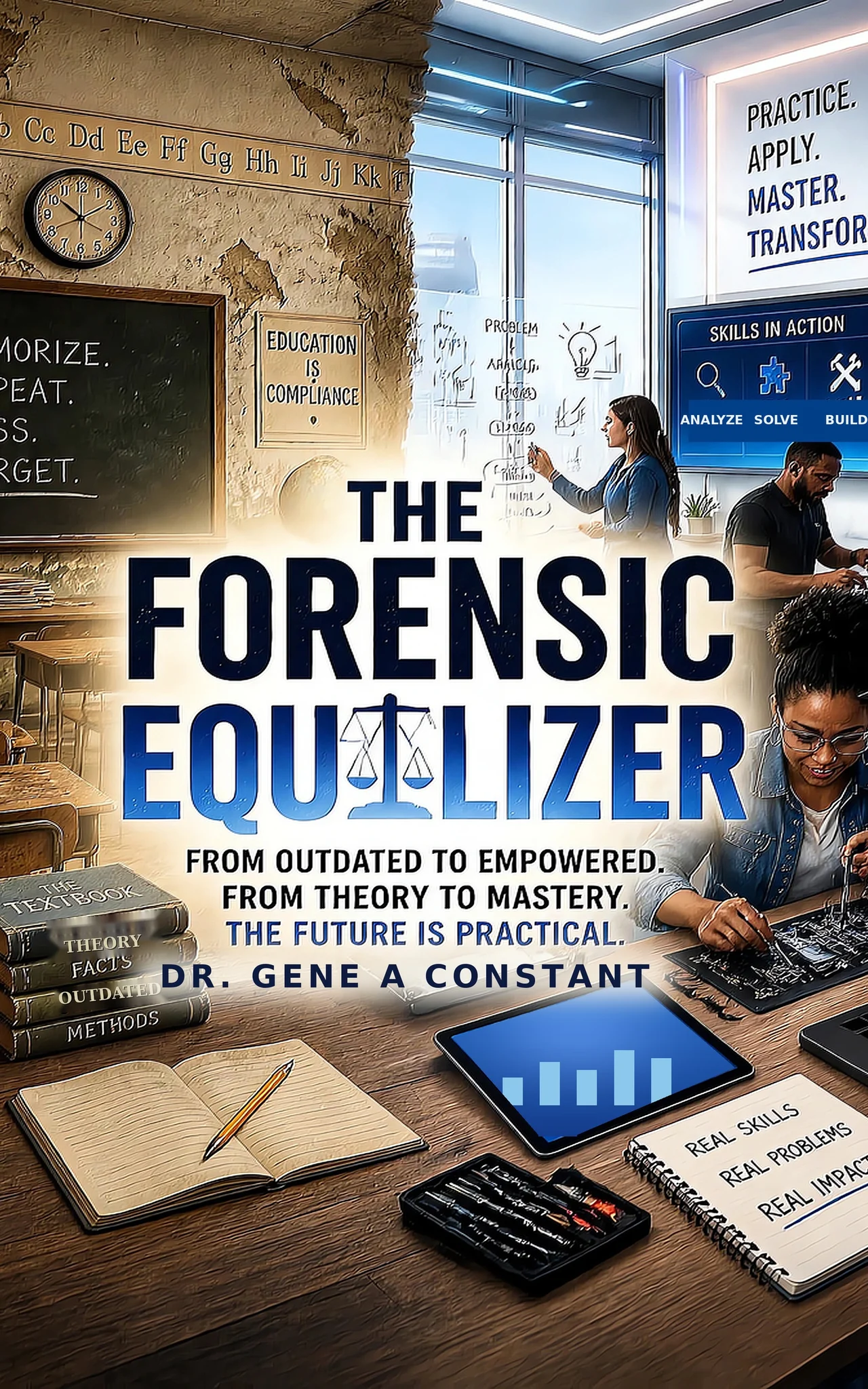
The Forensic Equalizer: From Outdated to Empowered. From Theory to Mastery.
They were taught around a skill rather than through it. This book shows adults how to rebuild it, one document and one number at a time.
A practical method for adults who finished school but still struggle with reading and math: forensic reading, hands-on mathematics, AI tutoring in your strongest language, and a habit of proving your own work.
Inside the Book (176 pages)
The Six Rooms · The Grade Level Check · Chapter 1: The Great Educational Illusion · Chapter 2: Unmasking Systemic Gaps · Chapter 3: AI as the Equalizer · Chapter 4: Forensic Reading: An Overview · Chapter 5: Entity Isolation in Complex Texts · Chapter 6: Root Cause Vocabulary Acquisition · Chapter 7: Spotting Friction Points in Documents · Chapter 8: Forensic Mathematics Foundations · Chapter 9: Mathematics in Maintenance and Trades · Chapter 10: The Validation Engine: Independent Mastery · Chapter 11: The Infinity Cycle of Systems · Chapter 12: System Sovereignty and Lifelong Learning · Case Studies · The Forensic Equalizer Dictionary · Practice What This Book Teaches · About the Author
Chapter 1: The Great Educational Illusion
The number is deliberately unsettling: 140,000 hours.
It is not a claim that every student spends 140,000 literal hours sitting at a desk. The arithmetic of classroom attendance does not support that. A child may spend roughly 15,000 to 18,000 hours in formal K–12 instruction, depending on attendance, district schedules, transportation, homework expectations, tutoring, disciplinary time, testing, remediation, and extracurricular requirements. But schooling is not merely classroom time. It is an entire social machine built around the learner: the hours of teachers, administrators, counselors, specialists, test designers, curriculum vendors, transportation systems, parents, support staff, compliance departments, and public investment. When the full system’s labor, attention, infrastructure, and funding are counted, an enormous amount of human capacity surrounds each student.
The 140,000-hour vacuum is the gap between that enormous investment and the usable capability many adults possess when they leave the system.
A vacuum is not simply an empty space. It is a space from which something necessary has been removed. In this case, what has too often been removed is mastery. Not exposure. Not attendance. Not a transcript. Not a passing grade. Mastery.
An adult may have been present for lessons on fractions, grammar, electrical safety, civic process, argument writing, scientific measurement, and reading comprehension. They may have passed unit tests, advanced from grade to grade, and received a diploma that legally confirms completion. Yet when they are asked to read a workplace manual, calculate a material quantity, compare two equipment specifications, write a clear email to a supervisor, or identify the condition hidden in a contract clause, they may freeze.
That freezing response is frequently misunderstood.
Employers may call it carelessness. Instructors may call it poor motivation. Family members may call it laziness. The adult may call it stupidity.
But the more accurate explanation is often much less cruel and much more useful: the person was moved through a system without receiving the repetitions, corrections, context, and verification required for durable learning.
They were taught around a skill rather than through it.
Consider reading. A student may have learned how to identify a main idea in a short passage selected for a standardized assessment. They may have learned that a paragraph has a topic sentence and supporting details. They may have answered enough multiple-choice questions to meet a threshold. Yet this is not the same as reading a three-page safety procedure and knowing exactly who must act, what equipment is involved, what condition activates the rule, what exception modifies it, and what consequence follows if the procedure is ignored.
The first task measures recognition inside a controlled environment. The second requires operational comprehension.
Operational comprehension means that reading changes what a person can do. It allows the reader to make a decision, prevent an error, challenge a bad instruction, locate responsibility, or protect themselves from being misled. It is the difference between looking at words and extracting a working model from them.
The same distinction appears in mathematics. Many people remember being told to “show your work.” They remember worksheets filled with problems that had one expected method and one expected answer. They may remember the anxiety of being timed, corrected publicly, or told that they were “not math people.” What they often do not remember is why the mathematics mattered.
A fraction becomes meaningful when a worker must divide a measurement accurately so that two components align. A decimal becomes meaningful when a calibration must be set within tolerance. A ratio becomes meaningful when a mixture must be prepared safely, when load capacity must be calculated, or when a production process begins creating waste because its inputs are out of proportion.
Without physical purpose, mathematics can become a ritual of symbols. A learner may memorize steps long enough to survive a test and forget them because no real system ever demanded their use. Then, years later, the same learner is handed a tape measure, a blueprint, a maintenance log, or a spreadsheet and is expected to perform as though the earlier instruction had created permanent understanding.
This expectation is one of the great educational illusions.
The illusion says that exposure equals learning.
It says that if a concept appeared in a curriculum, the concept was taught. If it was taught, it was learned. If it was tested, it was mastered. If a grade was recorded, the matter is closed.
Each step in that chain can fail.
A concept can appear in a curriculum but receive too little time for a learner to understand it. It can be taught in language disconnected from the learner’s life. It can be tested through guessing, memorization, partial credit, or repeated practice on predictable formats. A passing grade can reflect effort, improvement, attendance, behavior, administrative policy, or the understandable desire not to hold a student back. None of those things necessarily proves that the person can independently use the skill months or years later.
This is not an attack on individual teachers. Many teachers work under impossible conditions: overcrowded classrooms, rigid pacing guides, insufficient planning time, constantly changing mandates, limited support for students with language differences or learning interruptions, and intense pressure to produce acceptable metrics. A teacher can see that a student needs more time, more explanation, or a different route into the material and still be required to move on because the calendar says the unit has ended.
The system then turns the calendar into evidence of learning.
The result is a form of educational debt. The debt accumulates quietly. A student who does not fully understand place value may later struggle with decimals. The struggle with decimals may make ratios confusing. Confusion about ratios may make measurement, scaling, percentages, and algebra seem impossible. Because each new subject assumes the last one is secure, the learner is asked to build a second floor on beams that were never properly installed.
By adulthood, the original gap can be difficult to see. The person does not say, “I need to rebuild my understanding of quantity, equivalence, and spatial proportion.” They say, “I’m bad at math.”
Likewise, a person who was never taught to break a complex sentence into parts may not say, “I need to identify the actor, action, condition, object, exception, and consequence.” They say, “I can’t read big words.”
These statements sound like identity claims, but they are often reports of an uninspected system failure.
The 140,000-hour vacuum creates another injury: shame. Adults who have been passed forward without mastery often become experts at concealment. They avoid forms, manuals, technical documents, financial statements, and written instructions. They laugh off confusion. They ask someone else to “look at this real quick.” They rely on memory where verification is needed. They may become highly capable through observation and repetition while still fearing any task that exposes their reading or mathematics gaps.
This adaptation should be respected. It demonstrates intelligence, not its absence.
A person who has learned to survive complex workplaces through observation, pattern recognition, conversation, mechanical intuition, and persistence has already built valuable cognitive tools. The problem is that these tools have not always been connected to a reliable method for decoding formal text and mathematical systems. The purpose of this book is not to erase what adult learners already know. It is to make their existing intelligence visible, then connect it to a method of independent mastery.
The first step is refusing the false verdict issued by the vacuum.
A diploma is not proof of incompetence, but neither is it automatic proof of readiness. A low test score is not a measure of human potential. Difficulty with a document does not mean a person lacks intelligence. It means the document contains structures, vocabulary, assumptions, or hidden demands that have not yet been made visible.
Once the learner understands this, the ground changes. Shame loses some of its authority. The question is no longer, “What is wrong with me?” The question becomes, “What specific system was never built, and how do I build it now?”
That question is the beginning of forensic learning. It replaces vague failure with evidence. It replaces labels with components. And it turns the empty space left by the educational machine into a map for reconstruction.
The educational system often treats mastery as an administrative event.
A student completes an assignment. A teacher enters a grade. A course ends. A transcript records a credit. A diploma is awarded. At each stage, the institution creates a document showing that something has been completed. Over time, these documents form a powerful story: the student has learned what they were supposed to learn.
But completion and mastery are not the same thing.
Completion means a person has passed through a required sequence. Mastery means they can independently perform, explain, adapt, verify, and apply a skill when the setting changes. Completion can be recorded. Mastery must be demonstrated under real conditions.
This distinction matters because adults are routinely judged by credentials that do not reveal what they can actually do. An employer sees a high school diploma and assumes the applicant can read instructions, write a coherent report, interpret quantities, use basic percentages, and follow a multistep process. A training program sees a placement score and assumes it accurately separates capable learners from incapable ones. A government form assumes that anyone who completed school can decode its language. A lender, a landlord, a supervisor, an insurance company, and a court may all place demands on a person’s reading and mathematical abilities without ever checking whether those abilities were truly built.
The adult who struggles in these moments is then blamed for failing to meet a standard that the credential itself appeared to guarantee.
This is the myth of academic mastery: the belief that moving through academic structures proves durable command of the knowledge those structures were meant to teach.
The myth survives because schools need systems that can manage large numbers of students. Grades, credits, test scores, seat time, and graduation requirements provide a way to organize a massive institution. They are not useless. A record of attendance can show whether a student had access to instruction. A grade can reveal some evidence of performance. A test can identify patterns that deserve attention. But these measures become dangerous when they are mistaken for a complete picture of learning.
A person can earn a passing grade in mathematics by memorizing a procedure long enough to repeat it on a quiz. They may use a formula correctly while the example is familiar, then be unable to recognize the same relationship when it appears as a measurement problem at work. They may solve a worksheet on percentages but not know how to verify whether a discount, a pay deduction, a loan rate, or a material-waste estimate makes sense.
The grade says, “Passed.”
Reality asks, “Can you detect an error before it costs money, time, safety, or trust?”
Those are different questions.
Reading follows the same pattern. A student may be taught strategies for answering questions about a passage. They may learn to search for keywords, eliminate unlikely answer choices, or identify the sentence that most closely resembles an option on a test. These are test-navigation skills. They can help a learner survive an assessment. Yet they do not necessarily prepare that learner to read a maintenance procedure, a benefits package, a lease agreement, a medication label, a machine warning, or a work order with consequences attached.
A real document does not always ask politely, “What is the main idea?”
Instead, it hides its demands inside structure.
It may state that a worker must inspect a component before operation, except under a certain condition, unless a supervisor has issued an alternative procedure, provided that another record has been completed. The key information may be buried in the middle of a long sentence. The person required to act may be named only once. A deadline may appear in a footnote. A warning may be written in formal language that sounds important but remains unclear until the reader identifies the actual action required.
Academic reading often rewards the ability to discuss a text. Operational reading requires the ability to use a text.
The first may ask, “What did the author mean?”
The second may ask, “Who has responsibility, what must happen, by when, using what standard, under which conditions, and what happens if the requirement is ignored?”
Neither form of reading is inferior. Literature, history, argument, and reflection matter. Human beings need language for imagination, empathy, memory, and civic life. But an education that teaches discussion without also teaching extraction leaves people vulnerable. It gives them words without leverage.
The myth of mastery becomes especially harmful because it encourages adults to misread their own difficulty. If a person has a diploma, has completed a grade level, or has passed a required test, they may believe that any later confusion must be personal failure.
“I should already know this.”
“I learned this years ago.”
“Everybody else understands it.”
These statements are often not evidence. They are echoes of the system’s promise.
The system implied that the skill had been delivered, so the learner assumes the missing skill must be their fault. They do not see the missing repetitions. They do not see the rushed transition from one unit to another. They do not see the years when they were absent, distracted, working, caring for family, translating between languages, dealing with housing instability, recovering from stress, or simply trying to survive adolescence. They do not see that a concept can be introduced once, tested once, and then treated as permanently installed.
Human learning does not work that way.
A skill becomes durable when it is revisited across conditions. A learner must encounter it, use it, make errors, receive correction, use it again, explain it in their own language, connect it to physical reality, and verify that it still works when the surface details change. This process is slower than exposure, but it is faster than carrying confusion for twenty years.
Take a basic ratio. On paper, a ratio may look like two numbers separated by a colon or written as a fraction. In a classroom, it can become another symbol to memorize. But when ratio is connected to a real system, its meaning becomes visible. A cleaning solution may require a certain mixture of concentrate and water. A machine may require specific proportions of air, fuel, pressure, or material feed. A concrete batch, paint mixture, electrical load, or production schedule can fail when the relationship between parts is wrong.
At that point, ratio is no longer a school subject. It is a relationship that governs whether a system functions.
Mastery means the learner can see that relationship in more than one form. They can read it, say it, measure it, calculate it, estimate whether it is reasonable, and recognize the consequences when it is out of balance. They can also check their own work rather than waiting for someone with more authority to tell them whether they are right.
That final ability, self-verification, is one of the clearest signs of real mastery.
A learner who depends entirely on an answer key, a supervisor, a calculator screen, or another person’s confidence has not yet reached independence. They may have produced a correct answer, but they do not yet possess a validation method. They cannot distinguish between being right and merely being lucky.
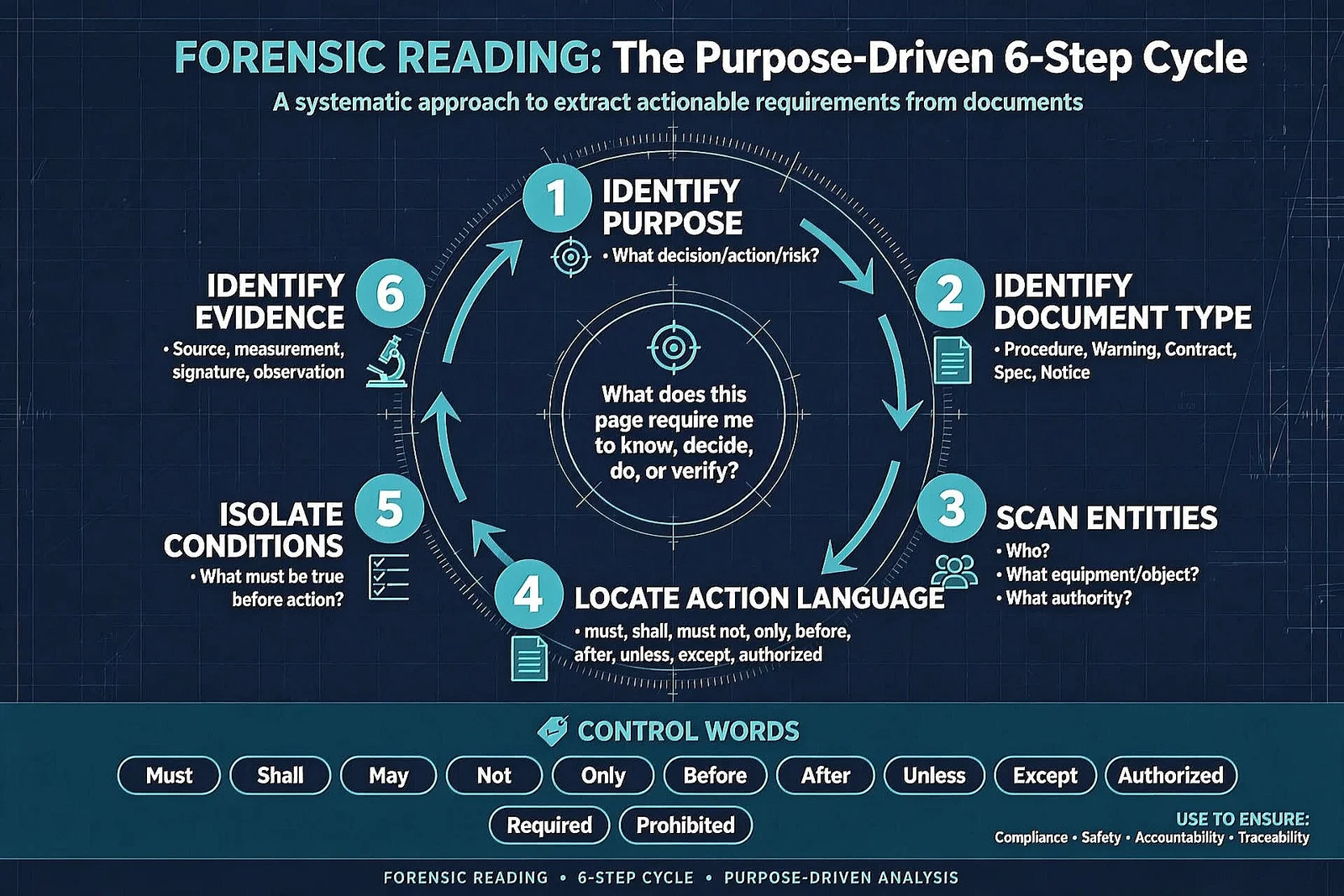
This is why the forensic approach matters. It does not ask the learner to trust a grade, a credential, or a vague feeling of understanding. It asks for evidence. What is the task? What are the entities? What action is required? What quantity is being measured? What condition changes the rule? What source confirms the conclusion? What physical result would show that the calculation or interpretation is correct?
These questions turn learning into an inspection process.
They also expose why so many adults were able to leave school with credentials but without confidence. The system often measured whether they could move forward, not whether they could stand independently. It rewarded speed over reconstruction, correct-looking work over visible reasoning, and compliance with the sequence over genuine control of the skill.
None of this means that every graduate lacks mastery or that every school experience is empty. Many people received excellent instruction. Many teachers created life-changing opportunities inside difficult conditions. Many learners developed strong knowledge despite the limits of the system around them.
The point is more precise: institutional proof should never be confused with personal command.
A transcript can open a door. It cannot guarantee that the person walking through it has been given the tools to navigate what waits on the other side.
For the adult learner, this realization should not produce bitterness alone. It should produce clarity. If an old grade does not prove mastery, then an old failure does not prove permanent incapacity either. A poor score, a remedial label, an unfinished course, or a moment of public embarrassment does not define the learner’s ceiling. It only identifies a place where the system did not yet produce reliable evidence of understanding.
That evidence can still be built.
It begins by replacing the question, “Did I pass this once?” with a more useful question: “Can I use this accurately, explain it clearly, and verify it independently now?”
When the answer is no, there is no need for shame. There is only a system to inspect, a missing component to identify, and a skill to rebuild.
Legal certification is a formal recognition issued by an institution. Practical reality is the test a person faces when no institution is present to explain the task, reduce the options, or soften the consequences.
The difference between the two can be enormous.
A diploma, license, training certificate, course completion record, or passing score has legal and social value. It may qualify a person for employment, allow entry into a program, satisfy a regulatory requirement, or signal that the person completed a prescribed process. These documents matter because modern institutions need a way to establish minimum eligibility. A hospital cannot hire every applicant based on a conversation. A construction site cannot simply assume that every worker understands safety procedures. A trade program needs some way to document who completed instruction.
Certification is meant to create trust.
The problem begins when the document is treated as proof of abilities it did not actually measure.
A person may be legally certified as a high school graduate while being unable to read a complex work order without assistance. They may have completed a required safety course while not knowing how to locate the specific condition that makes a procedure unsafe. They may have passed basic mathematics while remaining unsure how to convert a measurement, calculate material waste, estimate a percentage, or check whether a result is physically possible.
The certificate says, “This person completed the requirement.”
Practical reality asks, “Can this person perform the required action accurately when the conditions are unfamiliar, the wording is dense, and an error has consequences?”
Again, these are different questions.
This distinction is not meant to insult certification. It is meant to put certification in its proper place. A credential can establish that a person has been exposed to a body of information. It can document participation. It can show that an authority accepted certain evidence at a particular time. But it cannot automatically prove durable comprehension, judgment, transfer of learning, or independent verification.
Those capacities must be tested in action.
Consider a worker who receives a forklift safety card after completing a training module. The card may indicate that the worker watched instructional material, passed a quiz, and demonstrated a basic procedure. That is a useful starting point. But practical competence is revealed later, when the worker must inspect equipment at the beginning of a shift, notice an unusual hydraulic sound, interpret a load-capacity plate, recognize an unstable pallet, calculate whether a load is within safe limits, or refuse an unsafe instruction from someone with more authority.
The card may grant legal permission to operate.
It does not guarantee the courage, reading precision, mathematical reasoning, or situational awareness needed to operate safely.
The same pattern appears far beyond the workplace. A person may have signed a lease agreement, opened a bank account, accepted insurance terms, consented to a medical procedure, or entered a payment plan. Legally, their signature may be treated as evidence that they understood the document. Practically, they may have been unable to decode the language, identify the fee structure, recognize the deadline, or understand the clause that shifted responsibility onto them.
The law often recognizes a signature. Reality must deal with comprehension.
This gap can make adults vulnerable. When a document uses formal language, dense paragraphs, cross-references, exceptions, or technical vocabulary, a person who lacks operational reading skills may agree to conditions they did not actually understand. They may believe the failure belongs to them because they were taught that graduating school meant they should be able to read anything placed in front of them.
But no one is born knowing how to interpret a lease, a benefits package, a building code, a repair manual, a loan agreement, or a company policy. These documents are specialized systems. They contain entities, obligations, definitions, conditions, exceptions, timelines, and consequences. They must be dismantled before they can be understood.
A legal certification does not eliminate that work.
This is especially important for adults whose practical intelligence is stronger than their confidence with institutional language. A person may know how to diagnose a failing engine by sound. They may be able to watch a production line for five minutes and identify where materials are backing up. They may understand how to organize people, anticipate problems, repair damaged equipment, care for a family under pressure, or negotiate complicated social situations.
Yet that same person may hesitate when asked to read a technical bulletin or complete a written incident report.
The contradiction is only apparent. Their intelligence is real. Their gap is specific.
They may have learned through observation, repetition, touch, conversation, pattern recognition, and consequence. Formal education may have asked them to learn through decontextualized text, timed tests, and procedures that seemed disconnected from any urgent purpose. If the system failed to connect the two forms of learning, the adult can emerge with powerful capability in one domain and fear in another.
This is why practical reality must become the center of rebuilding.
The goal is not merely to help a learner obtain another credential. Credentials may be useful, and many adults need them for employment or advancement. The goal is to ensure that the credential corresponds to something real: the ability to inspect a situation, understand a document, calculate a quantity, identify uncertainty, ask the right question, and verify an answer without surrendering judgment to someone else.
That is the difference between being certified and being sovereign.
Certification says that an outside institution has granted recognition.
Sovereignty means the learner can evaluate evidence for themselves.
A sovereign learner does not assume that a manual is correct simply because it is printed. They examine the edition date, the equipment model, the stated condition, and the source of the requirement. They do not trust a calculation merely because it appeared on a spreadsheet. They estimate the result, check the units, compare it to physical reality, and determine whether the output makes sense. They do not accept a verbal instruction blindly if it conflicts with written procedure, safety requirements, or observable conditions.
This does not make the learner difficult or disrespectful. It makes them reliable.
A reliable person is not someone who always says yes. A reliable person is someone whose yes is informed.
The educational illusion trains many people to look upward for validation. They wait for the teacher, supervisor, answer key, test score, or official document to tell them whether they understand. This dependency can continue long after school ends. An adult may feel capable only when someone else confirms that they are right. In unfamiliar situations, they may either freeze or imitate the confidence of others.
But practical life does not always provide a teacher at the moment of decision.
A machine may fail at the end of a shift. A customer may ask a question that the script does not answer. A material order may arrive short. A medication label may contain a warning. A job application may ask for information in unfamiliar terms. A contractor may present an estimate with vague quantities. A supervisor may give an instruction that conflicts with a safety rule.
In those moments, the person needs more than prior exposure. They need a method.
The forensic method begins with refusal to pretend. The learner does not say, “I should understand this because I have a diploma.” Nor do they say, “I am stupid because I do not understand this immediately.” They ask what is actually present in front of them.
Who is involved?
What action is being required?
What object, tool, amount, or system is affected?
What condition activates the requirement?
What exception changes it?
What evidence supports the conclusion?
What result would confirm that the interpretation or calculation is correct?
These questions restore control. They transform a document from a wall of words into a system with parts. They transform a mathematical problem from a threat into a measurable relationship. They expose the distance between a legal statement of competence and actual capability without turning that distance into a personal insult.
That distinction is essential. The adult learner has often been judged enough already.
They have been judged by grades that did not explain their gaps, by tests that measured speed more than understanding, by employers who assumed credentials meant readiness, and sometimes by their own memories of embarrassment. They do not need another institution telling them that they failed to meet a standard. They need tools that reveal exactly what is missing and how to rebuild it.
Practical reality offers that kind of honesty.
A machine either operates within tolerance or it does not. A measurement either fits the physical space or it does not. A procedure either identifies responsibility clearly or it leaves room for confusion. A calculation either survives verification or it needs correction. This may sound unforgiving, but it is also fair. Physical and operational systems do not care about old labels. They respond to what works.
That is good news for the adult rebuilding mastery.
An old transcript cannot limit present learning. A past passing grade cannot force a person to remain confused. A credential that failed to produce confidence does not mean confidence cannot be built. The learner can return to the foundations, not as punishment, but as engineering. They can reconstruct the missing beams beneath the second floor.
The next work of this book begins there: with the practical act of looking closely. Reading will no longer mean simply moving through sentences. Mathematics will no longer mean repeating disconnected symbols. Each will become a tool for identifying entities, relationships, conditions, failures, and solutions.
The certificate may open a door. But practical mastery is what allows a person to walk through that door, inspect the room, understand the system, and decide for themselves what must happen next.
Chapters 2 through 12, the case studies and the dictionary continue in the complete book.