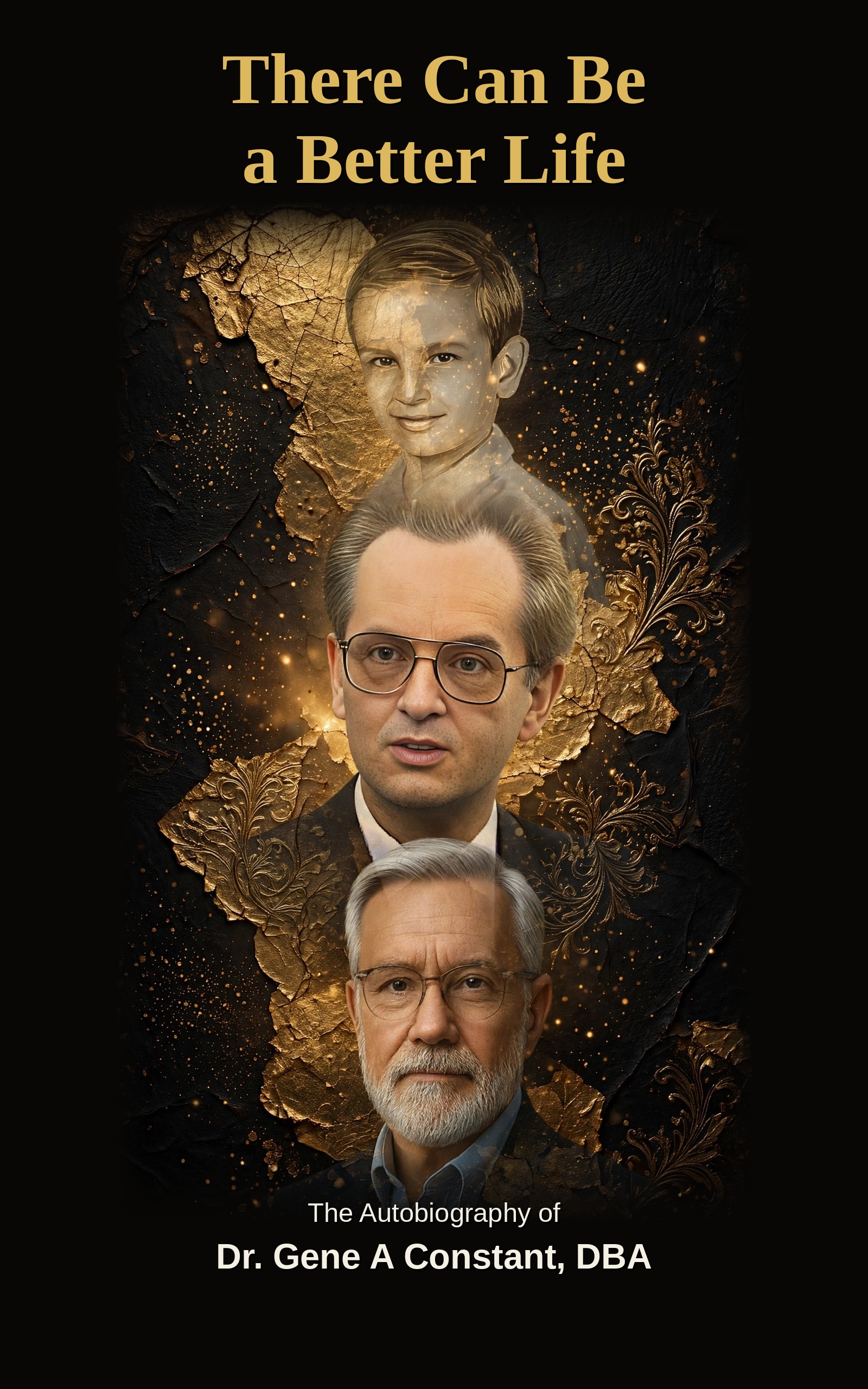
There Can Be a Better Life: The Autobiography of Dr. Gene A Constant, DBA
A gifted boy given no schoolbooks. A dropout who earned a doctorate. A man of seventy-three who built a university anyone can attend.
The autobiography of Dr. Gene A Constant: denied schoolbooks as a gifted boy, he never started high school, then rose through the Navy, JCPenney and a doctorate to found a tuition-free university at seventy-three. Illustrated in full color with more than thirty photographs and documents.
Contents
Paperback and ebook, 118 pages, illustrated in full color with more than thirty photographs and documents.
Preface · Dedication · When Opportunity Knocks
Chapter 1: First Steps. A childhood of borrowed houses, one heater and a mother who kept her secrets. In the third grade I learned I was gifted, and by the fourth I was already in business.
Chapter 2: The Year Without Books. In Springfield a nun gave me no books, and I failed the fifth grade. I learned to survive on my own wits, with paper routes, a vending machine and two hard lessons.
Chapter 3: Try Before You Can Succeed. At Jefferson Middle School I came out of my shell, played the stock game and won over an algebra teacher. Then the summer after eighth grade took my teeth, and I never started high school.
Chapter 4: Anchors Aweigh. The Navy turned a broken teenager into a radioman, after a swimming test I nearly failed. A Navy dentist told me the truth, and the USS Kansas City carried me across the Pacific.
Chapter 5: The Sky Is Falling. I came home to find my mother gone, and my savings with her. With an eighth-grade education and no skill anyone would pay for, I started over from nothing.
Chapter 6: On My Hands and Knees. Two weeks of temporary work at JCPenney grew into one of the company's top ten camera departments. I cleaned the counters on my hands and knees, then tested every idea that followed.
Chapter 7: Photographs and Prizes. I built a wedding photography business and won Best of Show. I also served my city as a volunteer in the Springfield Auxiliary Police.
Chapter 8: The Million-Dollar Photography Sale. At K's Merchandise Mart I turned photography into a multimillion-dollar line and bought eight hundred computers when everyone said no. My mentor, Kay, said I did not understand numbers smaller than a million.
Chapter 9: Learning by Doing. I went back to school at Richland Community College and was inducted into Phi Theta Kappa. I also led George Wallace's 1976 campaign in my congressional district and became an honorary lieutenant colonel.
Chapter 10: Semper Fidelis. I served in the Marine Corps Reserve as a radio operator and photographer. My lifelong dream of becoming a Navy officer came close, and then it closed.
Chapter 11: California. In California I met Christina, earned my bachelor's degree and my MBA, and rebuilt the operations of a savings and loan. Every job taught me something I would use for the rest of my life.
Chapter 12: Market Disruptor. I became a Certified Purchasing Manager, taught TPM in Mexico City and turned SCTD around. Then I built my own apparel business, with customers from the Supreme Court to Lagos.
Chapter 13: 1/11. A cyberattack on my birthday closed the business I had built. It took me six years to understand it, and I rebuilt anyway.
Chapter 14: There Can Be a Better Life. At seventy-three, with nothing left to focus on, a conversation with a friend led to Global Sovereign University. This is the story of how it began, and what I would tell the boy who was given no books.
The Grade Level Check · Other Books by the Author · About the Author
Preface
In the third grade, at Lincoln Elementary School in Lincoln, Illinois, I was identified as a gifted child in reading, comprehension and math. I discovered that I could read faster and understand more than almost anyone in my class. My teacher posted a chart on the wall with every student's name on it. For each book we took home and summarized on a single page, she put a gold star beside our name. I earned more stars than anyone else in the room.
I found I could do arithmetic the same way. When a teacher called out a problem, something like "five plus three, minus two, divided by one and a half, times six," my hand was usually up before the other children had finished writing it down. Most of the time, my answer was right.
Then we moved to Springfield, Illinois. My mother enrolled all of us in a Catholic school. My brother and sister had schoolbooks. I did not. She never bought or rented a single one for me, and I failed the fifth grade. I repeated it the next year at a public school, but that F is still on my record. It always will be.
After I finished the eighth grade, my mother put me in the hospital and approved the removal of every one of my upper teeth. I was told I had a thin white line between my teeth and gums, and that the bottom teeth should come out the following year. That fall, with no upper teeth and no denture, I could not bring myself to start high school. I never spent a single day in a high school classroom.
At seventeen and a half, I joined the United States Navy as a high school dropout, an odd title for a boy who never started high school. In boot camp I scored well enough on the tests to be sent to radioman school.
When my service ended, I came home and learned that my mother had left the state, and that seven thousand dollars I had saved in my checking account had gone with her.
So there I was: a civilian again, with an eighth-grade education, no skill anyone would pay for, no money, no place to live, and almost no clothes.
What became of me? That is what this book is about. Today I consider myself a business scholar. I read widely, I reason carefully, and I try to treat the people who disagree with me with respect. I hope you find a bit of inspiration in these pages. Maybe two bits.
My lifelong friend Linda once reminded me of something I had told her years before, and we both believe it: people never change. I keep that beside two sayings I have loved for most of my life:
"Take nothing but pictures. Leave nothing but footprints." (Eastman Kodak)
"Every successful something started from nothing." (author unknown)
Chapter 1: First Steps
A childhood of borrowed houses, one heater and a mother who kept her secrets. In the third grade I learned I was gifted, and by the fourth I was already in business.
My mother, Eugenia, had five children with her first husband, a man named Springfield, before she ever met my father. I never saw a photograph of him, and she told no stories about that part of her life. I knew only that there were two daughters and a son, Charlene, Sheila and Willard, whom we called Bill. I also knew that Mr. Springfield was the love who got away. Now and then she mourned out loud the choices that had ended that marriage.
Her second husband was Donald Roy Constant, and she had five more children with him. Four of us lived. Donald was born in March 1951, I came along in January 1952, Penny in February 1953, and then Harley. I never learned exactly when Harley was born. Donald had a twin sister who died in the hospital.
I was the only one of us given no middle name, not even an initial. In case you are wondering, I was not named after my mother. Our milkman's name was Gene. Years later, at my Confirmation at Sacred Heart in the fifth grade, I chose Saint Anthony of Padua as my saint, the patron of lost things, because I felt lost. I gave myself the "A" for Anthony, and it has been my middle initial ever since.
My father was a carpenter for a local construction company, and by all accounts a good one. He fathered four children and then left our lives. He never wrote, never called, and as far as I know never paid a dollar of child support. I suppose Illinois was not very interested in collecting from absent fathers in the 1950s. We never met him.
The only father figure we had in the late 1950s was John Van Deventer. He repaired televisions and radios for a living, drove a taxi when he needed to, and built and operated his own ham radio station under the call sign K9HLI.
A House With One Heater
In the first and second grades we lived in a three-room house with one source of heat: a kerosene heater in the shared room. It was in bad shape, much like the people it was supposed to warm. To keep it going, someone had to spoon kerosene into an open slot about three inches by five. My mother, Penny and I took turns. It goes without saying, though here I am saying it anyway, that the heater was useless unless someone fed it. The moment we stopped, the room slowly cooled until it was as cold inside as it was outside.
One winter day we were nearly out of kerosene, and I was chosen to carry the can to a gas station. There was deep snow. I was six or seven years old and had no winter coat; I went to school that winter wearing two summer jackets while my brother and sister wore real coats. The can was heavy even empty. The good news was that I only needed two or three gallons. The bad news was the long walk home.
Soon after I got back, I could hardly breathe or swallow. My mother had a quick, cheap remedy: a spoonful of sugar with kerosene poured on it. As revolting as it was, it worked. Afterward I wondered why her friend with the taxi could not have brought the fuel himself.
Another time, one of us made a mistake while fueling the heater, and it caught fire. We could not put it out. We ran into the snowy front yard in our nightclothes until the fire was out. When we were allowed back in, we realized that Donald was missing. We pulled the blankets and coats off the couch and found him underneath, sound asleep, unhurt and unaware of anything. Donald never took part in feeding the heater or any other chore. He did such a deliberately bad job of every task he was given that we stopped giving him any.
The fire forced us out of that house. My mother never stayed anywhere for long, and my schooling was interrupted again and again by her moves.
The Country House
For a little while we lived somewhere wonderful: a two-story country house surrounded by open fields, with wood floors, a bedroom for each of us, a big kitchen and a room just for entertainment. My mother was so happy there that she cooked and baked.
We drew water from a well for everything except drinking. A cistern collected rain from the gutters, with a small hand pump beside the kitchen sink for cleaning water, and a larger pump stood outside about sixty feet from the kitchen door. Drinking water we carried home in whatever containers we had, from anyone who would let us fill them.
A coal furnace in the basement heated the whole house. A truck would back up and pour coal straight down into the cellar. When the cold weather came, starting the fire every day was my job, school or no school. I would go down to the basement and use newspaper and dried corncobs to light the coal. No one else in the house ever did it.
In the warm months, stray dogs came to visit, from a little brown-and-white pup we named Duchess to a full-grown Saint Bernard. One summer day the Saint Bernard was in the kitchen with the door open and the screen door shut. Without the slightest warning, he jumped straight through the screen and landed on the porch without a scratch or a whimper. Then one day he moved on, and I was sorry to see him go.
John Van Deventer
From the country house we moved to a much smaller one, which we shared with John Van Deventer. My mother had married him, though none of us children knew where or when at the time.
Life with him was anything but normal. Once he found that someone had eaten some of the sliced peaches in an uncovered bowl in the refrigerator, and he screamed at the four of us never to touch his food again.
It was worse than that. He would invite Donald or me into the bathtub with him and make us take part in what he called a "game" that sexually abused us. I will say no more about it than that, except that it happened, and that my mother did nothing to stop it. We soon moved to government housing without him, but he kept visiting, and she kept riding off with him. If she had ever called the police, I do not believe he would have been welcome there at all. She never even dropped his last name.
Aunt Cora's House
Just before I started the third grade, we moved to Elm Street in Lincoln, Illinois, where Aunt Cora let my mother and the four of us share her home with her own four children. Harley, Donald and I slept in one bed. Aunt Cora's husband was a kind man who put up with a great deal; she was often out until the early morning. The house had a big yard front and back and a broken-down garage. I do not remember owning any toys except cardboard boxes, and I do not remember minding. We took turns pushing and pulling each other around in them.
My mother often took us to a bare little park downtown beside the railroad station. It had two pay telephones and a few benches, and she took us there to collect cigarette butts. At home she would strip the leftover tobacco from each butt, mix it into a pouch of Bull Durham, and roll her own cigarettes. As far as I could tell, she lived on coffee and cigarettes. I cannot remember ever seeing her eat.
Once, when I was six or seven, she took me along to pick strawberries for a local farmer. For lunch she gave me a Hostess cupcake. What joy for a little boy.
At school, lunch meant a sack lunch. There was no cafeteria full of free food in those days. The three of us often had two slices of buttered bread. I was so embarrassed to be seen with it that I ate as far away from everyone as I could. Penny had a habit of telling everyone everything about how we lived and what we ate, and it mortified me.
In the second grade we learned about brushing our teeth. We chewed a tablet that turned our teeth red wherever plaque was hiding, and the school sent us home with toothbrushes. At home no one ever showed me how to use one, and I cannot remember anyone in my family brushing. I never used mine. I did not understand then how much that would cost me.
The Third Grade
I have no memory of doing anything special in the first or second grade. That changed in the third.
The first hint came after a test, when a boy called out, "I finished before Gene!" I did not understand why that mattered to him, so I said I had forgotten to write my name on mine. But I noticed that someone was watching.
That year, three things about me came to light, and they became the bedrock of the person I would become.
The first was my love of reading. Until then it had never occurred to me that reading could be something you do for fun. Why would it? I was eight years old. Then my teacher started the gold-star contest. I read two or more books a week, easily met her conditions, and collected more stars than any of my classmates.
The second was my love of competition. I had always been quiet. Back then I called it shy, or maybe indifferent. For the first time, I was competing in public against my classmates, with my mind, and I loved it. Every test showed me my weaknesses as well as my strengths, and I worked harder to fix the first and build the second. I craved success in school. That drive came at a price: the hours I gave to learning were hours I did not give to learning how to get along with other people.
The third was my feel for numbers. When our third- and fourth-grade teachers called out a problem like "six minus two, times three and a half, divided by four, plus seventeen," I worked it out in my head while the others were still copying it down, and I answered without writing anything but the answer.
I was content in the third and fourth grades. For once, both school and home felt safe and full of possibility.
The Fourth Grade
In the fourth grade I got my first pair of glasses. The frames were pink, and everyone knew what pink frames meant: our family's food and shelter came from the taxpayers of Illinois. Soon after I got them, I threw them away on my way to school. Nobody said a word, and nobody ever gave me another pair.
My older brother Donald was a troubled boy, and his fourth-grade teacher, Mrs. Sullivan, had found him hard to bear. She openly worried that I would be another handful. She was relieved to find that I was his opposite. That year I was placed in accelerated classes, where our small group walked from room to room for each subject while the other children stayed in one classroom all day.
For months that year my mother suffered from contact dermatitis. Her hands were red, swollen, blistered and sore, and she would ask me to spread lard on them. Sometimes she held a knife out to me, handle first, and asked me to cut her hands off. I never did. In her rants she trashed our father and the whole Constant family.
The three of us boys still shared one bed, and for a while one or more of us wet it at night. There was no telling who. One morning, to stop it, my mother told me she had written "I Pee the Bed" on the back of the shirt I was wearing. I felt something like a pen tracing letters on my back. I never looked. I believed her. I had no coat that day.
I was terrified the whole day. I walked sideways down the halls with my back to the walls. On the way to school and back, I kept my back turned away from the street. I sat in the back of every class, at the desk nearest the door. From the third grade until I finished my master's degree, I sat in the front row of every class I ever took, as close to the teacher as I could get. That day is the only exception.
When I was small, my mother often told me she had thought about putting us in an orphanage. I believe the only reason she kept us was the Aid to Dependent Children program. The state paid her for every child under eighteen, gave us housing, and handed out staples like blocks of cheese, bags of flour and cans of Spam. We were her meal ticket.
That year a school medical exam led to surgery to repair a double hernia. As far as I remember, it was also the only year a dentist ever looked at my teeth while we lived in Lincoln.
I sang in the choir in our fourth-grade play. Because of my high voice, I had to sit with the girls, which did not please me. Before the performance, my mother had only one thing to say to me: "If you embarrass me during this play, I will stand up and leave." I spent the whole play watching her chair. She stayed in it.
Already A Businessman
Whenever my mother gave each of us boys a dollar for a haircut, the barber gave each of us a dime back. Donald and Harley would stop at the bus station's soda counter and spend theirs on a Coke. I went the other way, for two reasons.
First, the lunch counter inside Walgreens sold a Coke of the same size for a nickel, so my dime bought two.
Second, the two pay telephones in the park across the street were a steady source of coins. When a call went unanswered, people often walked away before the telephone returned their money. I checked those phones every chance I got. Some days I found a dime. Some days I found four dollars in quarters.
I did not know the word yet, but I was already thinking like an entrepreneur.
Chapters 2 through 14 and more than thirty photographs and documents continue in the book.