Lesson 1 of 8 · Chapter 1
The Multifamily Operating Landscape
A dripping faucet, water through a ceiling, a failed air conditioner and a smoke detector concern can all arrive within the same hour. What separates a maintenance department that stays in control from one that is buried is not effort. It is a promise, a daily discipline for keeping it, and the habit of treating every repeat call as information.
Step one
Read the material
Five ideas. The first two are the promise itself: the service-level agreement with its two clocks, and the priority categories that decide what comes first. The next two are how the promise is kept every day: triage that turns a resident's words into a field decision, and a cadence that carries work from the morning huddle to the end-of-day handoff. The last is callbacks, and why a repeat ticket is quality information rather than an insult.
Idea one
A promise with two clocks
A service-level agreement, commonly called an SLA, is the operating promise that connects the maintenance department, the property management team, and the resident. It is not merely a response-time chart. It establishes what must happen after a resident reports a problem: how quickly the request is reviewed, who decides its priority, when the resident gets an update, what repair is expected on the first visit, and how the work is documented and closed.
Not every ticket deserves the same response time, but every ticket deserves acknowledgement. A ticket that is properly categorized but left without communication can create more dissatisfaction than one that receives a realistic, clearly explained delay. So successful operations run two clocks: the acknowledgement clock and the completion clock. An automated reply may start the first, but a resident reporting water beneath a water heater or sewage backing into a tub should hear from a person as soon as possible.
The completion clock measures the time to stabilize, repair, or otherwise resolve the issue, and the two are not the same thing. A technician may stop an active leak by closing an angle stop, which fulfills the immediate safety objective without completing the work order. The permanent repair may need a part or a vendor. The work order should show both milestones: the time the hazard was controlled and the time the repair was completed.
Idea two
What comes first: the priority categories
Emergency requests involve an immediate risk to life safety, major property damage, or essential building services: an active uncontrolled water leak, sewage overflow, a smell of gas, sparking electrical equipment, a smoke or carbon monoxide alarm concern. Emergencies require immediate triage, not simply immediate dispatch. The person on the call decides whether the resident should leave, contact emergency services, shut off a valve, or wait safely. The SLA should direct the call taker to escalate based on impact, not on the resident's wording alone.
Urgent requests may worsen quickly or interfere substantially with normal occupancy: a toilet that will not flush in a one-bathroom apartment, a refrigerator that has stopped cooling, a failed water heater, an inoperable exterior door lock. The target may be same-day response, with a temporary solution where reasonable when the permanent repair cannot happen that day.
Routine requests are important but not an immediate threat: a dripping faucet, a loose cabinet hinge, a damaged blind. These are commonly scheduled within one to three business days. A minor leak can become cabinet damage, and a flickering light can turn out to be a failing fixture connection. Routine does not mean ignored. Deferred or project work, such as new cabinet doors because of visible wear, still needs a documented response: a clear explanation of the review process rather than a vague promise that someone will “put it on the list.”
Idea three
Triage turns a resident's words into a field decision
Triage is not simply assigning a priority code in maintenance software. The resident may say, “My toilet is broken,” and that could mean a toilet that runs continuously, one that threatens to overflow, a cracked tank leaking onto the floor, or one that is loose at the base. Each has a different urgency and repair path. That is why intake quality comes first: “AC not working” is a starting point, not a complete work order description. Residents should never be expected to diagnose, but they can report what they observe.
Priority must remain dynamic. A routine report of “cabinet water damage” becomes urgent when the technician finds an active dishwasher supply-line leak. And a “major electrical emergency” may be safely reclassified when a technician finds a single GFCI receptacle that has tripped and resets properly with no evidence of a fault. Reclassification is not dismissal; it is responsible use of the available information.
When several events arrive at once, triage becomes containment. The first question is often not which repair can be completed fastest. It is, “Which condition can cause the greatest harm in the next fifteen minutes?” After hours, residents get simple, safe instructions: close the angle stops under a leaking sink if they can do so safely; stop using fixtures during a sewage backup; and for a gas smell, do not operate switches, appliances, or flames, leave the area, and contact the emergency utility or fire authority according to company procedure. Maintenance staff should not attempt to troubleshoot conditions that require emergency responders.
Idea four
The daily cadence, from huddle to handoff
The morning maintenance huddle is brief and based on current information: open emergencies, urgent same-day work, resident appointments, turnover tasks, vendors, parts on order, and the weather. A freeze shifts attention to heat calls and exposed piping; heavy rain, to roof leaks and flooding. Then the supervisor assigns by priority and by capability. The nearest available technician is not always the best choice. Matching the work to the technician improves first-time fix rates, and grouping noncritical tickets by building saves the day from being spent walking across the property.
The plan rarely survives the morning, so the queue is reviewed again before midday. The supervisor finds the tickets that need a resident update before the promised window expires. Silence is one of the most common causes of resident dissatisfaction. A short message saying the technician was delayed by an active emergency, the request stays scheduled today, and a new arrival window will follow by a stated time preserves trust far better than an unexplained missed appointment.
End of day sorts every open ticket: completed, awaiting parts, awaiting a vendor, resident not home, scheduled follow-up, or needing overnight monitoring. A technician should never close a ticket merely because the immediate task has paused. If water was shut off pending a valve, the record says the leak was controlled, the fixture is out of service, the part needed, the communication given and the planned return, so the next person does not have to rely on memory.
Idea five
A callback is information
A callback is a repeat service request involving the same reported condition within a defined period, often seven, fourteen, or thirty days. The definition must separate a repeat failure from a separate concern: a loose toilet seat after a fill valve replacement is not a callback, but the same toilet running again the next day is. A callback should not automatically be treated as technician failure. Conditions evolve and hidden defects are common in aging buildings. But repeated callbacks in one trade, building, or workload are operational information.
Most callbacks come from treating the symptom and not the reason it occurred. Resetting a condensate float switch without clearing the drain restriction restores cooling only until the pan fills again. Replacing a GFCI without testing what it protects downstream invites another complaint. The repair scope should match the evidence: a few more minutes of focused inspection can prevent a second trip. And correct escalation is better than an unsafe or unsupported repair that fails later.
Supervisors review callbacks the way they review emergency response time and aging work orders, and they look past averages: average figures can hide serious failures. A weekly review should lead to a specific action. If technicians keep returning for common toilet repairs because trucks do not carry flappers, fill valves and supply lines, the solution is not a lecture about productivity; it is a stocked vehicle standard. Managing callbacks is ultimately a quality-control function, not merely a productivity metric.
Step two
Work it with your hands on it
The Morning Queue. Six real tickets arrive in the first hour of a Monday. Put each one where the chapter's categories put it, decide what happens to the leak ticket once the water is off, decide what the resident with the drip hears when their technician is pulled away, and decide how the week is reported. The board shows the queue as the day will actually run it.
Ticket A. “Water is coming out from under my kitchen sink.” It is still running and reaching the floor outside the cabinet.
Ticket B. “I smell gas in the kitchen.”
Ticket C. “My toilet will not flush.” It is the only bathroom in the apartment.
Ticket D. “The bathroom faucet drips.”
Ticket E. “Major electrical emergency!” On site, the technician finds one GFCI receptacle tripped. It resets and holds, with no evidence of a fault.
Ticket F. “Can I get new cabinet doors? The old ones look worn.”
Ticket A, once the water is shut off
The technician for Ticket D is diverted to Ticket A
How the supervisor reports the week
Hands on it, off the screen. Tonight, pick one thing at home that needs fixing and write it as a ticket the way the chapter asks: what you observe, when it began, whether it is getting worse, and whether there is water, a smell, heat, or a safety concern. Then give it a category and a completion target.
Next time you report a problem to a landlord, a store or a help desk, notice which clock you get. Did anyone acknowledge it? Did anyone tell you when it would be done?
Step three
Prove you understood it
One question per idea, a new situation every time. Miss one and you are sent back to the idea it was testing.
All five solid.
You can explain the two clocks, sort requests into emergency, urgent, routine and deferred by impact rather than wording, triage for containment first, keep the daily cadence from huddle to handoff, and read callbacks as information. Chapter two takes up high-volume plumbing triage.
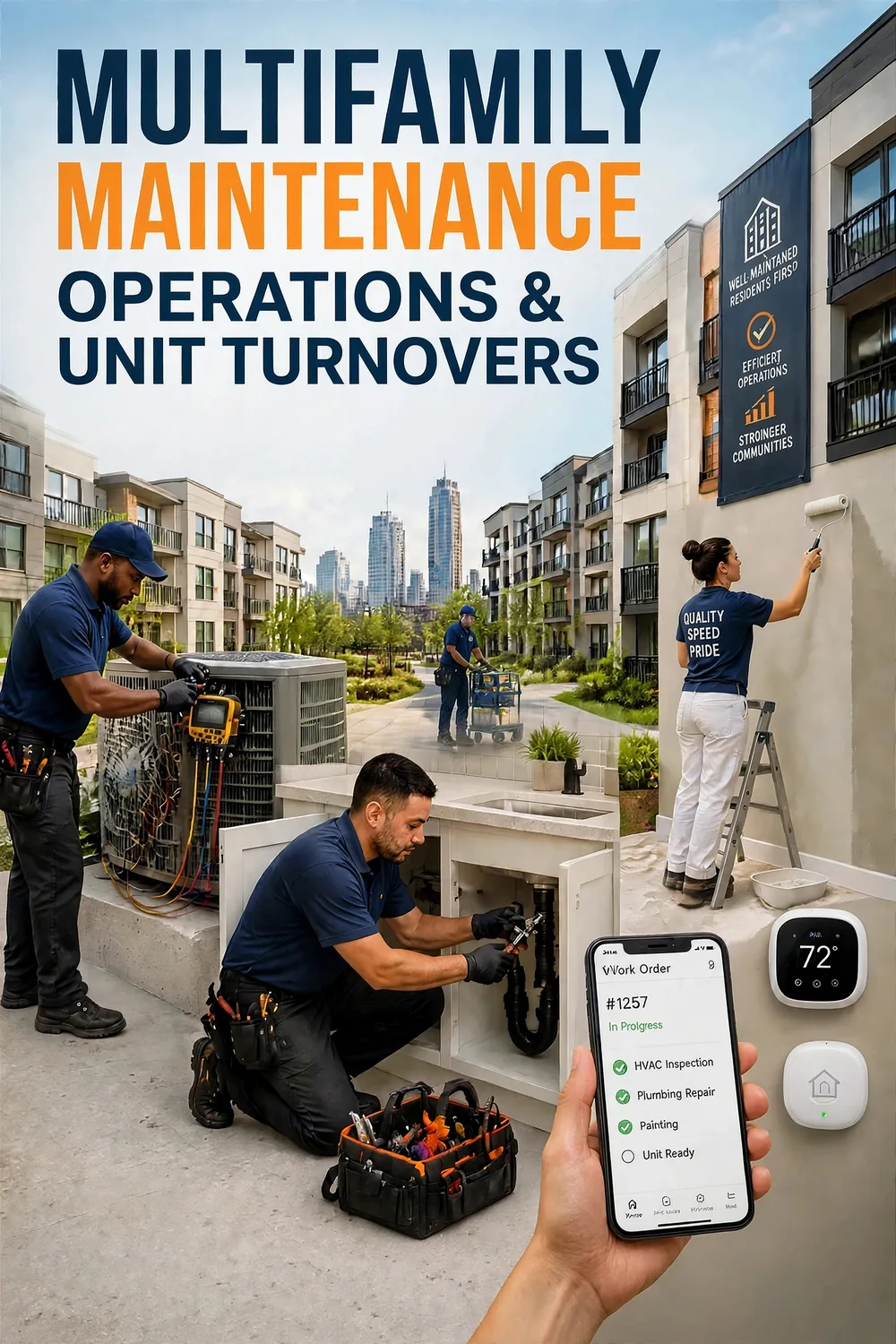
Multifamily Maintenance Operations & Unit Turnovers
Lesson one of eight, from chapter one. Written by our founder, Dr. Gene A Constant, and donated to the Foundation. Published by Global Sovereign University Press.
Buy a copy - it funds a free seatGSU is a 501(c)(3) nonprofit and book sales are its only income. A purchase is not a tax-deductible donation. As an Amazon Associate, GSU earns from qualifying purchases. This lesson is free and always will be.