Lesson 1 of 12 · Chapter 1 · The first door
GSU Reads to You
Listening is not passive. It is the first laboratory of communication. This lesson is about hearing language before you are asked to produce it: how sound turns marks on a page into meaning, and why being read to is a starting place, not a step backward.
Step one
Read the material
Five ideas. Why listening comes first. Where the gap really is for adults who struggle with print. How sound carries meaning the page cannot. Why shame blocks learning. And how hearing becomes understanding.
Idea one
Listening is the first laboratory
Before we ask a learner to speak with confidence, spell accurately, write clearly or enter a new language, we begin with a more basic human ability: listening. Listening is not passive. It is the first laboratory of communication. Long before most people learn to read a page, they learn the world through sound: a caregiver’s voice, a warning, a story, a name, the rise and fall of a question.
That is why the first door is simple: GSU reads to you. To be read to is not childish, remedial, or secondary to “real” learning. It is a direct route into the living structure of language.
When text is heard aloud, marks on a page become movement. A comma becomes a brief breath. A period becomes a completed thought. A question mark lifts the voice and invites an answer. A paragraph becomes a sequence of ideas with shape, pacing and emotional direction.
Idea two
The gap is the bridge from symbol to sound
Many adults who say, “I cannot read,” are not without language. They explain problems precisely, tell stories that hold a room, and follow complicated spoken instructions. The gap is often not a lack of thought. The gap is the connection between visual symbols and spoken sound.
When GSU reads text aloud, the learner sees the word and hears it at once. Take “necessary.” On the page it may feel long and unstable. Read aloud slowly, the learner hears its parts, nec-es-sar-y, and its stress. Meaning arrives with sound, and sound begins to make the spelling less mysterious.
The same happens with a word like “appointment,” which many people already know from life. Seeing it while hearing it links the long written form to a word they understand. This is not guessing. It is deliberate connection-building.
Idea three
Sound carries meaning
Every language has rhythm. A fluent reader does not merely pronounce one word after another; a fluent reader groups words into meaningful units. Read flat, “After. The. Meeting. We. Will. Review. The. Plan.” makes the listener assemble the pieces. Read with natural rhythm, the speaker provides the structure through pacing. The words are identical. The meaning is not.
Emphasis does the same. In “I did not say she lost the report,” Stress I: someone else may have said it. Stress say: perhaps the speaker implied it but did not state it. Stress lost: the person may have misplaced it rather than lost it. A page alone cannot always teach these differences to a beginning learner. Audio can.
Tone changes meaning too. “That sounds fine” is satisfaction; “Fine. I will do it myself” is frustration. The printed word remains the same. The foundation is simple: sound carries meaning.
Idea four
Shame interferes with learning
Literacy is not a measure of intelligence, worth, ambition, or potential. It is a set of learnable skills. When that system is never taught clearly, practised consistently or supported patiently, the learner is not defective. The instruction was incomplete.
Shame interferes with learning. Ashamed learners protect themselves by avoiding the very activity that could help them grow: declining the promotion that needs paperwork, “forgetting their glasses.” Those responses kept them safe from humiliation, but avoidance also limits choice.
So the learning environment changes. Permission to replay, to pause, to begin with simple material. Privacy is not isolation. It is protection for the early stages of courage. And there is no single correct age to begin. There is no expiration date on learning: an adult who starts today is not behind; they are beginning from where they are.
Idea five
From hearing to understanding
On first listening, a learner may miss sentences. This is not a failure. It is the natural beginning of comprehension. Understanding does not require catching everything at once. The bridge from hearing to understanding is built through repetition, attention, and use.
Rhythm helps the brain organize information. In “Before you sign the form, read each section carefully,” the pause after “form” is not accidental. It divides the condition from the instruction. In “Your appointment has been moved to Thursday afternoon,” the stressed words carry what you need: it changed, and the new time is Thursday afternoon.
Vocabulary grows the same way. A definition of “confirm” is fragile; “Please confirm your attendance” gives it a situation. A word in a list may be forgotten. A word connected to a situation has somewhere to stay. The chapter’s sequence: listen to a short sentence, pick one word, hear it again, say the word aloud, make a new sentence with it. Through this process, vocabulary moves from recognition to ownership.
Step two
Work it with your hands on it
The Listening Bench, built from the chapter’s own sentences. In Emphasis, choose which word carries the weight and watch the meaning move while the words stay still. In Phrasing, hear the same sentence read one word at a time, then in meaningful groups.
Bench
Hands on it, off the screen. Say “I did not say she lost the report” aloud three times, stressing I, then say, then lost. Ask someone which meaning they heard each time.
Then use the chapter’s sequence on one real message you received today: hear a sentence, pick one word, say it aloud, and make a new sentence of your own with it.
Step three
Prove you understood it
One question per idea, a new situation every time. Miss one and you are sent back to the idea it was testing.
All five solid.
You can explain why listening comes first, where the gap really lies, how stress and rhythm carry meaning, why shame blocks learning, and how hearing becomes understanding. Chapter two opens the building blocks of words.
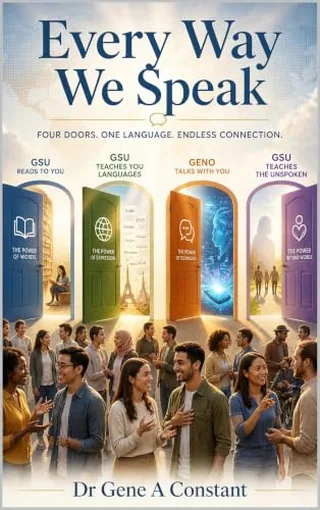
Every Way We Speak
Lesson one of twelve, from chapter one. Written by our founder, Dr. Gene A Constant, and donated to the Foundation. Published by Global Sovereign University Press.
Buy a copy — it funds a free seatGSU is a 501(c)(3) nonprofit and book sales are its only income. A purchase is not a tax-deductible donation. As an Amazon Associate, GSU earns from qualifying purchases. This lesson is free and always will be.