Lesson 4 of 12 · Chapter 4 · The second door
GSU Teaches You Languages
The voice you have begun to trust can now travel farther. This lesson is the second door: learning a new language the way people have always learned them, inside real situations, so the language becomes useful before it becomes perfect.
Step one
Read the material
Five ideas. Why immersion beats memorization. How to stay curious when you understand only part. Why grammar should be a map, not a wall. How words arrive inside relationships. And why fluency is a form of sovereignty.
Idea one
Immersion over memorization
For many people, a new language has been a long test of memory: vocabulary lists, verb tables, flashcards. These details can be useful. Grammar has value, and vocabulary is necessary. But neither one, alone, creates a living speaker. A learner can memorize one hundred words and still struggle to order food or say, “Could you repeat that more slowly?”
That is because language is not a storage contest. It is a human environment. We do not speak in lists. We speak in situations. Language comes alive when it has a purpose. GSU’s Language Lab begins from this principle: immersion over memorization. True immersion does not mean confusion and willpower, travel or expensive lessons; it means entering language through meaningful exposure.
A word learned in context has roots. A flashcard can teach that “agua” means water. In a situation it grows: “¿Quieres agua?” “Sí, quiero agua, por favor.” Now the word is attached to a need, a social rhythm and a possible action. The language becomes useful before it becomes perfect.
Idea two
Stay curious inside partial understanding
Before a learner can confidently produce an unfamiliar sentence, they need to hear how the language moves: where speakers pause, which syllables get weight, whether pitch changes meaning, how a request differs from a command.
A learner may not understand every word in a short dialogue, and that is acceptable. Listen for what you do recognize: Who is speaking? Is someone greeting, requesting, thanking? What repeats? This is active listening, now extended across languages. First a greeting and a number; next time a word for time; later, the speakers are arranging a meeting. This is not passive exposure. It is guided attention.
GSU teaches learners to stay curious inside partial understanding. Instead of “I cannot understand this, so I have failed,” ask, “What can I understand now?” Even fluent speakers meet unfamiliar words, accents and jokes. Strong communicators remain present, seek context, ask questions, and continue.
Idea three
Grammar as a map of meaning
Begin with a situation rather than a rule. To introduce yourself, you do not first memorize every form of “to be”; you use language you need: “Hello. My name is Jordan.” “I work in healthcare.” You build language around real identity. Then grammar enters as an explanation of a pattern you have already met.
Grammar becomes a map of meaning rather than a wall of terminology. Some learners love grammatical systems; others lose heart when grammar comes before communication. GSU makes room for both, but structure should serve expression. The purpose of a verb pattern is not to complete a chart for its own sake; it is to tell someone what happened, what is wanted, what matters.
And every phrase is part of a larger human scene. A language is never just a code that can be removed from the people who use it. Listen before assuming. Ask what form of address is preferred. Accept correction as an invitation into greater understanding rather than a personal defeat, without treating your own habits as the universal standard.
Idea four
Words arrive inside relationships
A word is more useful when you know when to use it, how to say it, and who to say it to. Words do not arrive alone. They arrive inside relationships. At a pharmacy you need a path through the interaction: explain the problem, say “Could you repeat that more slowly?”, state “I am allergic to this,” and confirm, “So I take this twice a day?”
There is often more than one correct way to say something. “Can you help me with this?” fits a friend; “Could you please help me understand this form?” fits a formal appointment. Neither is automatically better; the question is whether it fits the relationship and purpose. They are learning range.
Misunderstanding is part of real communication; the goal is to repair it. “I am still learning. Could you say that again?” “I used the wrong word. What I mean is…” These phrases are powerful because they transform uncertainty into action. A learner who memorized one perfect dialogue freezes when the menu is unavailable; one who understands the purpose can adapt. This adaptability is a deeper form of fluency.
Idea five
Fluency as sovereignty
Fluency is often imagined as a finish line. Fluency is not total knowledge. It is the growing ability to move through language with purpose. It means understanding enough to make choices, expressing enough to be understood, and repairing a misunderstanding without losing your place.
Sovereignty is the ability to think, choose, and act with greater independence. For someone who has depended on others to translate or speak for them, “I would like to understand this before I sign” changes the balance of a situation. Language becomes a form of self-advocacy. Translation is an act of care and skill, and interpreters perform essential work; direct ability adds immediacy.
The Language Lab treats progress as usable growth rather than a subscription-driven race: no endless streaks or pressure to pay while real confidence stays out of reach. Education should increase independence. And when a learner says, “I used the wrong word. What I mean is…”, they are not failing at fluency. They are practicing it. It is the freedom to belong more fully in more than one world.
Step two
Work it with your hands on it
The Scene Bench: language in scenes, not lists. In Scenes, walk a pharmacy visit, a workplace deadline, an introduction or a meal one moment at a time. In Register, see the same request for a friend and for a formal setting. In Repair, collect the phrases that keep a conversation open. Every phrase is the book’s own.
Bench
Hands on it, off the screen. Pick one real scene from your own life where you need another language: a clinic, a job, a family visit, a shop. Write down the moments in it, in order, the way the bench does.
For each moment, learn one phrase you would actually use, and add one repair phrase you can reach for when you do not understand. Say them aloud until they feel like yours.
Step three
Prove you understood it
One question per idea, a new situation every time. Miss one and you are sent back to the idea it was testing.
All five solid.
You know why immersion beats memorization, how to stay curious inside partial understanding, why grammar is a map, how words arrive inside relationships, and why fluency is sovereignty. Chapter five opens the third door: GENO talks with you.
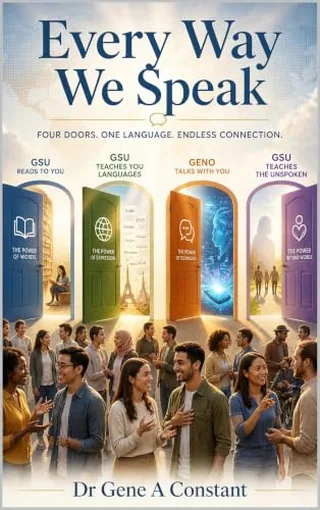
Every Way We Speak
Lesson four of twelve, from chapter four. Written by our founder, Dr. Gene A Constant, and donated to the Foundation. Published by Global Sovereign University Press.
Buy a copy — it funds a free seatGSU is a 501(c)(3) nonprofit and book sales are its only income. A purchase is not a tax-deductible donation. As an Amazon Associate, GSU earns from qualifying purchases. This lesson is free and always will be.