New from Global Sovereign University Press · Free to read here

Fractured Words, Fractured Worlds

What Screens Do to the Reading Brain and to Empathy

No brain was born to read. Every reader builds the skill by borrowing circuits made for other work, and deep reading is where that skill meets our ability to understand another person. This book shows what fractured digital text does to that connection, and gives readers, teachers, designers and policymakers a framework for protecting it.

By Dr. Gene A Constant · six chapters · the whole book below, with Listen · now on Amazon in paperback and Kindle

Read it freeGet the bookAudit your screenTry the three-minute test
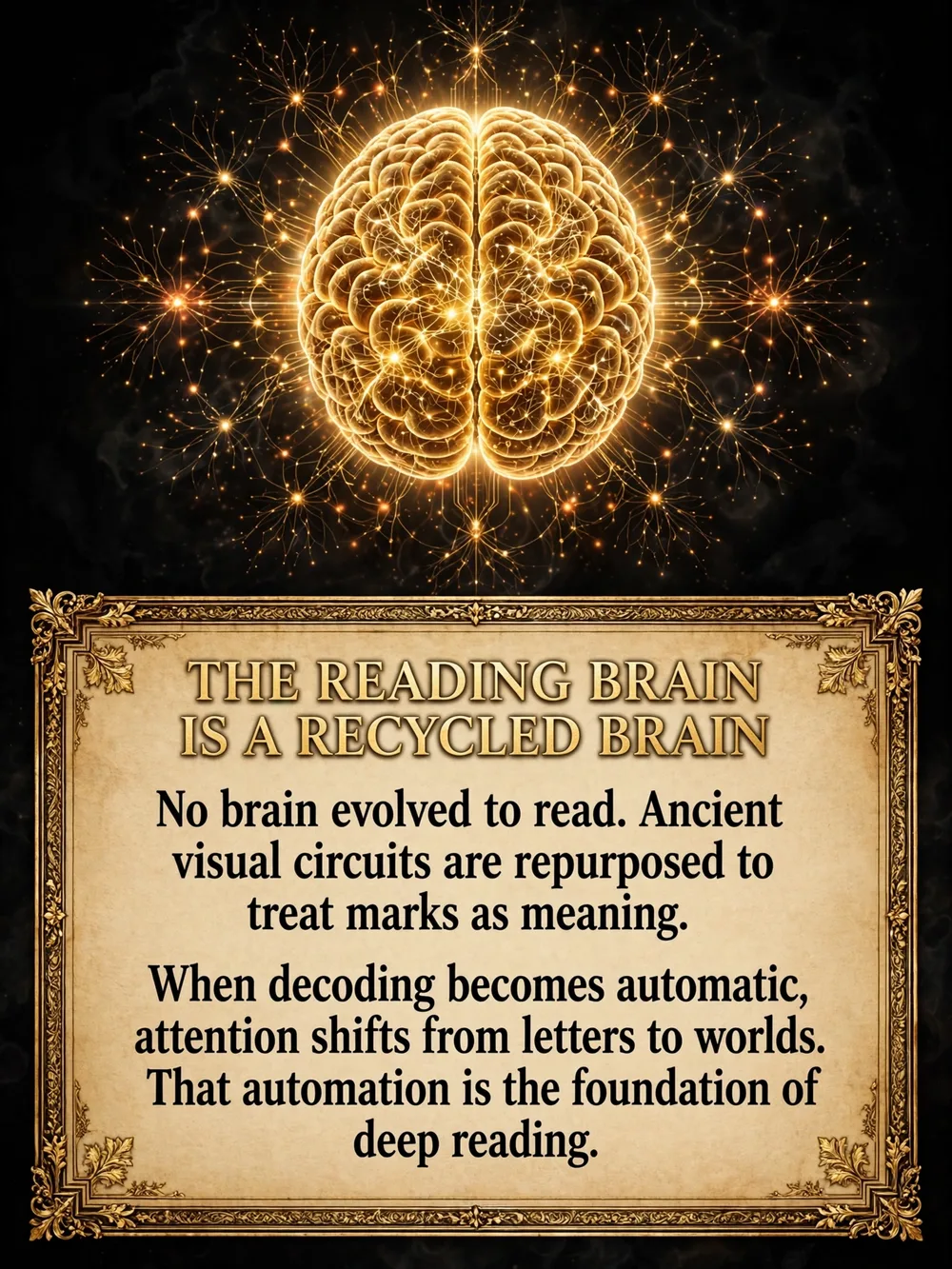
The reading brain is a recycled brain: no brain evolved to read. Ancient visual circuits are repurposed to treat marks as meaning. When decoding becomes automatic, attention shifts from letters to worlds.

Why this matters to everyone who reads

Reading is borrowed

The brain recycles circuits for faces and objects to recognize letters. That makes reading powerful, and it makes the reading environment matter.

Reading builds empathy

When decoding is automatic, attention is free to model other minds. That slow, sustained work is where understanding another person grows.

Screens can fracture it

Links, alerts, endless scroll and outrage-driven feeds pull attention toward fast judgment. The book does not say screens are the enemy. It says design decides.

The six chapters

Each chapter below links straight into the full text.

Chapter 1

The Ontological Reality of the Reading Brain

No brain was born to read. Reading borrows circuits that evolved to recognize faces and objects and teaches them letters. Only when decoding becomes automatic is attention free for meaning.

“Yet no human brain evolved to read.”
Read chapter 1 →
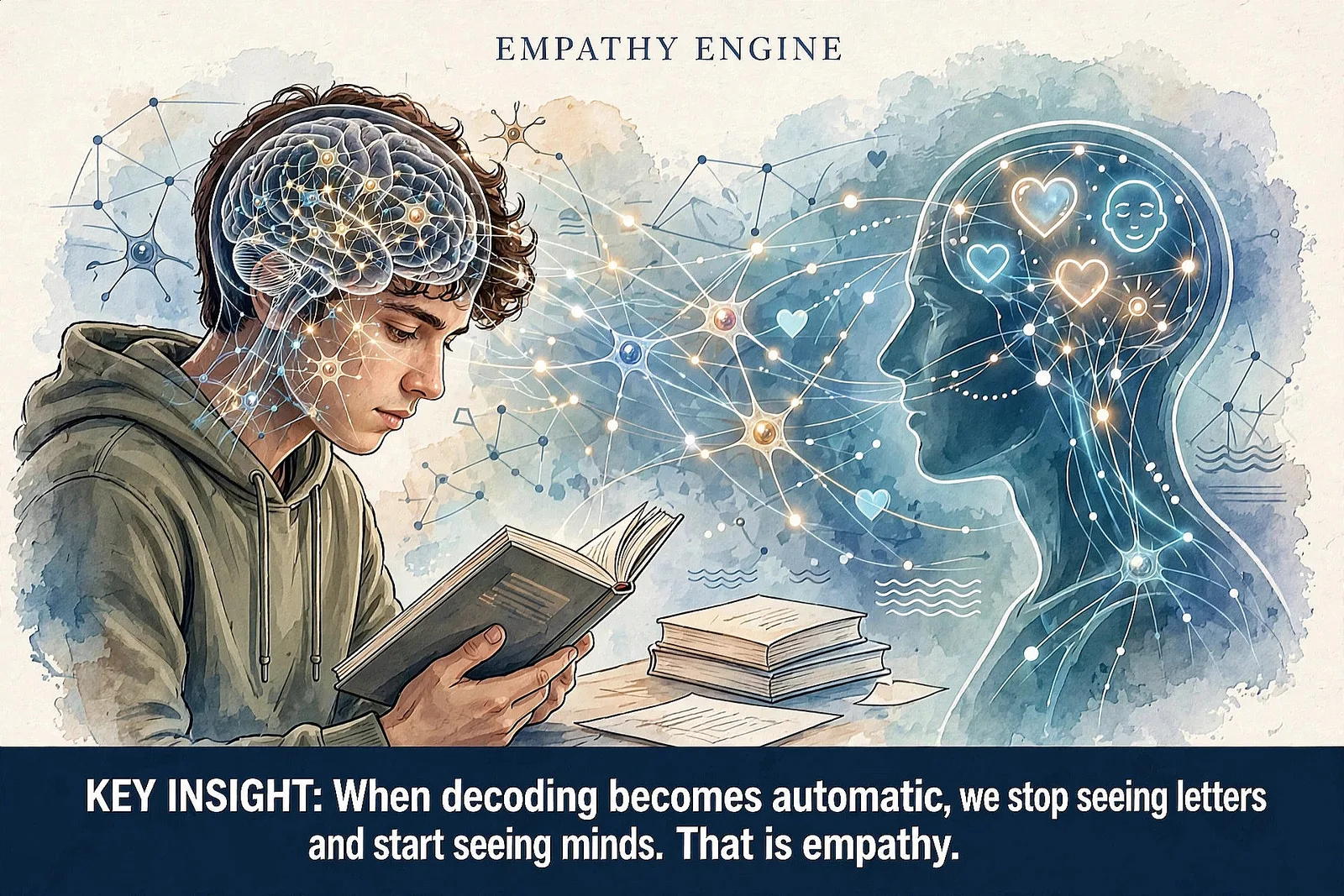
Illustration for chapter 2, The Empathy Engine and the Theory of Mind

Chapter 2

The Empathy Engine and the Theory of Mind

Automatic decoding frees the mind to model other minds: what a character believes, wants, fears and hides. Deep reading exercises that capacity, which the book calls the empathy engine.

“Immersive reading asks the mind to remain.”
Read chapter 2 →
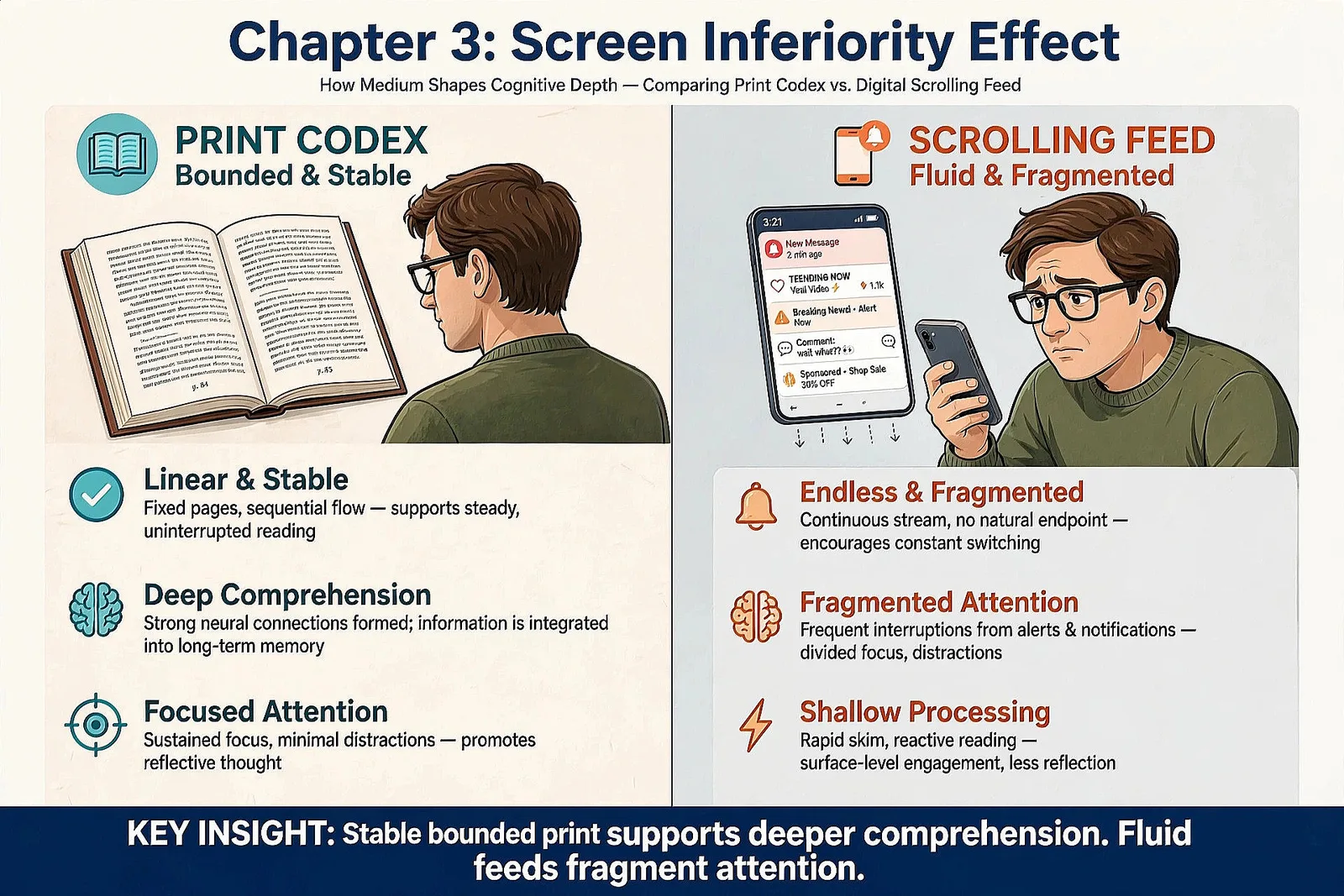
Illustration for chapter 3, The Screen Inferiority Effect

Chapter 3

The Screen Inferiority Effect

Reviews of the research find a modest but reliable advantage for print, larger under time pressure, and readers who feel more confident on screens than their results justify.

“This is one reason screens can create the curious experience of reading quickly while learning slowly.”
Read chapter 3 →
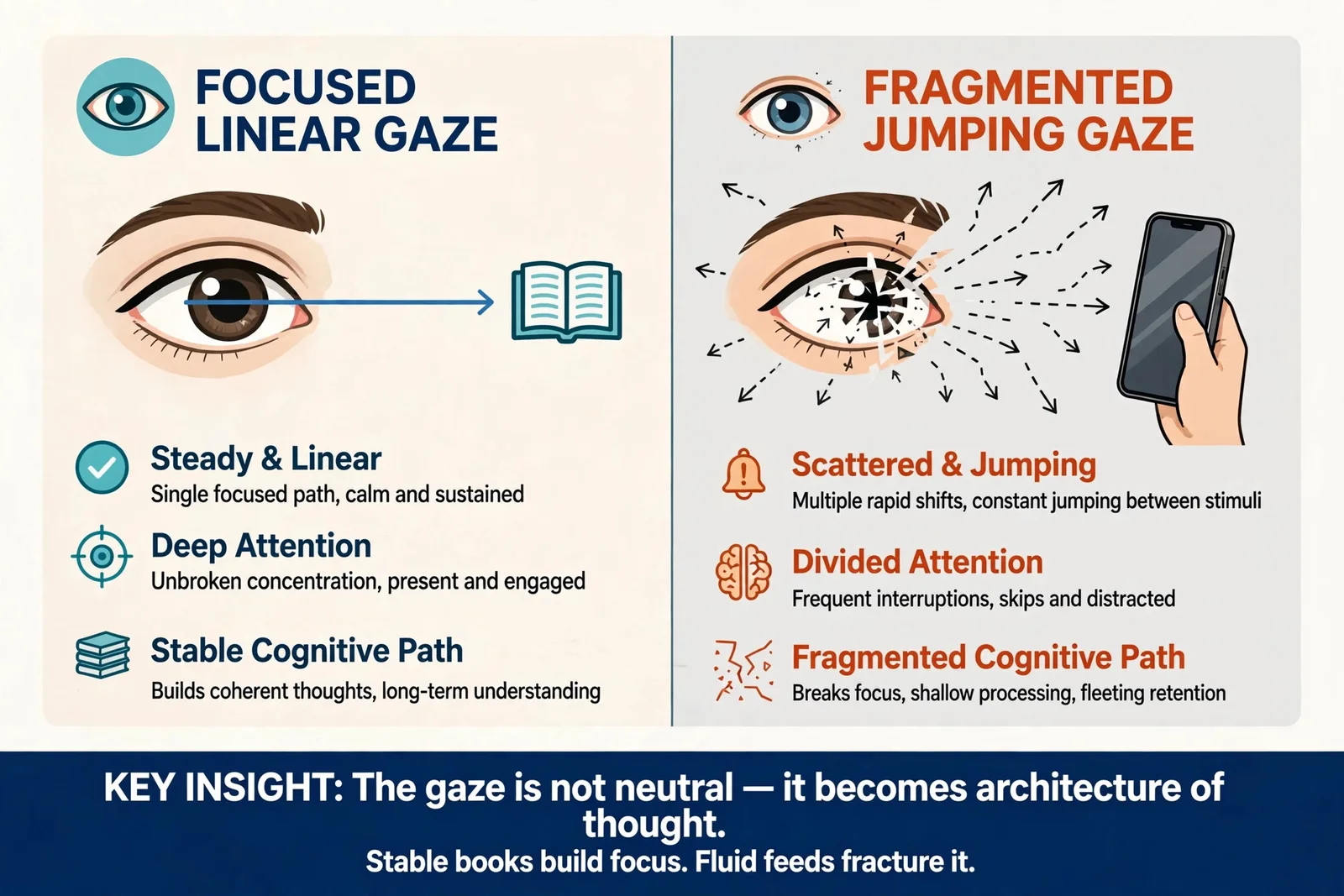
Illustration for chapter 4, The Fractured Gaze and Cognitive Load

Chapter 4

The Fractured Gaze and Cognitive Load

Links, alerts and shifting layouts each demand a small decision. On an endless scroll the page loses its landmarks, the load rises and recall falls.

“When every element announces itself, nothing can quietly develop.”
Read chapter 4 →

Chapter 5

System 1 Exploitation and Algorithmic Tribalism

Feeds reward fast, reactive judgment. Repetition begins to feel like truth, and people shrink into categories.

“Empathy depends on the willingness to treat another person as more than a familiar category.”
Read chapter 5 →

Chapter 6

The NADL Framework and the Future of Ethical Design

Neuro-Affective Digital Literacy names six conditions a reading space must protect, turns them into a design audit, and argues that print is a public-health resource.

“Ethical UI/UX must distinguish attention from capture.”
Read chapter 6 →

Three minutes · private · nothing saved

See it for yourself

Read one short story the way a feed delivers it and another the way a page does, then answer three questions after each. It is a demonstration, not a test, and nothing is recorded.

Try Two Ways to Read

From chapter 6 · free · nothing saved

The NADL Audit

Chapter 6 says its six domains “can become a design audit.” Here it is. Pick any app, website, e-reader or school platform, answer eighteen plain questions about what you see on the screen, and print the result. It audits the design, never the reader.

The audit loads with the page.

Who this book is for

Parents and teachers

Why a child learning to decode needs stable pages and quiet time, and why device fluency is not the same as deep comprehension.

Designers and developers

Attention versus capture, bounded design, links that are not trapdoors, reading modes by default, and reflective friction before sharing.

Leaders and policymakers

Why the book treats print as a public-health resource, and what schools and platforms owe readers who have the fewest quiet places to read.

Read the whole book

Every chapter, free. Tap any paragraph and press Listen to hear it in your device’s own voice, or use the language button in the menu to read it in your language.

Tap any paragraph to start listening from there.
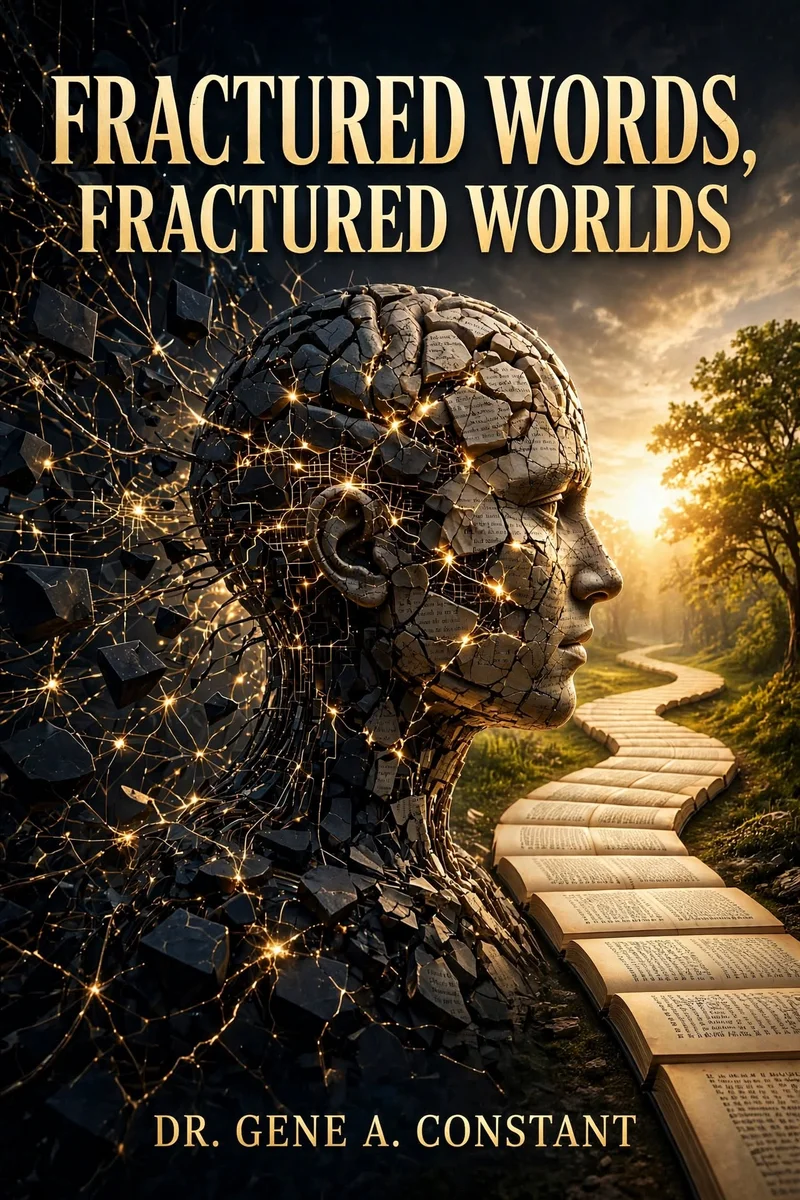
Fractured Words, Fractured Worlds, cover

Keep the book

Fractured Words, Fractured Worlds is on Amazon now, in paperback and for Kindle. A copy on paper is the book’s own advice put into practice. Book sales are the only thing that funds Global Sovereign University, a tuition-free 501(c)(3) nonprofit.

Paperback on AmazonKindle edition

A purchase is not a tax-deductible donation. Listening uses the voice built into your own device. Nothing you read, hear or audit on this page is sent anywhere.

Global Sovereign University: Different by Design. Better by Mission.

Accreditation notice: Global Sovereign University is not an accredited institution and does not grant degrees, academic credit, licenses, or industry credentials. Learners who pass GSU's online exams earn GSU certificates of comprehension.