Lesson 1 of 12 · Chapter 1
Fundamentals of Thermodynamics
Before gauges go on or a control board is read, you learn to trace heat: where it comes from, where it is supposed to go, and what pathway it is using. Every chapter after this one stands on it.
Step one
Read the material
Five ideas. The first two are how heat moves. The third is why the air side matters as much as the refrigerant side. The fourth is the four laws as guardrails. The last turns all of it onto the building.
Idea one
Heat is relocated. Cold is never made.
Heat always moves from a place where it is more concentrated to a place where it is less concentrated, unless you use energy to push it the other way. Comfort complaints, icing evaporators, short cycling furnaces and sweaty mechanical rooms all trace back to how heat is moving, how fast, and what is helping or resisting it.
People say “cold air” when they mean air that has less heat in it. Cold is not a substance that gets added. When a register blows air that feels cold, you are feeling heat leave your skin faster than your body can replace it.
Scale that up to a building. The equipment does not create cold. It relocates heat. A furnace does add heat to indoor air, but an air conditioner or heat pump moves heat from one place to another. Know the pathways heat can take and you can predict what a system should do before you pick up a tool.
Idea two
Conduction, convection, radiation
Conduction is heat transfer through a solid material, or between two objects in direct contact. A copper suction line in a hot attic gains heat through its wall, adding load to the refrigerant. That is why suction line insulation matters: it reduces the rate of conductive heat transfer into the line. Metals conduct very well, which is why coils are made from them; foams conduct poorly because they trap air.
Convection is heat transfer through the movement of a fluid — usually air, but also water or refrigerant. Natural convection is warm fluid rising and cool fluid falling, like the always-warmer upstairs of a tall stairwell. Forced convection is what most equipment uses: a blower across an evaporator, a condenser fan, a circulator pump in a hydronic loop.
Radiation is heat transfer through electromagnetic waves, with no contact and no moving fluid: the sun heating a rooftop unit cabinet, or a person chilled beside a large window on a winter night. It can change comfort without changing air temperature much — which is why you respect a complaint even when the thermostat says 72°F.
In real buildings all three happen at once. Surface area matters too: fins multiply it, and a dirty coil loses it, so coil cleaning is not a cosmetic upsell — it is a heat transfer repair. And look for resistance: insulation resists conduction, a clogged filter resists airflow, a closed register changes distribution.
Idea three
Airflow is the other side of the coil
Coils exchange heat efficiently only when air moves across them at the right rate. If airflow is too low, the evaporator coil can get colder than intended, drop below freezing and form ice — and the ice blocks even more airflow, a feedback loop that ends in a frozen coil. If airflow is too high, the system may not dehumidify properly because the air does not spend enough time in contact with the cold coil to drop its moisture.
In both cases the refrigerant circuit might be perfectly charged while the heat transfer on the air side is wrong. That is why technicians learn early that “it’s not always the refrigerant.” Heat transfer is a two-sided conversation. When someone says it is low on Freon because it froze up, remember that a frozen coil is often an airflow failure first.
The coil also removes two kinds of heat. Sensible heat changes air temperature. Latent heat is released when water vapour condenses on the cold coil. On a humid day much of the capacity goes to moisture, so you may not see a dramatic temperature drop even while the system does real work — and a sticky house can feel warmer than the thermostat says.
Idea four
The four laws as guardrails
The Zeroth Law makes temperature trustworthy at equilibrium. Take a reading with the probe in direct sun, pressed against metal, or in unmixed air and you are not measuring a true condition. “It’s blowing 40 degrees” from an infrared gun aimed at the grille is the grille, not the air.
The First Law: energy cannot be created or destroyed, only transferred or converted. Every BTU removed from indoors ends up somewhere else. The condenser rejects the indoor heat plus the heat of compression from the electrical energy the compressor and fans used — which is why condenser air is hotter than outdoor ambient.
The Second Law: you cannot have a net transfer of heat from a colder body to a hotter body without doing work. That work is your compressor. As outdoor temperature rises the hill gets higher: higher condensing pressure, more compressor work, often lower capacity. A dirty condenser makes the same chain predictable. Heat pump defrost is the system spending energy to restore a frosted coil, not a malfunction.
The Third Law is the far boundary: absolute zero cannot be reached. It supports the instinct that there is no free capacity hiding at colder and colder coil temperatures — chasing them brings icing, oil return trouble and compressor stress.
Idea five
The building is the load
The equipment does not decide how much work to do; the load does. Heat enters and leaves a space through four channels: conduction through surfaces, convection by air movement and leakage, radiation from sun and hot or cold surfaces, and internal gains — people, cooking, lighting, computers, even aquariums. Every watt inside the envelope becomes heat the system must move, and that includes the blower motor.
Picture a bucket with holes. Insulation and air sealing make the holes smaller; the equipment is the pump. If the holes are huge, even a strong pump runs constantly: long run times, high bills, rooms that drift on extreme days. You can clean coils and verify charge and still lose the battle.
And quick checks sometimes lie. A single supply temperature does not tell you how much heat is being moved. For that you need airflow and temperature change, and moisture measurements for latent removal. BTUs per hour are not a vibe; they are calculated from measurable flows.
Step two
Work it with your hands on it
The Heat Balance Bench. Change the day, the condenser, the airflow and the house, and watch where the heat goes. The outdoor coil always rejects the house’s heat plus the compressor’s work — no setting can make that untrue. Turn the airflow down and see what the coil does with a perfect charge.
Outdoor temperature
Condenser coil
Airflow across the indoor coil
The house
The numbers are illustrative, for a typical 3-ton system. The chapter gives the relationships, not these values.
Hands on it, off the screen. Stand beside your outdoor unit while it runs in summer and hold a hand in the air leaving it. That air carries the heat taken out of your house plus the energy the compressor used. Then find your indoor filter and look at it against the light.
Walk your home and list where heat is getting in today: sun on glass, the attic, cooking, people, electronics. That list is the load.
Step three
Prove you understood it
One question per idea, a new situation every time. Miss one and you are sent back to the idea it was testing.
All five solid.
You can say what the equipment really does, name the three ways heat moves, tell an airflow failure from a charge problem, use the four laws as guardrails, and read the building as the load. Chapter two puts this to work in the refrigeration cycle.
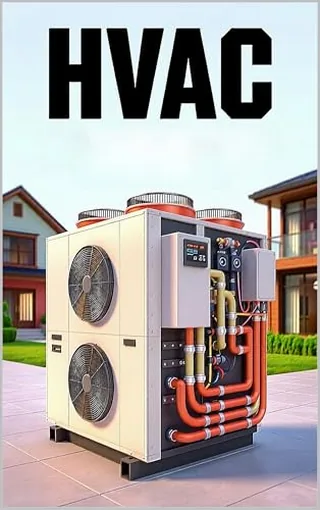
The HVAC Apprentice’s Field Guide
Lesson one of twelve, from chapter one. Written by our founder, Dr. Gene A Constant, and donated to the Foundation. Published by Global Sovereign University Press.
Buy a copy — it funds a free seatGSU is a 501(c)(3) nonprofit and book sales are its only income. A purchase is not a tax-deductible donation. As an Amazon Associate, GSU earns from qualifying purchases. This lesson is free and always will be.